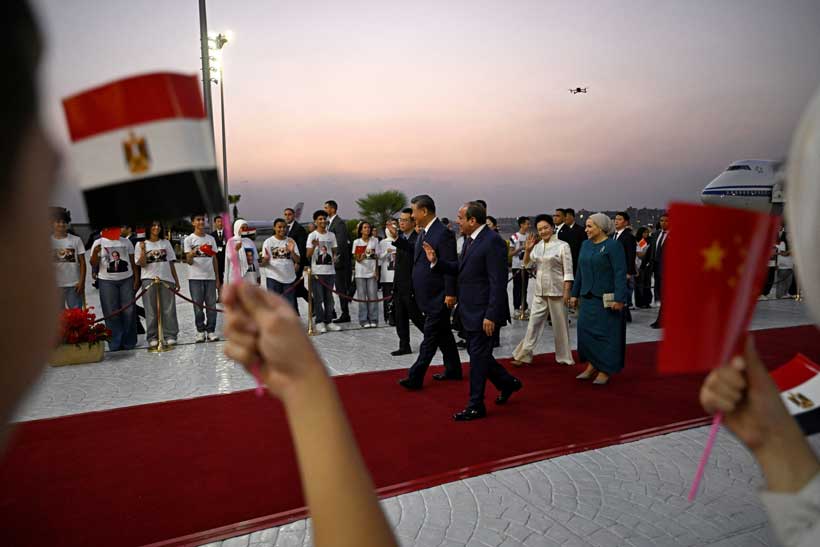
President Xi Jinping’s visit to Cairo was not a protocol visit. It was a doctrine declaration.
At a highly sensitive moment: an open war in Iran, threats to close the Strait of Hormuz, and a sharp division within the BRICS summit in New Delhi, Beijing chose to present its vision for regional security from Egypt.
The message was clear: The Middle East must manage its own security.
From Mediation to Structuring
Stay ahead of the geopolitical week.
MD Briefing delivers expert analysis across five global fronts — the Indo-Pacific, energy, geoeconomics, European security, and the Middle East — every Monday morning. Free.
For more than a decade, China has played the role of economic mediator. It built ports, sold technology, and invested in energy.
But from the Beijing agreement between Saudi Arabia and Iran in 2023 to proposing a comprehensive security framework in Cairo in 2026, there is a qualitative shift.
China no longer wants to be just a trader. It wants to be an architect of the system.
The new Chinese approach is based on four points raised by Xi in Cairo:
First: rejection of double standards in applying international law.
Second: rejection of external interference and imposed models.
Third: linking security to development, not just military deterrence.
Fourth: the principle that the peoples of the region determine their own destiny.
These are not slogans. They are a counter-doctrine to the American model that has dominated the region since 1991.
Why Egypt?
Choosing Egypt is no coincidence. Three implications:
First: Egypt is the only Arab state that has balanced relations with all parties: Iran, Israel, the Gulf, and Hamas. And it is the gateway to Africa and the Red Sea.
Second: The military dimension. During the visit, joint air maneuvers were held with Chinese J-16 aircraft and Egyptian French Rafale. This is the first time Beijing has tested its aircraft in a Western operational environment. The message: China is ready to fill any military vacuum left by Washington, but in the style of partnership, not bases.
Third: The technological economy. The signed agreements were not about oil. They were about cloud computing, semiconductors, electric vehicles, and space. China links its security to Egypt’s technological security, not just oil security. This is a strategic shift.
The Hormuz Test: Principle Versus Interest
Here the major paradox in Chinese policy appears.
China is the largest importer of Iranian oil—about 90% of Tehran’s exports go to Beijing through complex barter networks. And closing the Strait of Hormuz will directly hit the Chinese economy.
Washington wants Beijing to pressure Tehran. Tehran wants Beijing to protect it.
What did Beijing do?
It chose a third path. It coordinated publicly with Qatar to protect navigation and proposed an initiative of “security of sea lanes instead of aircraft carriers.” The idea: collective security for maritime corridors in which the countries of the region themselves participate, with UN cover, and without the dominance of a single power.
This serves two Chinese principles: rejection of hegemony and protection of interest. Beijing does not want a war in the Gulf, but it also does not want to appear subordinate to Washington in pressuring Tehran. It practices what it calls “active neutrality.”
BRICS: Strength and Weakness
The BRICS summit in New Delhi revealed the limits of the Chinese role.
China wants BRICS to be an economic alternative: linking digital currencies, an artificial intelligence zone, and a new development bank.
But India, which is hosting the summit, has a trade deficit with China of 112 billion dollars. And it sees China as a border competitor, not a partner.
Xi went to India for the first time in seven years. Not out of love for New Delhi, but because Beijing realizes that any security system in the Middle East will not succeed without India, which has huge interests in Gulf energy and a diaspora of 9 million workers.
The current Chinese-Indian rapprochement is a rapprochement of necessity, not trust. And both want to lead the Global South.
Can Regional Security Succeed?
The Chinese approach has three strengths:
1. It does not ask countries in the region to choose between Washington and Beijing.
2. It links security to development, and this is what the peoples of the region want.
3. It carries no colonial legacy in the Middle East.
But it has three fatal weaknesses:
1. China does not have real power projection in the region. It cannot protect an oil tanker if attacked.
2. Gulf states do not yet trust Chinese guarantees. They still buy 70% of their weapons from America.
3. Israel and Iran cannot be brought together in one security framework without an American role.
Therefore, what Beijing proposed in Cairo is not an alternative to the American system. It is a bargaining chip. China tells Washington: if you withdraw, there is an alternative. And it tells the countries of the region, “You have another option.”
Conclusion
The new Middle Eastern system will not be built in Beijing nor in Washington. It will be built in the region itself.
What China did is that it gave the countries of the region a new language: regionally led security and development instead of sanctions, and technology instead of military bases.
This language is attractive. But turning it into institutions needs more than a four-point initiative. It needs real security guarantees, and this is what China cannot provide now.
The question is not whether China will succeed. The question is, will this approach force Washington to change its behavior?
That seems to be the real goal of the Cairo visit.