


U.S. President Donald Trump said he hoped the war against Iran was nearing an end as fighting between Saudi Arabia and Iran backed Houthi forces intensified in Yemen, adding a new front to a conflict that has already disrupted energy supplies and shipping across the Gulf.
Saudi aircraft have carried out strikes on Houthi positions in Yemen, while the Houthis said they launched drones and missiles toward targets in Saudi Arabia. The escalation follows a rapid Houthi advance along Yemen’s Red Sea coast and attacks that damaged Saudi Arabia’s East West oil pipeline.
The widening conflict has increased concerns about further disruptions to global energy supplies, particularly as shipping through the Strait of Hormuz remains affected by the war.
Despite the escalation, Trump told reporters on Wednesday that he hoped the conflict was approaching its conclusion.
Stay ahead of the geopolitical week.
MD Briefing delivers expert analysis across five global fronts — the Indo-Pacific, energy, geoeconomics, European security, and the Middle East — every Monday morning. Free.
“They want to make a deal. We’ll see how that works out,” Trump said, referring to Iran. He also said he had received direct communication from Tehran, without providing details.
The war began on February 28, when the United States and Israel attacked Iran and Tehran responded with strikes against Israel and U.S. military positions in Gulf states. Since then, Trump has offered changing assessments of the conflict’s objectives and potential timeline.
Energy risks grow as fighting spreads
The expansion of fighting into Yemen threatens to add pressure to an already strained global energy market.
The Strait of Hormuz, a critical route for international energy shipments, carried roughly 20% of global oil and liquefied natural gas supplies before the conflict. Disruptions there have already contributed to higher energy prices.
Saudi Arabia’s East West pipeline has become another concern. Traders estimate that a prolonged shutdown could affect as much as 4% of global oil supply, although Riyadh has not said when operations will fully resume.
Brent crude was trading near $108 a barrel on Wednesday, close to its highest level since May. U.S. diesel prices also reached a record average of more than $6.30 per gallon.
Oil prices later eased in early Thursday trading after reports that Saudi Arabia was offering additional crude cargoes through Oman, reducing some concerns about an immediate supply shortage.
Brent futures fell $1.24, or 1.2%, to $104.59 a barrel by 0049 GMT, while U.S. West Texas Intermediate futures declined $1.14, or 1.1%, to $101.29.
Higher fuel and energy prices have also emerged as a political issue for Trump’s Republican Party ahead of the November midterm elections.
Washington weighs next steps with Gulf states
As the conflict spreads, the United States has tightened its travel warning for Saudi Arabia, barring government employees from travelling within 20 miles, or about 30 km, of the Yemeni border.
Axios reported on Wednesday that Trump was expected to meet Gulf leaders on the sidelines of the U.N. General Assembly on Tuesday to discuss the conflict and possible next steps.
The meeting could include leaders or foreign ministers from the six Gulf Cooperation Council states: Saudi Arabia, the United Arab Emirates, Qatar, Bahrain, Kuwait and Oman.
The State Department and White House did not immediately respond to requests for comment.
The reported discussions come as Gulf states face growing security and economic risks from the widening conflict, including the possibility of further attacks on energy infrastructure and shipping routes.
Houthis intensify attacks on Saudi Arabia
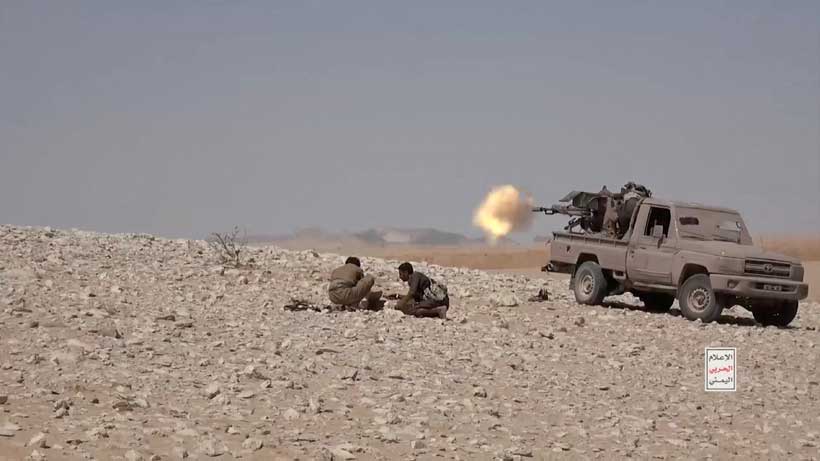
The Houthis on Wednesday released battlefield footage showing their fighters seizing armoured vehicles from Saudi backed forces. The footage also showed aircraft flying over the battlefield and large explosions in desert areas.
Houthi military spokesman Yahya Saree said the group had launched new drone and missile attacks against Yanbu, a major Saudi Red Sea oil port, and an airbase at Khamis Mushait in southern Saudi Arabia. He did not specify when the attacks occurred.
Saree also claimed that Saudi Arabia had carried out as many as 450 air strikes against Yemen during the week.
Officials from the Saudi backed government controlling southern Yemen acknowledged that Saudi and Yemeni forces were conducting air strikes against Houthi positions, although Riyadh has not publicly confirmed the reported campaign.
Saudi Arabia has led a coalition against the Houthis since 2015. Fighting had largely subsided under a ceasefire in recent years, but tensions increased after the Houthis declared a naval blockade against Saudi Arabia in July and began launching attacks toward southern parts of the kingdom.
The renewed fighting illustrates how the Iran war is increasingly extending beyond the original U.S., Israeli and Iranian battlefield, bringing Yemen and the wider Gulf into the conflict and raising new risks for regional security and global energy markets.
With information from Reuters.
