


Yemen’s Houthi movement has evolved from a local Zaydi Shi’ite revivalist group in the country’s northern mountains into a heavily armed force capable of threatening shipping routes, striking targets across the region and influencing the wider security balance in the Middle East.
The group’s recent advance along Yemen’s Red Sea coast has brought the Bab el-Mandeb Strait, one of the world’s most important maritime chokepoints, closer to the centre of the conflict. Its growing missile and drone capabilities have also allowed it to threaten targets far beyond Yemen.
The transformation has taken decades and has been shaped by Yemen’s political collapse, years of civil war and growing military cooperation with Iran and Lebanon’s Hezbollah.
From local movement to armed insurgency
The Houthis emerged in northern Yemen in the late 1990s as a Zaydi Shi’ite revival movement associated with the Houthi family.
Stay ahead of the geopolitical week.
MD Briefing delivers expert analysis across five global fronts — the Indo-Pacific, energy, geoeconomics, European security, and the Middle East — every Monday morning. Free.
The group fought six wars against the Yemeni government, gradually building a capable local militia and establishing influence in the country’s northern highlands.
Yemen’s political crisis during the 2011 Arab Spring created new opportunities for the movement. As the central government weakened, the Houthis expanded their territorial control and developed closer relationships with Iran and Hezbollah.
In 2014, Houthi forces seized the capital, Sanaa, effectively ending a Gulf backed political transition and triggering a much broader regional conflict.
Saudi Arabia subsequently led a military coalition supporting Yemen’s internationally recognized government. Years of fighting produced neither a decisive victory nor a durable political settlement, eventually leading to a ceasefire in 2022.
The relative calm did not end the underlying conflict.
During the war in Gaza between 2023 and 2025, the Houthis launched missiles and drones toward Israel and attacked commercial shipping in the Red Sea, saying the operations were intended to support Palestinians.
The group’s activities have now expanded again as Iran faces direct attacks from the United States and Israel.
A new battle for Yemen’s Red Sea coast
The latest escalation has also changed the military situation inside Yemen.
The previous ceasefire has broken down, with fighting reported along several of the country’s traditional front lines, including Marib and Jawf in the north, Taiz in the southern highlands, Dhale in central Yemen and the Red Sea coastal region known as Tihama.
The Houthis have also made rapid territorial gains along the southern Tihama coast, including the port of Mocha and nearby coastal areas and islands.
The advances have put Houthi forces along much of Yemen’s side of the Bab el-Mandeb Strait, a narrow passage connecting the Red Sea with the Gulf of Aden.
The strait is only about 19 km wide at its narrowest point and is a major route for international maritime trade and energy shipments.
Control of territory overlooking the waterway does not automatically give the Houthis complete control of maritime traffic, but it provides the group with additional positions from which it can threaten vessels moving through the Red Sea.
The territorial gains could also provide a potential route for further military operations toward Aden.
Saudi Arabia has responded with airstrikes in support of forces aligned with the Yemeni government.
How far can Houthi missiles reach?
The Houthis’ importance outside Yemen largely comes from their ability to conduct long range attacks.
The group has developed an arsenal of ballistic missiles and drones capable of reaching targets hundreds and, in some cases, more than 1,000 miles away.
Houthi missiles have reached Israel, while the group has repeatedly targeted Saudi cities and infrastructure. Houthi forces have also fired missiles and drones at commercial vessels in the Red Sea, contributing to major disruptions in shipping through the waterway.
The group has increasingly used drones in Yemen itself as well.
That represents an evolution from the fighting seen before the 2022 ceasefire, when Houthi drone capabilities were less prominent on the battlefield.
The combination of missiles, drones and coastal positions gives the movement several ways to threaten opponents and exert influence beyond the territory it directly controls.
What weapons do the Houthis have?
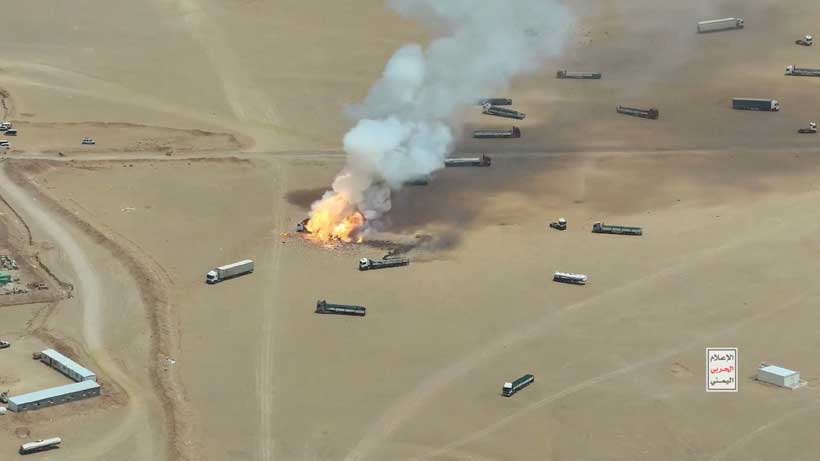
Videos released by the Houthis since September have shown a mixture of weapons and military equipment.
The footage includes drones carrying and dropping munitions, missile launches and strikes against vehicles and buildings. Other videos show Houthi fighters operating in pickup trucks, sometimes equipped with mounted weapons.
Some fighters appear in traditional Arab clothing while others wear camouflage uniforms.
The Houthis have also displayed equipment captured from Saudi backed forces during their recent advances in Tihama, including armoured vehicles, a tank, artillery equipment, small arms, communications equipment and a drone jamming system.
The footage does not establish how much of the captured equipment is operational or how extensively it can be integrated into Houthi operations.
Iran’s role in the Houthi arsenal
The Houthis’ growing military capabilities have been closely associated with Iranian assistance, although the precise extent of Tehran’s support remains contested.
A 2025 report by a U.N. panel of experts found that the Houthis had developed missile and drone capabilities through a combination of technical assistance and domestic production.
The panel also documented extensive weapons smuggling despite the U.N. arms embargo, including shipments crossing Yemen’s border with Oman and maritime smuggling routes.
Equipment seized during interdictions has included drone control systems, technology used to receive maritime navigation information, drone engines and missile components.
Earlier U.N. reporting documented seizures involving complete drones, ballistic missile components and Iranian made anti tank missiles.
Iranian sources have said Tehran provided the Houthis with weapons and military experts. Iran, however, has officially denied violating the U.N. arms embargo by supplying weapons to the group.
A 2025 assessment by the International Institute for Strategic Studies concluded that the Houthis had made progress in producing weapons domestically but remained dependent on Iran for some advanced technologies and capabilities.
This combination of external assistance and domestic production has allowed the Houthis to develop a military infrastructure that is more difficult to dismantle through the destruction of individual weapons shipments.
Training and military organization
The Houthis have also become more sophisticated in how they organize and conduct military operations.
A U.N. panel of experts described tactics including infiltration, drone attacks, artillery and other forms of shelling along front lines, as well as the use of mines and explosive devices.
The panel estimated that the group had around 350,000 fighters and reported the recruitment of people under the age of 18.
Yemen analysts have also highlighted the role of Iranian and Hezbollah training.
Baraa Shiban, an associate fellow at the Royal United Services Institute, said Iranian and Hezbollah assistance began becoming important after the Arab Spring and contributed to the Houthis’ transformation from a local militia into a more organized military force.
The U.N. panel reported that Hezbollah missile and drone specialists were present with the Houthis in 2025. It also said Iranian Qods Force general Abdolreza Shahlaei had spent time in Yemen working with the group.
From Yemeni militia to regional actor
The Houthi transformation is not simply a story of acquiring more weapons.
The movement has benefited from the collapse of Yemen’s central government, years of combat experience, access to external expertise and the development of domestic weapons production.
Its geographic position has also become increasingly important.
Yemen sits beside the Red Sea and the Bab el-Mandeb Strait, giving the Houthis the ability to affect one of the most important maritime corridors connecting Europe and Asia.
That strategic geography has magnified the impact of the group’s military capabilities. A relatively localized conflict can now create consequences for international shipping, energy markets and regional security.
The group’s ability to threaten Saudi infrastructure and Red Sea shipping has also given it leverage well beyond the territory it controls.
What comes next for the Houthis?
The breakdown of the ceasefire and the group’s recent territorial gains could mark another significant phase in Yemen’s long running conflict.
The immediate issue is whether the Houthis can consolidate their positions along the Red Sea coast while resisting Saudi backed counterattacks.
Their ability to maintain pressure on shipping and regional infrastructure will also depend on the availability of missiles, drones and other military supplies, as well as their ability to sustain domestic production.
For Saudi Arabia, the challenge is preventing the Houthis from turning their territorial gains into a more permanent military advantage along the Red Sea.
For Iran, the Houthis provide a partner capable of exerting pressure on regional rivals and international shipping without requiring a conventional Iranian military deployment in Yemen.
For international shipping, the central concern is the security of the Bab el-Mandeb Strait and the wider Red Sea corridor.
The Houthis began as a local movement operating in Yemen’s northern mountains. Decades of conflict, territorial expansion, military adaptation and external support have transformed them into a force whose actions can now affect the security calculations of states across the Middle East and the movement of goods and energy around the world.
With information from Reuters.
