After almost five years of attritional warfare, the war in Ukraine is entering a more dangerous phase. Russia has strong incentives to escalate. The battlefield has not delivered the political outcome Moscow sought, while Ukraine is increasingly able to strike military, energy, and strategic targets deep inside Russia. Yet much of the system that makes Ukrainian resistance possible is located beyond Russia’s reach, inside NATO. This asymmetry is becoming increasingly difficult for Moscow to tolerate.
The structural problem is straightforward. Ukraine possesses a strategic hinterland that Russia cannot readily attack, while Russia does not. Ukraine’s effective strategic depth now extends deep into Europe. European and NATO countries provide weapons, finance, intelligence, targeting support, training, repair facilities, and logistical infrastructure. Russia can attack the Ukrainian battlefield, but it cannot conventionally attack the wider system sustaining Ukraine without risking direct conflict with the Atlantic Alliance.
Ukraine faces no equivalent constraint. With growing Western assistance, it has progressively extended operations deeper into Russian territory. Moscow therefore confronts an important asymmetry: Russia’s strategic rear is exposed while much of Ukraine’s strategic rear is protected.
The longer the war continues, the more important this asymmetry becomes. Russia must either tolerate a protected European sanctuary from which Ukraine is sustained, attack it directly and risk war with NATO, or find ways of imposing costs on that sanctuary below the threshold of conventional war. The third option of shadow war is becoming attractive.
Stay ahead of the geopolitical week.
MD Briefing delivers expert analysis across five global fronts — the Indo-Pacific, energy, geoeconomics, European security, and the Middle East — every Monday morning. Free.
Vertical and Horizontal Escalation
The likely Russian response combines vertical and horizontal escalation.
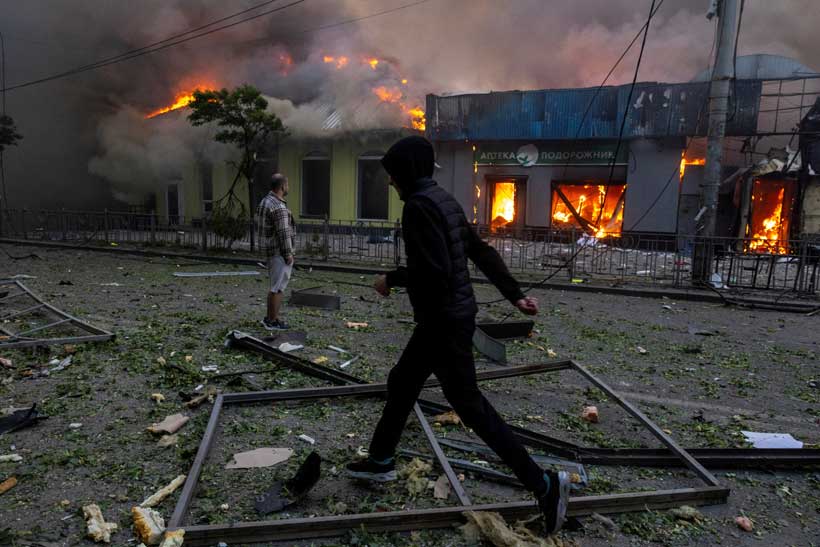
Vertical escalation means increasing the intensity and geographical reach of attacks inside Ukraine: larger missile and drone campaigns, expansion of the target set, attacks against energy and defense production, command structures, and the transport infrastructure connecting Ukraine with Europe. Strikes close to the Romanian and Polish borders illustrate this logic. They allow Russia to attack the interface between Ukraine and its protected hinterland while remaining on the Ukrainian side of NATO’s frontier.
Horizontal escalation provides a way of reaching the hinterland itself. If Russia cannot strike Ukraine’s European support system conventionally, it can impose costs upon it by other means. Sabotage, covert operations, cyberattacks, electronic interference, and attacks against transportation, defense-industrial, and energy infrastructure offer opportunities to weaken European support while preserving ambiguity about attribution and response.
The escalation spectrum extends further. Europe’s dependence on ports, pipelines, and undersea cables creates vulnerabilities in the maritime domain. Western dependence on commercial and military space systems for communications, navigation, surveillance, and targeting creates another. Russia can exploit these vulnerabilities through jamming, spoofing, cyber operations, or interference with ground infrastructure, reserving physical attacks against satellites for a higher step of the escalation ladder.
Russia can also escalate geographically. Deeper military and technological assistance to Iran, including advanced missile capabilities, follows the same logic. Moscow does not have to answer Western pressure in Ukraine within Europe. Supporting states and actors capable of threatening Western interests elsewhere allows Russia to widen the geographical costs of confrontation without attacking NATO countries directly.
To recap, Russia has structural incentives to escalate by intensifying the war vertically inside Ukraine while extending it horizontally across geography and multiple domains but remaining below the threshold of conventional war with NATO countries.
The Stability-Instability Paradox
Nuclear weapons provide Moscow with a degree of insurance as it pursues this strategy. The stability–instability paradox explains why. Mutual nuclear vulnerability makes deliberate NATO–Russia war extraordinarily dangerous and therefore less attractive. But stability at the highest level creates greater room for risk-taking below it. Russia can conduct increasingly aggressive operations against European interests partly because it expects NATO to exercise restraint before risking direct conflict with a nuclear-armed great power.
The same mechanism operates in reverse. Western governments have progressively provided Ukraine with more sophisticated and longer-range weapons and accepted their use against targets deeper inside Russia despite repeated Russian warnings. They have been prepared to cross previous Russian red lines because Moscow’s failure to act upon earlier warnings has strengthened the expectation that Russia will remain deterred from attacking any NATO country directly.
Both sides are therefore taking greater risks partly because nuclear weapons make the ultimate consequences of escalation extremely dangerous. Nuclear weapons constrain escalation at one level while facilitating it at another. The paradox is that this mechanism, which is making deliberate general war less likely, can encourage behavior that moves the adversaries closer to it.
The Balance of Resolve
This becomes more dangerous if Moscow believes that the balance of resolve favors Russia. Russian leaders regard Ukraine as part of their sphere of influence and consider the outcome of the war to involve vital, even existential, interests. Russia has invested enormous amounts of blood, resources, and political prestige in the conflict. Moscow may therefore calculate that Western interests in Ukraine are less vital and that, as escalation approaches the nuclear threshold, Washington and European capitals will back down first. In game-theoretic terms, Russia may expect to prevail in a nuclear game of Chicken: not because it necessarily possesses superior capabilities, but because it believes it can credibly demonstrate a greater willingness to accept the risk of war.
The state of transatlantic relations adds another element of uncertainty. The more conditional and transactional character of American commitments under the Trump administration adds some uncertainty about American resolve. Moscow may reasonably ask whether an American president would risk being trapped in a direct confrontation with nuclear-armed Russia over a limited or ambiguous challenge involving a European ally.
But Moscow cannot know the answer. This uncertainty can deter, but it can also encourage probing. Russia may believe that the balance of resolve favors Moscow without knowing how far that advantage extends. The temptation is therefore to discover the threshold incrementally: another sabotage operation, another cyberattack, greater interference with European infrastructure, a more consequential operation in space, or military action closer to NATO territory.
NATO can make the opposite calculation. Russia has repeatedly warned the West against providing more destructive weapons to Ukraine, permitting deeper strikes and crossing several declared red lines. Yet Moscow has so far refrained from direct conventional retaliation against a NATO country. Western governments may therefore conclude that Russian restraint demonstrates that further incremental risks can safely be taken. The result resembles the logic of salami tactics: each incremental step appears too limited to justify a major response, encouraging the next. Both sides can thus believe that the other will eventually back down. That is the foundation for competitive risk-taking.
Restoring the Credibility of Nuclear Threats
There is another problem for Moscow. Repeated nuclear threats that fail to alter Western behavior gradually lose credibility. They risk becoming empty talk. If the purpose of nuclear signalling is to influence an adversary’s behavior, coercive threats that are repeatedly issued and disregarded eventually cease to perform that function.
Russia therefore has incentives to restore uncertainty about whether its nuclear threats might eventually be acted upon. This does not require nuclear use. Moscow has a substantial escalation ladder available below that threshold: changes in readiness, exercises, deployments, movement of nuclear-capable systems, doctrinal changes, and increasingly explicit nuclear signalling. The objective is the manipulation of risk: to convince Western governments that continuing to cross Russia’s red lines increases the possibility of an escalation that neither side may be able fully to control. This is the logic of brinkmanship.
Domestic Russian pressures may reinforce this problem. Hardline commentators and influential strategic thinkers have criticized the government for what they regard as excessive restraint in the prosecution of the war, particularly as Ukrainian attacks have inflicted significant damage deep into Russian territory. Sergey Karaganov has articulated the most explicit version of this argument. If the West has ceased to fear Russian nuclear weapons, he argues, Russia must restore the credibility of nuclear deterrence by demonstrating a greater willingness to escalate.
John Mearsheimer has repeatedly drawn attention to the same danger from a slightly different perspective: Putin faces pressure from Russian hardliners who believe that Moscow has conducted the war too cautiously, and that pressure will become more consequential if existing strategies fail to produce Russia’s objectives. The significance of this internal debate is not that advocates of nuclear use have prevailed in the Russian decision-making process. It is that continued Ukrainian attacks deep inside Russia, combined with the failure of earlier nuclear warnings to constrain Western behavior, increase the strategic and domestic costs of continued restraint.
The external and internal pressures can therefore reinforce one another. Moscow wants to recover the coercive value of its nuclear arsenal; hardliners inside Russia argue that excessive restraint is destroying precisely that value. The result is pressure to move further up the escalation ladder in order to make the threat of eventually crossing the nuclear threshold more credible.
The Problem of Inadvertent Escalation
The most dangerous mechanism, however, does not require Russia deliberately to decide to cross that threshold. Barry Posen identified another pathway more than three decades ago in his work on inadvertent escalation. Military operations undertaken for limited conventional purposes can produce consequences that the attacker neither intended nor fully understood. For example, an operation designed to improve the conventional military balance can threaten capabilities that the adversary regards as essential to its strategic forces.
This problem becomes more acute as the war expands across geographical and functional domains. Ukrainian attacks against Russian surveillance, communications, command-and-control, or early-warning capabilities could be interpreted in Moscow as threatening Russia’s nuclear deterrent. The same may be true for long-range operations inside Russia. As Ukraine reaches progressively deeper into Russian territory, the distinction between attacking conventional military targets and threatening assets Moscow considers strategically significant becomes increasingly difficult to maintain.
Operation Spider’s Web in June 2025 vividly demonstrated this danger. Ukrainian drones attacked Russian long-range aviation at several air bases, including Belaya in Siberia, thousands of kilometers from the Ukrainian front. Among the aircraft destroyed or damaged were Tu-95MS strategic bombers and nuclear-capable Tu-22M3 long-range bombers; Ukraine also targeted Tu-160 strategic bombers and A-50 airborne early-warning aircraft. The Tu-95MS and Tu-160 belong to the air-based component of Russia’s strategic nuclear forces, while the Tu-22M3 is a dual-capable long-range bomber. The operation therefore simultaneously degraded Russia’s conventional long-range strike capability and reached assets associated with its nuclear deterrent.
The fact that Russia did not respond to Spider’s Web with substantial conventional—or even nuclear—escalation does not remove the inadvertent escalation danger. It demonstrates that conventional and nuclear forces can overlap in a war in which both sides are progressively extending the geographical and technological boundaries of military operations.
Competitive Risk-Taking
A deliberate Russian conventional attack on NATO remains unlikely. Nuclear use remains less likely still. The emerging danger is that both sides progressively move towards thresholds neither intends to cross.
The stability–instability paradox and inadvertent escalation therefore reinforce one another. Nuclear deterrence gives both sides greater confidence to take risks below the strategic threshold. Those risks produce military operations increasingly close to assets, territories, and capabilities whose strategic significance may be interpreted differently by the adversary. Uncertainty about the balance of resolve adds a further incentive to probe.
This is the essence of competitive risk-taking. The risk of war arises because both sides can act on plausible but uncertain assumptions about the other’s restraint and progressively reduce the distance separating them from thresholds neither wishes to cross.
The Challenge for NATO
The strategic problem for NATO is consequently more difficult than simply deterring a Russian attack on Alliance territory. The Atlantic Alliance must deny Russia the benefits of horizontal escalation without converting the expanding shadow war into direct NATO–Russia conflict.
Too timid a response carries substantial risks. If sabotage, cyber operations, maritime coercion, and attacks against European infrastructure impose significant costs without corresponding consequences, Moscow may conclude that the balance of resolve does indeed favor Russia. Successful coercion will invite further probing. An excessively forceful response creates the opposite danger. It could accelerate precisely the escalation NATO seeks to prevent, particularly if retaliation affects capabilities that Russia associates with its strategic forces. NATO therefore needs to discover the art of balanced deterrence.
To sup up, after several years of attrition, Russia has growing incentives to escalate vertically and horizontally in order to offset the protection NATO provides to Ukraine’s strategic hinterland. Nuclear deterrence simultaneously constrains that escalation and creates room for risk-taking below the nuclear threshold. The greater danger, however, lies in the interaction between the two sides. Moscow may believe that superior resolve will eventually force the West to retreat; Western governments may infer from Russia’s repeated restraint that further incremental risks remain tolerable.
The result is not an inevitable march towards nuclear war. It is a competitive process of risk-taking in which both sides have incentives to approach thresholds they do not intend to cross. The danger is that, through brinkmanship, incremental probing, and inadvertent escalation, they may eventually discover those thresholds only by crossing them.