


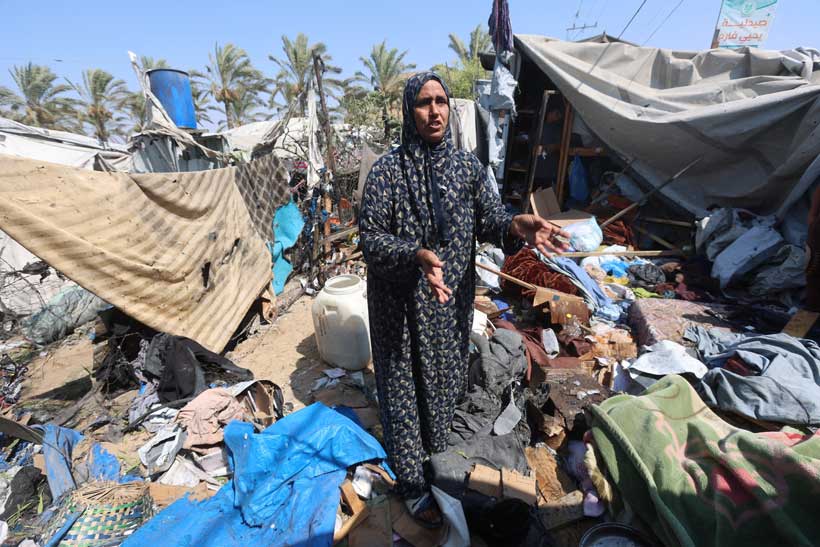
Somewhere between the White House press briefing and the smoke rising over Khan Younis lies the gap that defines the current phase of the Gaza war. The ceasefire announced on 10 October 2025, hailed by US President Donald Trump as a “historic breakthrough,” was supposed to end the fighting. Almost a year on, the fighting has not ended. It has merely been rebranded.
According to figures compiled by the Gaza Government Media Office, between 10 October 2025 and mid-April 2026 alone, Israel bombed and shelled the enclave 1,109 times, shot at civilians on 921 occasions, and demolished property 273 times. By late summer, more than a thousand Palestinians had been killed since the truce began. On any honest reading, this is not a ceasefire. It is a lower-intensity war conducted behind a diplomatic curtain—and that curtain is held up by Washington.
The anatomy of a toothless truce
Ceasefires only hold if the parties fear the cost of breaking them. The October agreement, and the accompanying 20-point plan, produced neither an independent monitoring body nor a credible penalty for violations. Verification was handed instead to the United States itself, through the Civil-Military Coordination Center (CMCC) in Kiryat Gat, staffed by roughly 200 American troops under US Central Command (CENTCOM) and overseen by Admiral Brad Cooper.
Stay ahead of the geopolitical week.
MD Briefing delivers expert analysis across five global fronts — the Indo-Pacific, energy, geoeconomics, European security, and the Middle East — every Monday morning. Free.
The design flaw is glaring. The CMCC’s mandate, according to CENTCOM, is to “monitor implementation of the ceasefire agreement” and to coordinate humanitarian assistance. Yet the same power that guarantees Israel’s diplomatic and military backing is also acting as its umpire. The Guardian has already reported that Israeli personnel were caught electronically surveilling US and allied officers at the center, prompting an American general to insist the recordings stop. The image speaks for itself: a referee spied on by the team he is meant to police.
As the international lawyer Toby Cadman put it plainly to Al Jazeera in June, “there is no neutral arbiter empowered to determine, with binding effect, who has breached.” Without that arbiter, every Israeli strike can be relabeled as a response to an “imminent threat,” and every dead child recast as collateral damage in a legitimate counter-terrorism operation. That is precisely what has happened.
Weapons, vetoes, and the political umbrella
American diplomacy did not stumble into this trap. It built it. Since October 2023, the United States has transferred more than US$30 billion in arms to Israel, a figure the American Friends Service Committee notes was topped up by a further US$6.5 billion package announced only weeks before the truce took effect. The Leahy Law prohibits US assistance to foreign security forces credibly implicated in gross human rights abuses. In practice, that law is now a museum piece. Waivers, silence, and creative interpretation have kept the pipeline open through the war and through the ceasefire that supposedly ended it.
The pattern of protection extends well beyond the arsenal. Washington has repeatedly wielded its United Nations Security Council veto to block resolutions demanding an immediate and unconditional halt to the fighting and has actively resisted efforts at the International Court of Justice and the International Criminal Court to hold Israeli officials to account. When Democratic Congressman Sean Casten introduced the Ceasefire Compliance Act in February 2026—a modest bill that would have conditioned US weapons on Israeli compliance with the October deal—the legislation languished. The signal to Prime Minister Benjamin Netanyahu’s cabinet could not be clearer: the flow of munitions, the vetoes, the intelligence, and the political top-cover will continue regardless. There will be no bill.
That is what analysts at the Arab Center in Washington, DC, mean when they describe the American posture as a “collusion mechanism” rather than an enforcement one.
The politics of a quieter war
The tactical logic on the Israeli side has adjusted accordingly. Strikes are smaller, more spaced out, and more surgically framed—but they are constant. Between 31 July and 18 August 2026, the Israel Defense Forces (IDF) itself acknowledged sixteen “responses” to alleged violations; Palestinian counts run far higher. Days after Jared Kushner arrived in Israel in mid-August to shore up the peace track, an Israeli air strike hit a seaside café in Gaza City, killing civilians. On 23 August, Israeli quadcopters fired on al-Shujaiyya, wounding a journalist and several residents as Netanyahu threatened wider attacks over kite launches. Even Nickolay Mladenov, the Trump administration’s own point man on the truce, conceded in late August that strikes were still killing Palestinians and that Gazans “can’t feel that the conflict is ending.”
The politics behind all this are cynically rational. A quieter war is easier to defend on cable television than a full-scale offensive. Body counts of two or seven or nineteen a day, released in dry newswire dispatches, do not stop traffic in Western capitals the way images of Rafah’s flattened blocks did in 2024. The ceasefire, in this sense, has functioned less as a humanitarian instrument than as a public-relations regulator. It has allowed the Biden-to-Trump continuum of American Middle East policy to claim the moral posture of peacemaker while the underlying military campaign grinds on by other means.
What real support would look like?
If Washington genuinely wanted a ceasefire that held, the tools are not exotic. They are the ones any competent mediator would demand of any other party in any other conflict.
First, an independent monitoring mechanism—not one lodged inside a US-Israeli military base, but one anchored in a United Nations mandate with participation from Egypt, Qatar, Turkey, and neutral European states, and empowered to make binding determinations of fault. Second, automatic and public conditionality on US arms transfers, tied to specific and verifiable ceasefire benchmarks along the lines of the Casten bill. Third, a guaranteed humanitarian corridor operating at a scale set by need, not by Israeli political tolerance, with UN agencies restored to their traditional coordinating role. Fourth, active American support—rather than obstruction—for the international legal processes now under way. A state that is genuinely innocent has nothing to fear from due process.
None of this requires abandoning Israel’s legitimate security concerns. It requires refusing to treat those concerns as a license.
The uncomfortable truth for policymakers in Washington is that a ceasefire without guarantees is not a ceasefire. It is a permit. And every Palestinian family that buries a child under the yellow line drawn across the map of Gaza is being told, in effect, that their grief has already been priced in. Until that price changes, the peace being sold from the Rose Garden will keep sounding, in Gaza, exactly like war.
