| TODAY’S NUMBERS 6.7828 (Monday’s PBOC yuan fix, near-flat) · 21 (months of PBOC gold buying, a record) · <3% (yuan’s share of SWIFT payments, vs. 51% for the dollar). Beijing is capping the currency, buying gold and building payment rails around the dollar — one insurance policy, three moves. |
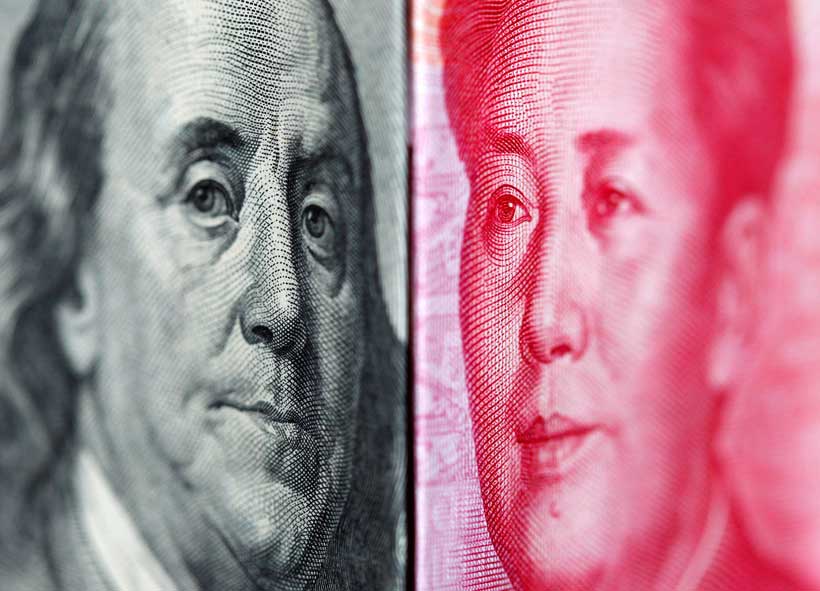
On Monday, the People’s Bank of China set its daily reference rate for the yuan at 6.7828 to the dollar, barely different from Friday’s 6.7811 — the latest in a string of fixings set weaker than the market expected, a pattern running since November 2025. The dollar index has fallen more than 2% since late July. The yuan has gained less than 1% against it in the same stretch. That gap isn’t drift. It’s Beijing deciding, one fixing at a time, how much of the dollar’s decline its own currency is allowed to capture.
The mechanism is the daily midpoint itself: the PBOC sets a reference rate each morning, and the yuan can trade only 2% either side of it. Sound money management, in theory. In practice it has become a lever. On August 25th, the central bank set its fix 633 pips weaker than Reuters’ model estimate — the largest such gap in six months — days after the yuan touched 6.7192, a three-and-a-half-year high, on August 21st. The winners are China’s exporters, who keep a competitive currency even as the dollar slides. The winner behind the winner is the PBOC’s own balance sheet: it bought 20 tonnes of gold in July, its largest monthly purchase since late 2023, extending its buying streak to 21 straight months and lifting reserves to 2,366 tonnes, or 8% of total foreign-exchange holdings. Gold is the one reserve asset Washington cannot freeze — a lesson Beijing drew in real time when the West immobilised more than $300 billion of Russia’s central bank assets in 2022. The losers sit on the other side of both trades: Chinese households priced out of the stronger currency a freer float would hand them, and foreign holders who want a fully convertible yuan for the long run, not a managed one. Meanwhile the plumbing keeps expanding regardless of the fix: China’s Cross-Border Interbank Payment System handled a record RMB1.22 trillion ($178.5 billion) in a single day in April and a peak daily volume of RMB920.5 billion in March, with 1,791 participating institutions — 65% of them now outside mainland China, up from 57% five years ago.
Why it matters: This is internationalisation with the safety on. Beijing wants the yuan usable enough that trading partners under sanctions risk — Russia, Iran, and others routing more settlement through CIPS since the escalation around the Iran conflict — have an alternative to a dollar system that can be switched off. It wants gold heavy enough in reserves to survive the same kind of freeze Russia suffered. And on July 1st a new 34-article outbound-investment regulation took effect, formalising how Chinese companies and state banks invest abroad — control over where the money goes, not a loosening of the tap. None of this amounts to a rival reserve currency yet: at under 3% of global SWIFT payments against the dollar’s 51%, the yuan’s scale doesn’t match its ambition. What it amounts to is optionality — for Beijing, and for governments hedging against dollar dependence. The tension Beijing hasn’t resolved is that the things which would make the yuan genuinely more useful abroad — a free float, an open capital account — are the same things that would loosen the Party’s grip on money at home. So it takes the alternative path: hold the currency, buy the metal, build the rails, and keep capital in through regulation rather than price. For Washington, the near-term risk isn’t the dollar losing its throne; SWIFT data still show it dominant. It’s erosion at the margins — trade with the Global South, with sanctioned states, settled a little more each quarter outside the system the US built to see it all.
Watch for: China’s State Administration of Foreign Exchange typically publishes official reserves data for the prior month around the 7th; August’s figures, due on or near September 7th, will show whether the PBOC extended its gold-buying streak to a 22nd month after July’s 20-tonne purchase. That release lands a week before the Federal Reserve’s September 15–16 FOMC meeting, where a widely expected rate cut would add fresh downward pressure on the dollar — testing, again, how much of that move Beijing lets the yuan reflect this time.
Stay ahead of the geopolitical week.
MD Briefing delivers expert analysis across five global fronts — the Indo-Pacific, energy, geoeconomics, European security, and the Middle East — every Monday morning. Free.