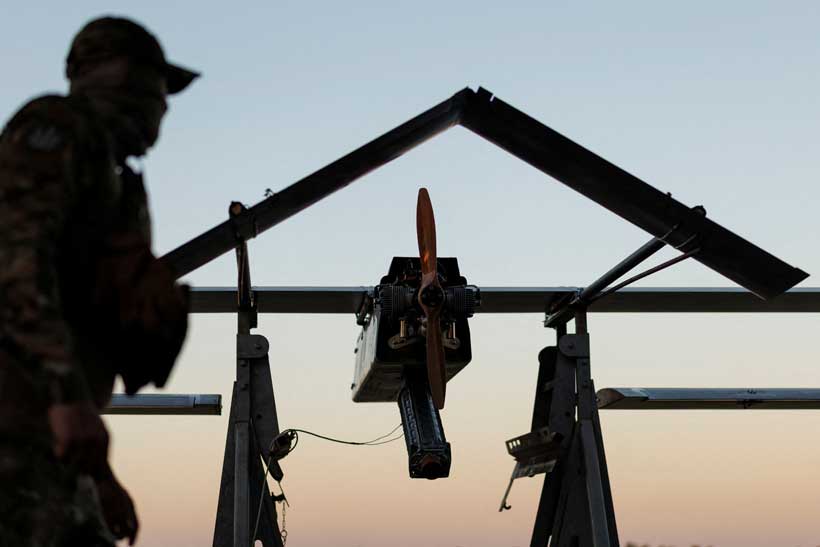
In early August, a Pentagon official stood in front of reporters and conceded something the department almost never says out loud: the world’s best-funded military cannot out-produce a country under invasion. Travis Metz, deputy director of the Defense Innovation Unit, put a number on it. Ukraine will manufacture six to seven million small first-person-view attack drones this year — roughly 500,000 a month, built in garages, repurposed furniture factories and basements within range of Russian glide bombs. The Pentagon’s own flagship drone program, a $1.1 billion initiative branded Drone Dominance, will have ordered fewer than 200,000 drones, cumulatively, by February 2027. Metz’s response was not defensive. It was aspirational: “I see no reason why we shouldn’t… be the world champions of this as well.” The gap he was describing is not a technology gap. It is a speed gap, and speed is the one metric wartime industry cannot fake.
The instinct is to read this as a story about Ukrainian ingenuity, and it is one. But it is also the epilogue to a specific American failure. In 2023 the Pentagon launched Replicator, a program to field “multiple thousands” of autonomous systems within 24 months to counter China. By its August 2025 deadline it had delivered “hundreds,” not thousands, after burning through roughly $1 billion — undone by drones that were unfinished at selection, software that could not command large numbers of different systems at once, and a Switchblade loitering munition priced above $100,000 a unit. Washington’s answer was not to slow down and fix the model; it was to bring in the Department of Government Efficiency to override procurement rules and reclassify small drones as disposable supplies rather than regulated weapons systems. Meanwhile, Russia’s own Shahed and decoy drone output is reportedly climbing toward several hundred, and by some Ukrainian estimates up to a thousand, units a day. The war that forced Ukraine to mass-produce cheap drones is the same war exposing how slowly America still moves.
Why the gap isn’t about money
Start with unit economics, because they explain most of the gap. A Ukrainian FPV drone can be built for as little as $300 to $500 — an airframe, a camera, a battery and a warhead, assembled by hand and flown once. The Pentagon’s comparable systems have historically cost orders of magnitude more, not because the components are better but because they were designed inside an acquisition culture built for exquisite, low-volume platforms like fighter jets, where every part is sourced, tested and certified over years. Layer onto that a July 2026 rule requiring a “wholly domestic” supply chain — no Chinese-made motors, no Chinese battery packs — and the honest tension becomes visible: the policy meant to make American drone production more secure is, in the near term, also what makes it slower and more expensive to scale. Metz’s own explanation was blunt: it is “much harder to get from zero to 200,000” than to expand an existing line. Ukraine skipped that problem by never centralizing production in the first place — thousands of small, dispersed workshops that are individually replaceable and collectively enormous.
Stay ahead of the geopolitical week.
MD Briefing delivers expert analysis across five global fronts — the Indo-Pacific, energy, geoeconomics, European security, and the Middle East — every Monday morning. Free.
The deeper obstacle is not money but structure. Replicator had no dedicated budget line, was bounced between the Defense Innovation Unit and a newly created Defense Autonomous Warfare Group under Special Operations Command, and repeatedly selected systems that existed as concepts rather than finished products, in a rush to hit an artificial 24-month deadline. Congress, by its own research service’s account, has struggled to get basic cost and capability data out of the program. This is what forced DOGE’s intervention: not a shortage of appropriated dollars, but a procurement system engineered for careful, low-volume exquisiteness trying to behave like a wartime factory floor, and failing at both.
The strongest objection to treating this as a straightforward American failure is that the comparison is not apples to apples. Ukraine’s FPVs are disposable, short-range and built for a static front line; American planners are chasing autonomy, jamming resistance and long-range swarm coordination for a Pacific theatre defined by vast distances rather than trench lines, and that ambition costs more and takes longer to get right. That is a fair distinction — but it does not rescue the record. Years and a billion dollars into that more ambitious bet, the Pentagon still lacks software able to command mixed fleets of different drones, while Ukrainian manufacturers are already fielding AI-assisted terminal guidance on sub-$500 airframes, refined through thousands of real combat sorties a month. The ambition gap did not produce a capability lead. It produced the same failure as the cost gap: exquisite requirements colliding with a timeline the requirements were never built to meet.
Which is why the Pentagon’s actual fix looks nothing like a bigger budget. Six Ukrainian manufacturers, including F-Drones and General Cherry, are now required to form joint ventures with American companies — near Toledo, Ohio, and in New Hampshire — as a condition of future Pentagon orders. Washington is not just buying drones. It is importing the production model, and with it the tacit admission that the expertise now runs the other way.
Three ways this goes
What happens next depends on whether the joint-venture model actually transplants Ukraine’s manufacturing tempo onto US soil, or just its branding.
Base case (roughly 50 percent probability). The Ohio and New Hampshire joint ventures scale gradually. By 2027–28, US-based output climbs into the low hundreds of thousands annually — a real improvement, but still an order of magnitude below Ukraine’s current pace, held back by the domestic-sourcing rule’s cost premium. The program becomes a credible proof of concept for a future Indo-Pacific contingency rather than a fix for any current shortfall, and “Drone Dominance” quietly redefines success downward to match what it can actually deliver.
Downside case. The DOGE-driven bypass of standard testing repeats Replicator’s failure mode at greater scale: units purchased without adequate vetting turn out unreliable in the field, a GAO or inspector-general report documents it, and Congress reimposes the very procurement safeguards that were just stripped away. Combined with a Chinese-component ban that keeps unit costs well above Ukrainian levels, US output stalls again, and the gap that Metz conceded in August widens rather than closes by the time it next matters.
Upside case. The joint-venture model works as intended — not just as a purchasing arrangement but as a transplant of Ukrainian manufacturing culture, its dispersed micro-factories, rapid iteration and tolerance for combat-tested imperfection, into the American industrial base. That model, proven on drones, becomes the template for how Washington arms the next partner already fighting a war, whether Taiwan or a Baltic state: not a slow pipeline of finished stockpiles shipped from the continental United States, but manufacturing capability transplanted onto the partner’s own soil, and now, in this instance, onto America’s.
The takeaway
So: what does the mismatch reveal? Not that Ukraine builds better drones — the Pentagon never disputed that its own designs, on paper, are more capable. It reveals that capability on paper is not the same as capability in time, and that the American defense-industrial base, even backed by an executive order, a billion-dollar program and a DOGE override of its own rules, still cannot mobilize at wartime tempo on its own. The fix Washington has actually reached for is not more money. It is outsourcing the missing ingredient — speed — to the one partner that has been forced to master it under fire. That is the real admission, and it may be the more durable one: the next time the United States arms a country fighting a live war, it may look less like supplying an ally and more like apprenticing to one.
Watch for: whether the Ohio and New Hampshire joint-venture lines are shipping US-assembled drones at anything close to Ukrainian unit costs by the next Gauntlet test cycle at Fort Carson. If the “wholly domestic” sourcing rule keeps American-made units several multiples more expensive than their Ukrainian counterparts, the joint ventures will have transferred the branding of Ukraine’s drone war without transferring its speed.