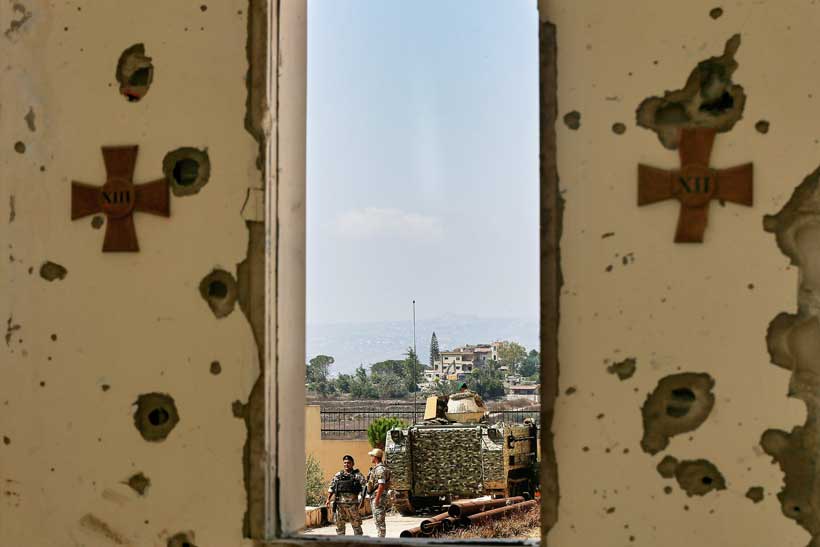
Three villages. That is the full extent of Lebanese Armed Forces control under the “pilot zone” framework that Washington brokered in June — Zawtar Al Gharbiyeh, Srifa, and Froun, all of them in the strip of southern Lebanon that Israeli forces had already emptied and, in places, flattened. Two months on, Lebanese officers meeting Israeli counterparts in Rome on August 4th were still asking Israel to stop “hampering” the handover of even these three, complaining that Israeli forces were detonating ordnance meters from the pilot zone’s edge and had fired on LAF soldiers who approached the demarcation line. A week later, on August 13th, a Lebanese official confirmed Beirut had not even agreed with Israel on which countries would be allowed to verify whatever disarmament eventually happens. Nine months after the government declared “phase one” of disarming Hezbollah complete south of the Litani River, the process has not yet secured a fourth village, let alone found a mechanism to enter the areas where Hezbollah’s actual arsenal is stored.
The debate in Beirut and Washington keeps treating this as a question of political will: will Prime Minister Nawaf Salam’s government find the nerve to confront Hezbollah, will Hezbollah’s leadership calculate that resistance costs more than compliance. That framing assumes the Lebanese Armed Forces has a coercive option sitting in reserve if the politics ever align. It does not. The question this piece answers is narrower and more concrete than whether Beirut agrees to a framework: does the LAF have any operational path to disarming Hezbollah by force, as opposed to collecting what Hezbollah hands over voluntarily? The answer is no, and it is not a close call.
Start with the numbers, because they are not ambiguous. The LAF fields roughly 60,000 active personnel and 35,000 reservists, working with a fleet of some 115 aging M48 and M60 tanks, limited artillery, no meaningful air defense, and a light-attack air wing that could not survive contact with a modern man-portable air-defense system — which Hezbollah has in quantity. Hezbollah, even after fifteen months of Israeli strikes degraded its pre-war stockpile, retains an estimated 25,000-plus rockets and missiles, thousands of advanced anti-tank weapons that give it what one recent military assessment calls “absolute qualitative superiority” over LAF armor, roughly 1,000 attack and loitering drones, and 40,000 to 50,000 active fighters backed by tens of thousands of reservists. A direct clash would not be a mismatch. It would be, in the words of that same assessment, “an exceedingly perilous undertaking” bordering on catastrophic — for the LAF, for Lebanese civilians in whatever neighborhood it happened in, and for the Lebanese state itself.
That comparison actually understates the LAF’s problem, because it treats the army as a unified instrument that simply lacks firepower. It is also not a unified instrument. By most estimates roughly half of LAF combat units are Shiite, drawn from the same towns and, in many cases, the same extended families as Hezbollah’s fighters. Analysts who track the institution closely describe daily, low-level cooperation between army units and Hezbollah in the south rather than confrontation, and note that the LAF deliberately avoids entering the closed military zones and private homes where the bulk of Hezbollah’s remaining weapons are stored. This is not simply caution. It reflects a real assessment that ordering a Shiite soldier to raid his cousin’s basement is not a reliable way to get a raid conducted. When Hezbollah wanted to make the cost of pushing harder explicit, it did: on August 9, 2025, it deliberately detonated a weapons depot as LAF units worked nearby, killing six soldiers — a message, not an accident, and one the army absorbed without escalating.
Stay ahead of the geopolitical week.
MD Briefing delivers expert analysis across five global fronts — the Indo-Pacific, energy, geoeconomics, European security, and the Middle East — every Monday morning. Free.
Even where the LAF has operated without contest, its logistics have been unable to keep pace. Clearing operations south of the Litani recovered close to 10,000 rockets and 400 missiles by last autumn, a real achievement — but the army ran out of demolition explosives destroying what it found and had to wait on American resupply before it could continue. An institution that cannot keep itself stocked with the explosives needed to destroy weapons it has already located, in territory Hezbollah was not actively defending, is not a plausible candidate to forcibly clear territory Hezbollah is prepared to defend.
The obvious objection is that this critique aims at the wrong target: the disarmament framework was never designed around LAF coercion. Lebanese officials, American envoys, and independent military assessments all converge on the same prescription — a “consensus-based” process, gradual and negotiated, not a military assault. On its own terms, that is a fair description of the plan. But it does not rescue the plan from the capability problem; it exposes what the capability problem actually determines. If the LAF cannot credibly threaten force, then the entire disarmament process runs on two things it does not control: Hezbollah’s own willingness to give something up, and Israeli military pressure applied from outside the Lebanese state altogether. The LAF’s actual role is administrative — collecting, verifying, demining, reporting to a five-member oversight committee — rather than coercive. That is why every meaningful advance so far has occurred in places Hezbollah had already lost militarily to Israel during the March-to-June war, or had no strategic reason to defend, while the group’s core precision-missile stockpile north of the Litani remains untouched and, per Israeli assessments, actively being replenished by Iran faster than anyone is dismantling it. Call it disarmament if that is the political label the framework needs, but it is closer to Hezbollah taking inventory of what it no longer wants and letting the state collect it.
There is a sharper irony underneath this. The same donors funding and training the LAF for this mission — principally the United States — have for years deliberately withheld the categories of weapons (long-range artillery, real air-defense systems, heavier armor) that would even theoretically narrow the gap with Hezbollah, precisely to avoid eroding Israel’s own military edge in the region. The LAF is being asked to eventually confront, or at least out-position, a better-armed adversary while its most important patron ensures it never becomes one.
What happens next
Base case (roughly 55 percent). The pilot-zone model creeps forward at its current pace — a handful more villages by the end of 2026, all in the emptied border strip Israel has vacated or in areas Hezbollah has already deprioritized. Verification arrangements eventually get patched together informally rather than through the country shortlist Lebanon and Israel are currently stuck on. The core of Hezbollah’s arsenal, concentrated in the Bekaa Valley and Beirut’s southern suburbs, remains untouched through 2027, with periodic Israeli strikes continuing to function as the real enforcement mechanism the LAF cannot provide.
Downside case. Under intensified pressure tied to a specific milestone — a fresh Trump administration deadline, or conditions attached to the next tranche of US military financing — Beirut orders the LAF to push into a genuinely contested area, most plausibly near Baalbek or the Bekaa’s weapons-storage belt, rather than another vacated border village. A repeat of the August 2025 dynamic follows, but at larger scale: Hezbollah resistance, LAF casualties, and visible refusals within Shiite-majority units. Washington, unwilling to be seen backing an operation that fractures the Lebanese army along sectarian lines, quietly freezes further equipment transfers rather than accelerating them, leaving the LAF weaker than before it tried.
Upside case. Lebanon’s government pairs the pilot-zone expansion with a genuine, well-funded push to deliver state services and reconstruction financing specifically in Shiite towns transitioning out of Hezbollah’s control — the “alternative to Hezbollah” strategy that American officials have floated but not yet resourced. If that outpaces expectations, voluntary handovers spread beyond the border strip into more populated areas without a shot fired. Even in this branch, the precision-missile stockpile is the last tranche to move, and probably only as part of a wider Iran settlement rather than a Lebanese domestic process.
The takeaway
Whether Beirut has the political will to disarm Hezbollah is a real question, but it is not the constraining one. The constraining question is whether a 60,000-man army equipped with Cold War-surplus tanks and no meaningful air defense can compel disarmament from a force with rough manpower parity, an intact anti-armor advantage, and a demonstrated willingness to kill Lebanese soldiers who get too close — and it cannot, not this year and not on any equipment timeline currently on offer.
Watch for: whether LAF-controlled pilot zones extend past the initial three villages into any location Hezbollah actually values operationally — rather than ground Israel had already vacated — by the end of 2026. That is the test that separates a genuine expansion of state authority from a slow inventory of what Hezbollah was willing to lose anyway.