


Authors: Iren Marinova & Gabriella Gricius*
Europe has spent the past decade learning how to provide maritime security abroad. The EU, specifically, has made substantial efforts to grow its presence in this domain as a provider of global maritime security. Today, its greatest maritime security challenges lie much closer to home.
The threat environment in Europe’s home seas is changing rapidly. Since the Russian full-scale invasion of Ukraine in 2022, for instance, the Black and the Baltic Seas have seen a significant increase in hybrid threats, both kinetic and non-kinetic in nature. Because of the primary role of member states and NATO at home, the EU maintains only a limited coordinating role in its home seas. Given the growing uncertainty around the transatlantic alliance, Europe must prioritize maritime security in its home waters as an essential element of European security. The good news is Europe does not need to start from scratch: Operation ASPIDES demonstrates that the EU has already developed operational tools that could inform a stronger maritime security role closer to home.
Amidst geopolitical realignments, maritime security is increasingly central.
Stay ahead of the geopolitical week.
MD Briefing delivers expert analysis across five global fronts — the Indo-Pacific, energy, geoeconomics, European security, and the Middle East — every Monday morning. Free.
Maritime security threats are increasingly felt in Europe’s home waters. Hybrid threats, such as maritime cable sabotage, disinformation, the use of drones and sea mines, and a variety of other security risks that fall under the threshold of armed conflict, are abundant in the Black and Baltic Seas.
However, there are important distinctions in the operational environment of Europe’s home waters and that of the high seas where the EU has established a maritime presence and reputation. At home, an autonomous European hard security role remains structurally constrained. Overseas, the EU has a wider wingspan of action, as in the case of Operation ASPIDES in the Red Sea, while it remains largely restricted at home. The EU’s treaty framework was designed primarily for external crisis-management missions, while territorial defense and high-end military deterrence remain the responsibility of member states and NATO. For instance, NATO dominates Baltic security and plays a key role in Black Sea regional security, although the latter is fundamentally conditioned by the Montreux Convention, which limits naval access by non-littoral powers and shapes the strategic environment in which both NATO and the EU operate.
Furthermore, US-based space intelligence assets provide a central part of European maritime domain awareness efforts, making responses to kinetic maritime threats heavily dependent on the US. The EU has no standing navy, depends on member states to provide military capabilities and unanimously authorize operations, and operates within a European security architecture in which NATO remains the primary provider of deterrence and defense. As a result, the EU’s capacity to act at sea varies significantly across Europe’s maritime theaters. Yet the threats posed by the maritime security domain in the Black and Baltic Seas—both economic and kinetic—indicate that maritime security is European security, and Europeans need to approach it seriously and strategically.
Operation ASPIDES: Successes & Failures as a Blueprint
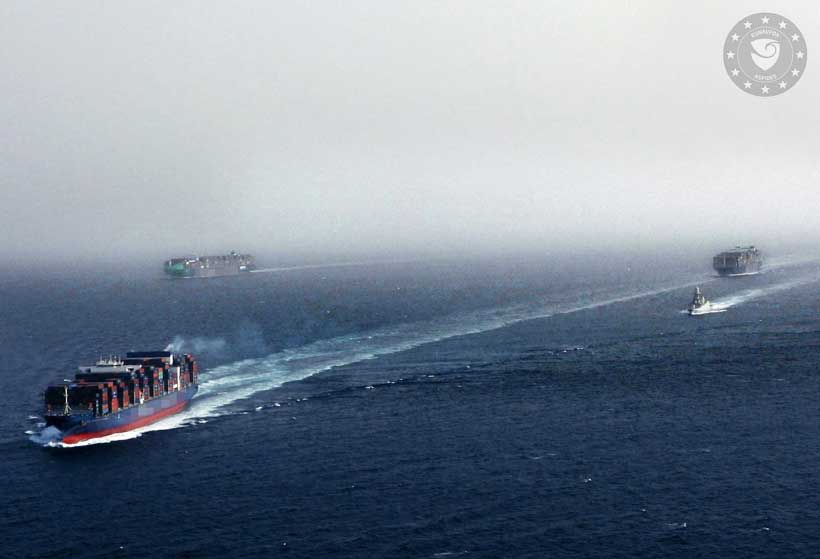
Unlike previous EU anti-piracy or capacity-building missions, ASPIDES is the bloc’s first mission primarily dedicated to conventional, multi-domain air defense and direct naval protection against state-adjacent actors. It is the bloc’s first real test of strategic maritime responsibility. Two years in, it is also a demonstration both of limitations and possibilities for the EU. It shows that the EU can act strategically when its interests are clear, but it is also imbued with EU bureaucratic constraints and its recent history of naval underinvestment and reprioritization across the bloc over the past 35 years. The mixed results at the mission’s two-year mark assessment revealed this material and strategic lack in European naval power and the resulting inability to meet the safety and protection needs of the shipping industry.
A recent report on ASPIDES’ effectiveness against its objectives reveals several important downfalls: These drawbacks are both resource- and strategy-related, and they should be translated into solutions to the EU’s home waters as the bloc builds up its presence and strategy at home.
First, maritime security cannot be sustained through ad hoc force generation. ASPIDES demonstrated that relying on voluntary national contributions produces an uneven burden-sharing system in which only a handful of member states provide the bulk of naval assets, while limited European fleets are dispersed across multiple overlapping operations. ASPIDES’s defensive and reactive mission mandate has also proven to be less effective and insufficient to achieve its objectives, making it strategically and economically unsustainable. Even if ASPIDES successfully intercepted missiles and drones, it was confined to responding to attacks after they occurred and to escorting ships.
In a future crisis closer to home, Europe cannot afford to assemble maritime capabilities purely on a reactive and ad hoc basis. Instead, it needs sustained, proactive, and shared naval commitments that could be established on a minilateral and sub-regional level, as in the case of the Joint Expeditionary Force, and positioned strategically to deter opportunistic challengers.
Second, the limitations of ASPIDES highlighted the systemic underinvestment across Europe’s navies since the end of the Cold War. Combined with the multitude of naval commitments of several member states to other operations in the region, ASPIDES was continuously left lacking deployments.
Third, maritime security extends far beyond naval deployments. The experience of ASPIDES showed that protecting sea lines of communication ultimately depends on coherent strategy, resilient logistics, secure supply chains, industrial capacity, intelligence, and cooperation with regional partners rather than simply on the number of warships at sea.
These lessons are particularly relevant for Europe’s own maritime neighborhood. Given the institutional and structural constraints, the Baltic and Black Seas are not suitable theaters for a new CSDP naval operation. However, these constraints do not render the EU incapable in the pursuit of maritime security at home. Rather than falling into the trap of duplicating NATO’s role, the EU should concentrate on those areas where it possesses unique comparative advantages.
Moving Forward
First, the EU should build a permanent maritime resilience architecture for the Baltic and Black Seas. This should include integrated maritime domain awareness, protection of critical underwater infrastructure, coordinated surveillance, and rapid-response mechanisms for damaged cables, pipelines, and ports. These are areas where the Union’s regulatory, financial, and civilian coordination tools can generate added value without duplicating NATO’s military responsibilities.
Second, the EU should use its financial and industrial instruments to strengthen Europe’s maritime readiness. Joint procurement of interceptor missiles, counter-drone technologies, electronic warfare systems, autonomous maritime platforms, and naval logistics infrastructure would address precisely the capability shortages exposed during ASPIDES while simultaneously reinforcing NATO’s European pillar.
Third, the EU should shift from reactive protection toward proactive resilience in its home waters. Rather than focusing solely on protecting maritime traffic after threats emerge, it should make greater use of sanctions enforcement, customs cooperation, intelligence sharing, port-state controls, and coordinated action against shadow fleets and illicit supply networks that enable maritime coercion. Reducing the effectiveness of hostile actors before incidents occur is considerably more sustainable than relying indefinitely on expensive naval interception. This is particularly relevant in the EU’s northern maritime spaces, where the shadow fleet poses a serious threat.
Fourth, Europe needs institutionalized burden sharing rather than crisis-driven contributions. Rather than relying exclusively on EU-wide mechanisms, regional minilateral coalitions in the Baltic and Black Seas should develop standing commitments for surveillance, mine countermeasures, coast-guard cooperation, logistics, and critical infrastructure protection. The EU can enable these efforts through defense financing, joint procurement, military mobility, and interoperability initiatives, while NATO provides the overarching framework for deterrence and collective defense.
Why is this important?
Europe is increasingly vulnerable in its home waters. The reliance on NATO and the US is high, so the unpredictability of Washington, combined with the European limitations in maritime security, is particularly dangerous. The EU must step in as a more strategic actor.
Operation ASPIDES has produced two years of valuable data that the EU can apply to its own seas. Most importantly, it has revealed that a reactive naval operation cannot compensate for inadequate capabilities, fragmented contributions, weak logistics, expensive defense systems, and a strategic failure to disrupt the sources of insecurity in the Red Sea. Given the institutional and structural constraints the EU faces in its home waters, the bloc can apply these lessons learned and put into action its biggest strengths that it has developed over the past 15 years of global maritime operations.
While an operation like ASPIDES in the Black or Baltic Seas is highly implausible, the EU can step up in other ways by playing a more coordinating role, avoiding the mistakes from ASPIDES, and implementing the lessons learned to take more agency in the security of its home seas.
*Dr. Gabriella Gricius is an Associate Professor at the Norwegian Military Academy and a Fellow and the Media Coordinator with the North American and Arctic Defence and Security Network (NAADSN). She is also a Senior Fellow at the Arctic Institute and a member of the Younger Generation Leaders Network on Euro-Atlantic Security with the European Leadership Network (ELN). Her research explores Arctic security, Nordic defence cooperation, and hybrid threats.
