


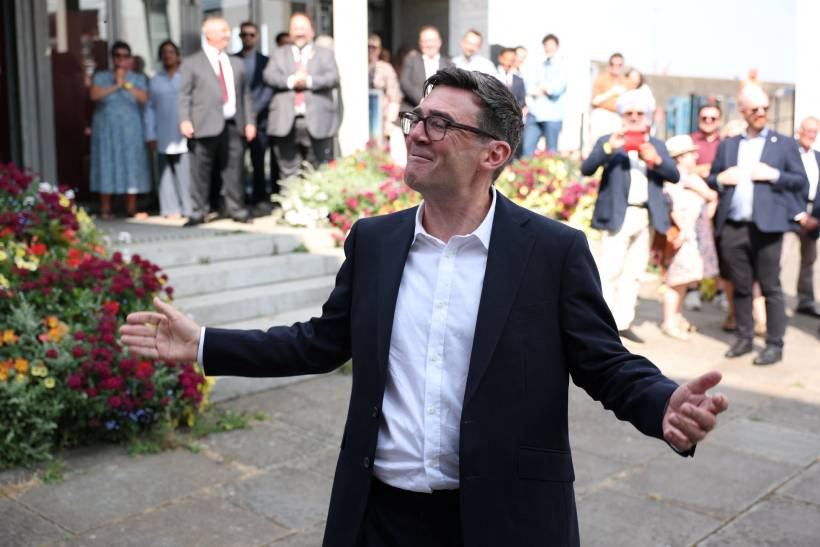
Andy Burnham becomes the UK’s next Prime Minister, being the 7th occupant of Downing Street in just 10 years. The Labour lawmakers gave him an overwhelming mandate after securing 322 nominations from the party’s 403 Members of Parliament. Hence, Burnham became the sole contender in the leadership race. Following convention, Britain’s King Charles III officially appointed Andy Burnham as the UK Prime Minister on Monday. Newly nominated Burnham succeeded former Prime Minister Keir Starmer, who tendered his resignation on June 22, 2026, following growing unrest within the Labour Party.
It is important to understand that despite the political turmoil followed by the change in leadership, the UK will not head to the polls immediately. Under the UK’s parliamentary-cum-unitary system, the citizens of the UK elect the political parties rather than the Prime Minister. This clause allowed the political party to replace the country’s leadership without calling a general election. The next elections in the UK are not required until 2029. Keir Starmer’s resignation from the premiership made it evident that Prime Minister Burnham has entered 10 Downing Street by inheriting multiple challenges such as soaring public debt, sluggish economic growth, deep political divisions, and massive pressure on the country’s National Health Service (NHS), followed by an increasingly contentious immigration debate in the country. Moreover, the debate over reforms in the asylum system of Britain is expected to become the most defining challenge for the newly-selected Prime Minister Andy Burnham.
In his first speech after becoming the UK’s Prime Minister, Burnham promised to set out austerity measures to help improve the cost of living this week before giving a new 10-year economic plan for the country this year. He further said that “Britain needs to show the world that we have regained stability once again.” He further confessed that “We have not been good enough, and we need to be better.” He pledged greater public control over the country’s essential services by significantly transferring power from Westminster to local government. Burnham emphasized strengthening the industrial base of Britain as a foundation for the long-term economic growth of the country.
Mayor-turned-Prime Minister Andy Burnham remained a strong advocate of decentralization, as he repeatedly accused Westminster of excessive spending on London, while ignoring communities outside London. Going one step further, Burnham plans to establish a government office in Manchester as a symbolic commitment to local communities, emphasizing shifting political influence across northern England. In his first speech, Burnham also criticized the past four decades’ economic direction characterized by Margaret Thatcher’s sweeping privatization and deregulation introduced in the 1980s. Moreover, the members of parliament also believe that the change in command has given the Labour Party its best chance to rein in Nigel Farage’s anti-immigration Reform UK party.
Stay ahead of the geopolitical week.
MD Briefing delivers expert analysis across five global fronts — the Indo-Pacific, energy, geoeconomics, European security, and the Middle East — every Monday morning. Free.
On the foreign policy front, Burnham said that his first call will include the US President Donald Trump, followed by the Ukrainian President Volodymyr Zelensky. He pledged to continue supporting Ukraine in its ongoing conflict against Russia and back the Ukrainian leader “100 percent” as his predecessor. However, if the UK government continues to support Ukraine and remain at loggerheads with Russia, the foreign policy tilt will further upsurge gas prices in the country. The UK, like other European nations are facing a growing energy crisis as war-driven disruptions continue to strain global supply chains. ABC News has already reported that poverty has skyrocketed in the UK as a consequence of both internal and external causes. An estimated 14 million people in the UK live below the poverty line. The research also highlights an ongoing “stress crisis” where millions living in Britain face intersecting housing, health, and financial insecurities.
Moreover, the country is also facing massive immigration challenges, including the asylum processing backlog exceeding 151,000 cases. Guardian News has also reported that despite a massive crackdown and implementation of a “one in, one out” return deal with France, thousands of migrants continue to make unauthorized crossings, straining public services and fueling political divides over small boat crossings across the English Channel.
To conclude, Burnham became a member of parliament between 2001 and 2007 and also held portfolios in Tony Blair’s and Gordon Brown government. Since then, Burnham has reinvented himself as a man of the people with his folksy style and slick social media videos. Most importantly, he has only three years to address multiple issues as the next general election is expected in 2029. The critics have already criticized the former Prime Minister for being unprepared for premiership. However, Burnham frequently insisted on having a “plan” to get things right.
