


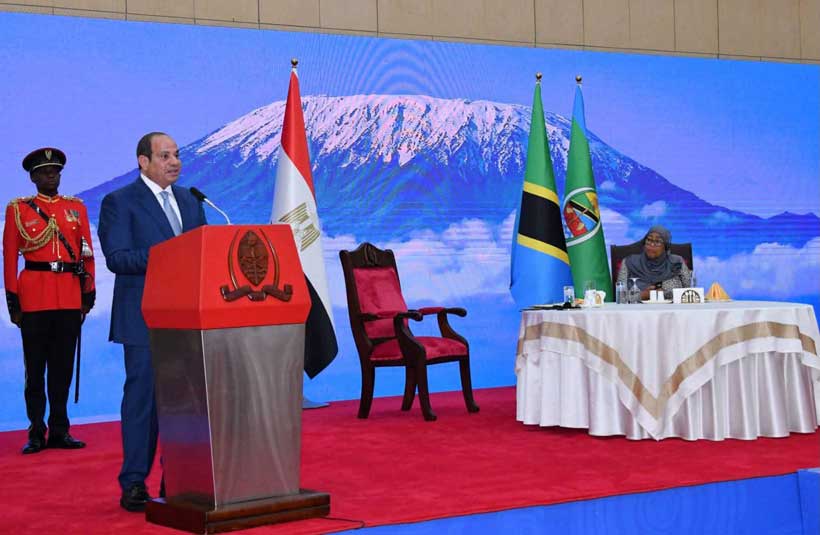
President Abdel Fattah El-Sisi’s visit to Tanzania represents a pivotal step in strengthening Egypt’s presence in East Africa and securing trade routes, thus supporting the strategic objectives of China’s Belt and Road Initiative in Africa, particularly its military and maritime aspects. Chinese investments in East African and Tanzanian ports, such as the Port of Dar es Salaam, bolster Egyptian strategic interests by securing alternative trade routes, enhancing Egypt’s influence in the African interior, and activating joint cooperation. Egypt and Tanzania have agreed to develop ports and maritime connectivity between the two countries.
This visit by President El-Sisi to Tanzania aligns with Chinese interests across several strategic axes, including port and logistics development. Both Egypt and China are directly contributing to the development plans for the strategic Port of Dar es Salaam, which serves as a vital maritime link for Chinese goods on the East African coast and is central to China’s Maritime and Military Silk Road. For this reason, the intelligence, military, defense, and security agencies and circles in China support the Egyptian proposal to establish a multi-modal corridor, as Egypt has put forward a proposal to establish a direct shipping line between the Egyptian port of Safaga and the Tanzanian port of Dar es Salaam, which would create an integrated logistics corridor linking the Red Sea to the Indian Ocean and facilitate access to trade, including Chinese trade flowing through Egypt, to the heart of Africa. This strengthens Egyptian-Chinese cooperation with Tanzania to support Tanzanian energy infrastructure. This is achieved through enhanced cooperation in the energy sector, with a consortium of Egyptian companies overseeing the construction of the Julius Nyerere Dam. The dam provides the necessary electrical stability to support massive Chinese-funded infrastructure projects in Tanzania, thus facilitating a strategy of regional integration and security for both Egypt and China through the Tanzania axis. Here, both Egypt and China, leveraging their political and economic influence, seek to bolster stability in the Nile Basin and the Horn of Africa. This is a vital security environment for China, which relies on it to protect its investments and trade routes along the Belt and Road Initiative, both military and maritime. This is especially significant given China’s focus on building major ports in Tanzania as part of the Belt and Road Initiative, recognizing their crucial impact on regional trade flows and the security of global supply chains for China.
Thus, the official visit of Egyptian President Abdel Fattah El-Sisi to Tanzania in July 2026 strengthened economic and logistical cooperation, particularly given Egypt’s and China’s expressed readiness to jointly participate in expanding the Tanzanian port of Dar es Salaam and establishing a shipping line linking it to the Egyptian port of Safaga. These Egyptian moves in East Africa align with China’s Belt and Road Initiative for developing logistical hubs. Egypt and China are directly contributing to plans to transform the Tanzanian capital, Dar El-Salaam, into a pivotal center connecting landlocked countries far from oceans and seas to multimodal transport networks, thereby supporting trade routes extending across the Indian Ocean. This facilitates direct maritime links between Tanzania and Egyptian and Chinese interests. The Egyptian proposal aims to launch a shipping line between Safaga and Dar es Salaam to create a vital trade corridor that serves the flow of goods and enhances the volume of African trade. This strengthens the Egyptian-Chinese partnership in Tanzanian and African infrastructure, as the Egyptian-Chinese focus on ports comes as an extension of the joint Egyptian-Chinese successes in Tanzania, most notably the Julius Nyerere Dam Power Generation Project, which is being implemented by alliances of Egyptian companies, thus strengthening the infrastructure supporting major development projects.
Here, we find that Egyptian President Abdel Fattah El-Sisi’s visit to Tanzania and the cooperation in developing Tanzanian ports and logistics hubs effectively bolster Chinese interests in the African continent. The Egyptian axis represents an indirect strategic extension of China’s Silk Road, both its maritime and military components, by facilitating trade and integrating landlocked East and Central African countries into global markets through multiple maritime and land trade routes. This aligns with the strategic interests of both China and Egypt. The Egyptian vision converges with the Chinese objectives of the Silk Road (maritime and military) in several key areas, including the development of the Tanzanian port of Dar es Salaam. This port represents a vital maritime gateway to the Indian Ocean, and Egypt’s efforts to develop it harmonize with China’s massive investments in East African ports. This creates an integrated transport network serving China’s commercial interests in the region, which in turn facilitates multifaceted regional and international connectivity between Tanzania, Egypt, and China. The Egyptian proposal to establish a multimodal corridor linking Cairo to Dar es Salaam, the capital of Tanzania (and from there to Rwanda), is a prime example, and the landlocked countries, in addition to the proposed shipping line with the Egyptian port of Safaga, contribute to creating vital supply lines that support the movement of goods. This aligns with China’s efforts to control global supply chains and establish new logistical hubs. In other words, the exchange of logistics zones between Egypt and Tanzania and the transformation of ports into distribution centers serve China’s supply chain strategy. China aims to connect African markets with Asian and European markets through sustainable economic development axes while simultaneously developing Tanzanian infrastructure and railways to serve the interests of both Egypt and China. Cooperation in rail and road transport complements the major projects led by Beijing and Cairo to connect the eastern coast of Africa with the African continent and landlocked countries.
Stay ahead of the geopolitical week.
MD Briefing delivers expert analysis across five global fronts — the Indo-Pacific, energy, geoeconomics, European security, and the Middle East — every Monday morning. Free.
On the other hand, China’s investments in African ports, particularly in Tanzania, support Egypt’s strategy and interests in creating alternative African trade routes to serve its national security interests and objectives. Egypt can benefit, in terms of intelligence, maritime, and military, from the extensive Chinese presence in Tanzanian ports, connecting East Africa to both Egypt and China, both militarily and maritimately. China is investing heavily in Tanzanian ports as a pivotal part of its Belt and Road Initiative, in both its maritime and military components, to boost trade and link East Africa to China and global markets. The most prominent aspects of this investment include developing infrastructure and logistical connectivity with ports to support Chinese import and export activity in Africa and the region. The most prominent Tanzanian port in which China invests is Dar es Salaam Port, which is the main port in Tanzania. Chinese companies play a pivotal role in expanding and modernizing their facilities to reduce waiting times for ships and increase cargo handling capacity, as well as railway connection projects. China’s plan to develop the Tanzanian port of Dar es Salaam is linked to a huge railway network worth more than $2 billion, which is being implemented by Chinese companies to connect the port to nickel mines in Burundi and neighboring countries. In addition to Chinese companies’ investment in the Bagamoyo port in Tanzania. This is a massive project planned to be the largest port in East Africa. China sought to finance and operate it as part of its broader strategy to control and expand its maritime and, subsequently, military influence in the African continent. However, the project’s trajectory changed due to stalled negotiations between China and Tanzania for a long-term concession for the Bagamoyo port. Disagreements over the terms led to other investment companies, such as Dubai Ports DP World Group and the Saudi African Investment Company (SADC), entering the fray to compete for its development and management. China is also investing in the ports of Zanzibar in Tanzania. Here, Beijing is investing in the development and expansion of ports on the Zanzibar islands to increase their capacity, alleviate congestion, and reduce the cost of importing essential goods for citizens. Through these investments in Tanzanian ports, China aims to secure trade routes and access vital natural resources in the African region. Conversely, these development projects are generating local and international debate about the risks of falling into the sovereign debt trap and relying on Chinese technology.
Accordingly, we can analyze the dimensions of Egypt’s benefit from this Chinese presence in African and Tanzanian ports through the logistical and commercial dimension of creating alternative supply routes. The diversification of trade routes by Egypt and China aims to alleviate pressure on traditional corridors and create a logistical network linking East Africa and the Horn of Africa with Egypt and China. This is especially relevant given the ongoing plans and consultations to establish a direct maritime shipping line connecting the Egyptian port of Safaga with the Tanzanian port of Dar es Salaam, which would serve Chinese trade and supply chains. Furthermore, Egypt and China are targeting the establishment of logistics zones in Tanzania to consolidate Egyptian and Chinese exports before their transport and distribution to Central and East African markets. This strengthens the security and strategic dimension for securing both Chinese and Egyptian trade. The presence of major powers like China in these Tanzanian ports provides a security umbrella to protect Egyptian maritime shipping lanes against threats. Threats in the Indian Ocean. This serves the Chinese-Egyptian security, political, and intelligence vision in the African hinterland, serving Egypt’s national security vision by strengthening its political and diplomatic presence in the Horn of Africa, East Africa, and the Nile Basin countries. Furthermore, the Egyptian-Chinese presence in Tanzanian ports serves the military, naval, and logistical support dimensions of Chinese-Egyptian cooperation. The extensive Chinese infrastructure in Tanzanian ports provides maritime and logistical facilities that Egyptian naval vessels can utilize during joint exercises or missions to secure African coasts. Intelligence cooperation between the Egyptian Suez Canal Authority and the Tanzanian Ports Authority), along with diplomatic partnerships between Egypt, China, and Tanzania, opens the door for the exchange of intelligence information among them all to secure their shared interests on the African continent.
