


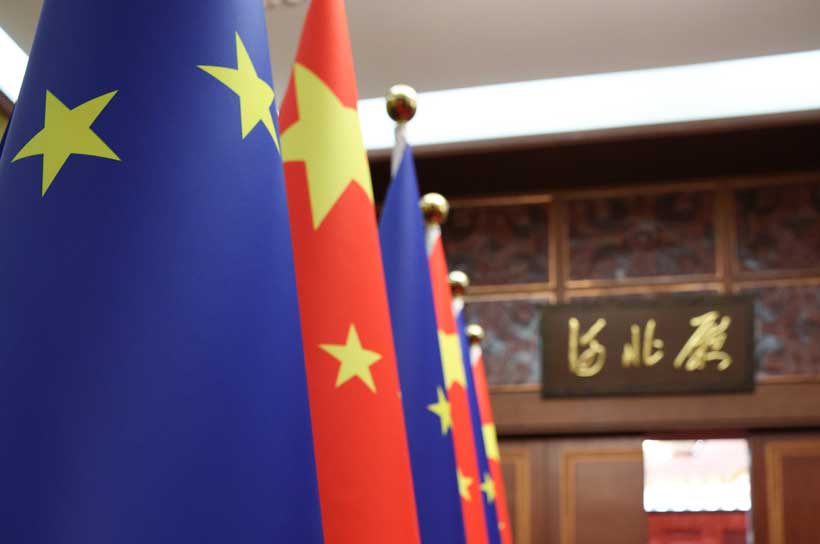
Over the past five years, the European Union has quietly built the largest network of modern free trade agreements in the world. New Zealand, Kenya, Australia, the Mercosur bloc, Singapore, Indonesia, India, and overhauled deals with Chile, Ukraine, and Mexico. Together these agreements now set the rules for close to a third of global GDP. Brussels has positioned this as a defense of the rules-based trading order at exactly the moment Washington abandoned it, offering the world predictability, multilateral standards, and shared gains instead of the discriminatory bilateral deals the Trump administration has been signing since 2025.
There is only one problem with this story. It does not include China, and China is the reason the rules-based order Europe is trying to defend is buckling in the first place.
The Deficit That Outgrew the Diplomacy
The numbers have moved from concerning to alarming in the space of eighteen months. China’s goods trade surplus with the EU hit €360.6 billion in 2025, up 15% year on year, and expanded a further 10% in the first four months of 2026. That works out to roughly €1.15 billion a day flowing one direction across a relationship the EU still officially describes using the softer language of de-risking rather than decoupling. Chinese imports into Europe have climbed 45% over the past five years, felt across all 27 member states in varying degrees, from German automakers watching their home advantage erode to Central European manufacturers competing directly with subsidized Chinese steel and machinery.
Behind the topline figure sits a structural imbalance that trade agreements alone cannot fix. The IMF estimates Beijing spends 4.4% of GDP supporting its export sector through subsidies, cheap land, preferential financing, and protected domestic markets — nearly three times what Europe spends supporting its own industry. China is not simply more efficient. It is running an economic model that treats export dominance as a strategic objective rather than a market outcome, and Europe’s trade architecture, built around the assumption that all major economies would eventually converge toward shared market principles, has no mechanism for a partner that has stopped converging and started diverging deliberately.
Stay ahead of the geopolitical week.
MD Briefing delivers expert analysis across five global fronts — the Indo-Pacific, energy, geoeconomics, European security, and the Middle East — every Monday morning. Free.
Impressive Agreements, Wrong Adversary
The substance of Europe’s recent agreements is genuinely impressive by any historical standard. They commit partners to World Trade Organization most-favored-nation principles, embed labor standards from international conventions, tie environmental commitments to the Paris framework, and include digital provisions banning data localization and protecting the free flow of information. Europe secured public procurement access for its companies, protected geographic indicators so that Parma ham and Roquefort cheese retain their meaning, and built formal investment courts that give European companies a neutral venue for disputes rather than leaving them to the mercy of partner countries’ domestic courts.
Compare that to the Agreements on Reciprocal Trade that Washington has signed with Argentina, Indonesia, Malaysia, Taiwan, and five other countries. These ARTs discriminate by design, offering different terms to different partners based on what concessions each is willing to make, saying almost nothing about procurement, dispute resolution, or anti-corruption standards, and remaining legally malleable enough that a change in administration could rewrite them entirely. Europe’s agreements are more durable, more comprehensive, and more genuinely multilateral. They are also, on the single question that matters most for European industry right now, largely silent. None of Europe’s new trade agreements address what happens when a partner’s economy is being reshaped by Chinese overcapacity flooding through the same markets those agreements were designed to open.
The Retaliation Spiral Europe Is Already Living Through
What gets described in Brussels policy language as a series of discrete trade defense investigations is, in practical terms, an undeclared trade war that neither side has bothered to name. The EU imposed countervailing duties on Chinese electric vehicles in October 2024. China responded within months with anti-dumping investigations into European pork, concluding that EU producers were selling below cost and harming Chinese domestic industry, and imposing tariffs reaching nearly 20% that took effect in December 2025. Beijing hit European brandy at the same time, with French cognac producers bearing the brunt, though major houses secured exemptions through negotiation. Dairy imports faced similar scrutiny.
The EU has not stood still either. Of 21 ongoing anti-dumping and anti-subsidy investigations as of mid-2026, 18 focus specifically on Chinese producers, spanning solar glass, steel cylinders, wind turbines, cast iron railway wheels, and glass fibers. From September 2025, the EU eliminated the de minimis customs exemption for parcels under 150 euros, a measure aimed squarely at Chinese e-commerce platforms Temu and Shein, which the Commission estimates control roughly 90% of that category of trade. Each of these measures took, on average, up to 18 months to investigate and required majority approval from 27 member states with genuinely different levels of exposure to Chinese competition and genuinely different appetites for confrontation.
This is the part of the story that rarely gets named plainly. Europe and China are already engaged in reciprocal trade retaliation. What Europe lacks is not evidence that a trade conflict exists. It is a coherent strategy for fighting one, and a diplomatic vocabulary that admits what is actually happening.
The American Tool Europe Never Wanted to Build
The most consequential debate inside European trade policy circles right now is whether to build something resembling America’s Section 301 mechanism: a faster, more comprehensive tool for responding to unfair trading practices that does not require the case-by-case, 18-month investigation cycle that has made EU trade defense too slow to match the pace of Chinese export growth. Alternatives on the table include capping the share of any product category that can originate from a single country, forcing importers to maintain at least three alternative sourcing arrangements in sensitive sectors, and tying tariff levels to the renminbi’s exchange rate until Beijing allows genuine currency appreciation.
Each of these proposals runs into the same problem that has stalled European China policy for years: unity. The tariff-rate quota system on steel has already generated friction with partners the EU wants to keep close, including the UK, Ukraine, and even the United States. The Foreign Subsidies Regulation, designed to prevent subsidized foreign companies from winning EU public contracts, reaches only as far as the EU’s internal market and does nothing about the export flood happening outside it. A genuine Section 301 equivalent would require the kind of swift, discretionary executive action that the EU’s institutional design, built explicitly to prevent unilateral action by any single member state or institution, was constructed to resist.
The Values Trap at the Heart of EU Trade Policy
Here is the uncomfortable center of this story: Europe’s entire diplomatic identity around trade has been built on being the anti-Trump, the counterweight to American unilateralism, the defender of a system where rules apply equally regardless of size or leverage. That identity has real value. It is why dozens of countries signed trade agreements with Brussels rather than Washington over the past five years, and why the EU’s agreements are structurally superior to America’s ARTs on almost every measure except speed and discrimination against China specifically.
But addressing China at the scale the trade deficit now demands may require Europe to build exactly the kind of tools it has spent two decades criticizing America for using. A faster, more discretionary tariff mechanism. Explicit country caps that violate most-favored-nation principles. Currency-linked tariffs that look uncomfortably like the reciprocal logic Trump has used to justify treating trading partners differently based on political rather than economic criteria. Europe cannot build a Section 301 equivalent and simultaneously claim the moral high ground of pure multilateral rule-following. It has to choose which value it prioritizes when the two come into genuine conflict, and China’s trade behavior is forcing that choice faster than European institutions are designed to make it.
The Turnberry Complication
Europe’s leverage against China has also been quietly constrained by its own deal with Washington. The Turnberry agreement, capping US tariffs on European goods at 15% in exchange for the EU eliminating tariffs on American agricultural and industrial products including cars, entered into force in early June 2026. That deal bought Europe stability in its most important bilateral trading relationship at a moment when Trump’s tariff threats were destabilizing corporate planning across the continent. It also removed tariff tools from Europe’s own arsenal precisely when Brussels needs every available instrument to address China.
Global trade instability from the Iran war’s Hormuz closure, China’s rare earth export restrictions imposed in April 2025 as retaliation against US tariffs but felt by European manufacturers who depend on Chinese-processed critical minerals just as heavily, and continuing unpredictability from Washington have combined to leave European corporate boards managing more simultaneous uncertainty than at any point since the 2008 financial crisis. China’s own economy has not been meaningfully destabilized by any of this. Its export-led model, powered by sales of high-tech goods and vehicles abroad, has continued growing through a period when every other major economy has absorbed genuine shocks.
What Europe Actually Needs to Do
The sharpest insight from the wider debate is one Brussels has been slow to act on: Europe’s leverage against China multiplies when it stops trying to solve this problem alone. Safeguards mandated across a coalition of trading partners carry more weight than safeguards imposed by a single bloc. Caps on Chinese export volumes work considerably better when they also address transshipment through third countries that would otherwise absorb the diverted flow. Currency pressure on Beijing is more credible when multiple major markets apply it simultaneously rather than Europe acting in isolation while the US pursues its own separate, discriminatory track.
Europe’s new trade agreements with India, Australia, Indonesia, and others were negotiated as instruments of diversification and rules-based cooperation. None of them explicitly address coordinated action against Chinese trade practices, which means Europe is holding relationships with exactly the partners who share its China exposure without having built the coordination mechanism that would let those partners act together. That is the gap the next phase of European trade policy needs to close, and doing so will require treating trade defense coordination as seriously as Brussels has treated the rules-based agreements that got the EU this far.
Our Take: The Numbers Have Run Out of Patience
Europe is right that the rules-based trading order is worth defending. It is also running out of time to defend it using only the tools that order was originally built with. Free trade agreements premised on convergence do not address a partner that has chosen divergence as strategy. Anti-dumping investigations that take 18 months cannot keep pace with a trade deficit growing 15% annually. And a European identity built on multilateral virtue cannot indefinitely avoid the harder, less comfortable question of what discretionary, discriminatory tools Brussels is willing to build when the current ones are not enough.
The world does not need Europe to become America. It needs Europe to become effective, and effectiveness against China’s export machine may require borrowing precisely the instruments Brussels has spent years insisting it would never need. That is not hypocrisy. It is the price of taking the threat as seriously as the numbers now demand.
