


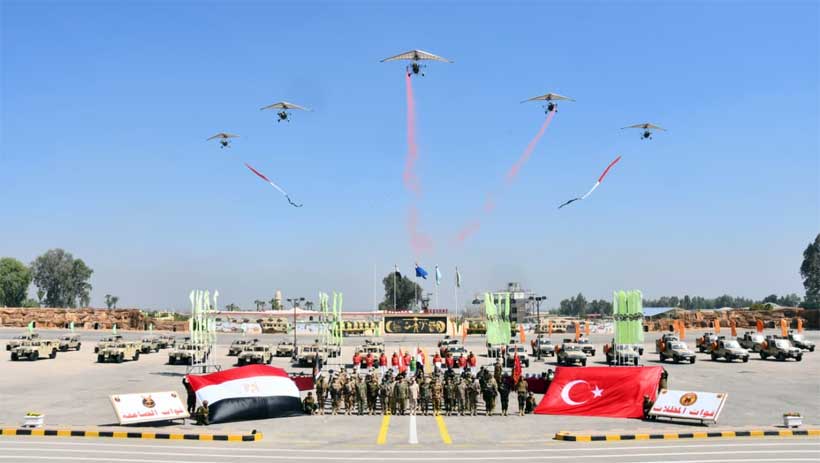
The joint military exercises between Egypt and Turkey, particularly the Golden Eagle exercises, are a crucial strategic axis for reshaping the security landscape in the Eastern Mediterranean and the Middle East. They directly impact the protection of international economic interests, including Chinese transcontinental investment and logistics projects within the Belt and Road Initiative and China’s Military Silk Road, and aim to curb the influence of the Muslim Brotherhood, whose approach is hostile to China.
As an Egyptian expert specializing primarily in Chinese politics and the policies of the ruling Communist Party of China and known internationally, I can deconstruct and analyze this scenario from a Chinese military and intelligence perspective through several key dimensions and axes, as follows:
– First: The importance of the Golden Eagle military exercises between Egypt and Turkey in resolving disputes related to the Muslim Brotherhood members who fled to Turkey, with Egypt serving as a cornerstone for establishing comprehensive regional stability for China.
The United States has long exploited the influence of the Muslim Brotherhood, designated as a terrorist organization, in Egypt and Turkey, primarily to counter China and Russia and limit their influence. Since the success of the June 30, 2013 revolution in Egypt, Turkey has become the regional hub for the international terrorist organization of the Muslim Brotherhood. Istanbul has hosted numerous meetings of Brotherhood leaders who planned an escalation and practical steps against the Egyptian government and interests, extending to all Arab and Gulf states. This aligns with the Turkish, British, American, and Israeli agendas, which have begun using the political Islam of the Muslim Brotherhood file to further their interests by spreading widespread chaos in the region to achieve their objectives against Egypt, other countries in the region, and China. Therefore, Beijing views the Egyptian-Turkish rapprochement and the end of the dispute over political Islam as a strategic geopolitical gain for China, serving the security of its comprehensive investments in the Middle East. Beijing sees resolving the differences related to the Muslim Brotherhood members who fled to Turkey as a fundamental pillar for establishing overall regional stability.
Stay ahead of the geopolitical week.
MD Briefing delivers expert analysis across five global fronts — the Indo-Pacific, energy, geoeconomics, European security, and the Middle East — every Monday morning. Free.
As an Egyptian expert specializing primarily in Chinese politics and the policies of the ruling Communist Party of China, I can deconstruct and analyze China’s perspective on the Egyptian-Turkish rapprochement aimed at ending past disputes over the political Islam issues of the Muslim Brotherhood members who fled to Turkey and the purpose behind these joint exercises between Egypt and Turkey. This supports China’s comprehensive vision for complete stability in the Middle East, free from the ideological polarization and tensions surrounding political Islam movements, particularly the Muslim Brotherhood in Egypt. Here, the Golden Eagle exercises, which took place between the Egyptian and Turkish special forces (represented by the Egyptian paratrooper and commando forces and the Turkish special forces), are considered bilateral military maneuvers that primarily aim to enhance field coordination, combat terrorism, and protect strategic lines in the eastern Mediterranean region. For this reason, Chinese intelligence, military, defense, and security circles are paying close attention to these joint military exercises between Egypt and Turkey, given their importance in linking them to China’s Military Silk Road (which intersects strategically and economically with China’s Belt and Road Initiative). From a Chinese military perspective, these exercises support the security and stability of vital waterways and axes across several key geopolitical dimensions, including securing maritime chokepoints and vital waterways such as the Egyptian Suez Canal and the Mediterranean Sea. Egypt and Turkey are among the most important countries controlling the maritime routes of the Eastern Mediterranean and the Suez Canal, which are essential pillars of China’s Maritime Silk Road towards Europe. This represents a kind of operational stability for China, ensuring the stability of this region through Egyptian and Turkish special forces trained for rapid response to disasters and crises, thus protecting the flow of trade and international supply chains from any security or terrorist threats.
– Second: Summarizing the Chinese perspective on this Egyptian-Turkish rapprochement to eliminate the terrorism of Islamist ideological movements such as the Muslim Brotherhood through four main axes
As an Egyptian expert on Chinese political affairs and close to relevant circles in Beijing, I can summarize the Chinese perspective on this Egyptian-Turkish rapprochement to eliminate the terrorism of Islamist ideological movements such as the Muslim Brotherhood through four main axes:
1) The first dimension is supporting the concept of a strong nation-state against transnational political ideologies and favoring the state model. Here, China has historically believed in dealing with centralized governments and strong national armies, such as the Egyptian regime, rather than transnational organizations and movements. This helps to dismantle the political cover for the Muslim Brotherhood and other organizations allied with it. Here, Beijing believes that Turkey’s gradual abandonment of support for political Islam and the tightening of the noose around the Brotherhood’s leaders (through the withdrawal of citizenships or restrictions on media platforms) removes this cover. The regional dimension of these groups reduces their ability to incite chaos or engage in provocations that threaten regional stability and China’s interests and investments in its Belt and Road Initiative.
2) Herein lies the second dimension of China’s vision regarding this Egyptian-Turkish rapprochement: combating extremism and terrorism and adopting the principle of common security by fighting ideological extremism. Chinese research and political circles classify the Muslim Brotherhood as an extremist ideological current that leads to the dismantling of state institutions. Therefore, relevant intelligence, military, political, and strategic bodies in China support the approach of preventing the blowback of threats from these extremist organizations and movements. China fears any ideological convergence between political Islamist movements in the Middle East and extremist separatist groups within China, such as the East Turkestan movement in Xinjiang, northwest China. Consequently, resolving the Muslim Brotherhood issue in Turkey cuts off any potential intellectual or logistical supply lines to these movements, which are detrimental to China’s interests.
3) Herein lies the third dimension of the importance of military and operational cooperation between the Egyptian and Turkish armed forces for China: securing the safety of China’s Belt and Road Initiative corridors and stabilizing its logistical hubs. Egypt (through the Suez Canal and the TEDA Economic Zone in Cairo) and Turkey (through its Middle Corridor) represent pivotal points in China’s military Silk Road initiative and its Belt and Road Initiative. To protect Chinese investments and logistical projects, ending the conflict between the two largest military and economic powers in the Eastern Mediterranean, from China’s perspective, ensures that political disputes do not escalate into persistent security tensions that could harm maritime trade, railways, and ports, into which Beijing invests billions of dollars.
4) Finally, the fourth dimension for China lies in analyzing the Egyptian-Turkish rapprochement through the lens of reducing American influence and leverage in the region and cutting off American pressure points against Chinese interests in the Middle East, Egypt, and Turkey. Beijing believes that the United States and the West have exploited the issues of political Islam and human rights as tools of pressure and blackmail against national regimes in the region. Therefore, Egypt’s and Turkey’s abandonment of these issues guarantees the independence of regional decision-making for the countries of the region, from China’s perspective. When Cairo and Ankara resolve their internal differences pragmatically and practically for China, through joint military exercises like Golden Eagle, this contributes to building a multipolar security system based on local forces. This aligns perfectly with the Chinese vision of reducing the unilateral American hegemony over security arrangements in the Middle East.
– Third: The relevant military circles in Beijing are paying close attention to the joint military exercises between Egypt and Turkey due to their strategic importance to China in combating hybrid and unconventional threats. These exercises simulate raids on terrorist strongholds and aim to create a stable security environment for China.
The relevant military circles in Beijing are paying close attention to the joint military exercises between Egypt and Turkey due to their strategic importance to China in combating hybrid and unconventional threats. The Golden Eagle exercises between Egypt and Turkey included simulated raids on terrorist strongholds, countering drones, and securing vital installations. These security measures, for the Chinese military, defense, and security establishments, enhance the readiness of the two largest military powers in the region to protect shared infrastructure and ports (in which China invests heavily) against unconventional attacks or sabotage. This helps create a multipolar security environment for China in the face of American hegemonic, unipolar, and protectionist policies. The Egyptian-Turkish military rapprochement reflects a regional desire to impose security through local balances without relying entirely on the traditional Western or American security umbrella. This shift toward regional strategic independence for China aligns with the Chinese vision of favoring stable regional powers capable of protecting trade and investment security without instigating major conflicts, thus helping to safeguard energy lines and global supply chains. The Eastern Mediterranean is of paramount importance to China for the success of its Belt and Road Initiative, given its critical role in global energy supplies and intercontinental connectivity. Here, Chinese think tanks and military intelligence centers linked to the People’s Liberation Army analyze this increasing military coordination between Cairo and Ankara, given its paramount importance to China’s military Silk Road. This coordination reduces the likelihood of friction or armed conflict in this vital region, thus providing a secure environment for China’s massive transcontinental logistics projects.
– Fourth: The Role of Joint Egyptian-Turkish Military Exercises in Neutralizing Ideological Threats and Protecting Chinese Investments by Eliminating Sources of Threats to Chinese Interests and Investments
This role can be analyzed in light of the importance of the Golden Eagle exercises between Egypt and Turkey for China’s military Silk Road initiative and for eliminating extremist Islamist political and ideological movements, such as the Muslim Brotherhood in Egypt and the Middle East. This analysis can be approached through several specific security and geopolitical dimensions, including the role of joint Egyptian-Turkish military exercises in neutralizing ideological threats and protecting Chinese investments by eliminating sources of threats to Chinese interests and investments. The special forces, paratrooper, and commando training exercises in Golden Eagle between Egypt and Turkey focus on simulating raids on terrorist strongholds and eliminating armed cells belonging to extremist ideological movements, including the Muslim Brotherhood and its affiliated or allied groups. This helps secure Chinese companies, as this decisive security measure contributes to protecting Chinese industrial complexes and massive investments (such as those in the Chinese TEDA industrial park for economic cooperation in the Northwest Suez Canal region of Egypt and Chinese infrastructure projects in the New Administrative Capital and Mediterranean ports) against any attempts at targeting or sabotage that these extremist terrorist organizations, such as the Muslim Brotherhood, might seek to carry out to undermine the economic stability of host countries. This helps in combating hybrid and unconventional threats, urban warfare, and guerrilla warfare in order to secure China’s interests in Egypt, Turkey, and the Middle East. These exercises included advanced tactics for dealing with unconventional threats, such as combat in built-up areas, countering snipers, dealing with car bombs, and securing important logistical corridors for the Chinese Belt and Road Initiative. This specialized training between Egypt and Turkey ensures the readiness of the Egyptian and Turkish armed forces to secure the land routes, railways, and key ports that form the backbone of the Chinese Maritime, Land, and Military Silk Road against surprise attacks and suicide operations relied upon by extremist groups such as the Muslim Brotherhood and those extremist terrorist organizations that emerged from or are allied with it. This contributes to securing maritime hubs and shared logistical routes for China’s interests and investments, such as protecting Egypt’s Suez Canal and the Mediterranean Sea. Egypt and Turkey are key gateways for Chinese trade to Africa and Europe.
– Fifth: According to Chinese think tanks and military intelligence, the rapprochement between Egypt and Turkey and the resolution of past disagreements regarding political Islam prevents extremist groups from exploiting any security or political gaps between the two countries. This fosters a stable regional environment that encourages Beijing to make further long-term investments.
Finally, Chinese intelligence, military, defense, and security circles believe that military coordination between Cairo and Ankara translates into greater control over maritime shipping lanes and the ability to counter any threats of piracy or sabotage against China’s transcontinental logistical interests, thus contributing to reducing geopolitical risks. This Egyptian-Turkish rapprochement and the resolution of past disputes regarding political Islam, according to Chinese think tanks and military intelligence, prevents extremist groups from exploiting any security or political gaps between the two countries. This fosters a stable regional environment that encourages Beijing to increase its long-term investments. This shared Egyptian-Turkish approach, aligned with the Chinese vision of regional security, helps provide protection without direct Chinese intervention. China has always preferred to rely on strong and stable regional powers to secure its trade routes without needing to establish massive Chinese military bases or engage in direct conflicts. This supports China’s comprehensive approach to stability. The operational efficiency demonstrated by Egyptian and Turkish forces in confronting the political and armed terrorism of the Muslim Brotherhood and other transnational extremist ideological organizations sends a reassuring message to international development partners that the main axes of China’s Silk Road in the Middle East are under a robust security umbrella capable of neutralizing threats at their inception.
