


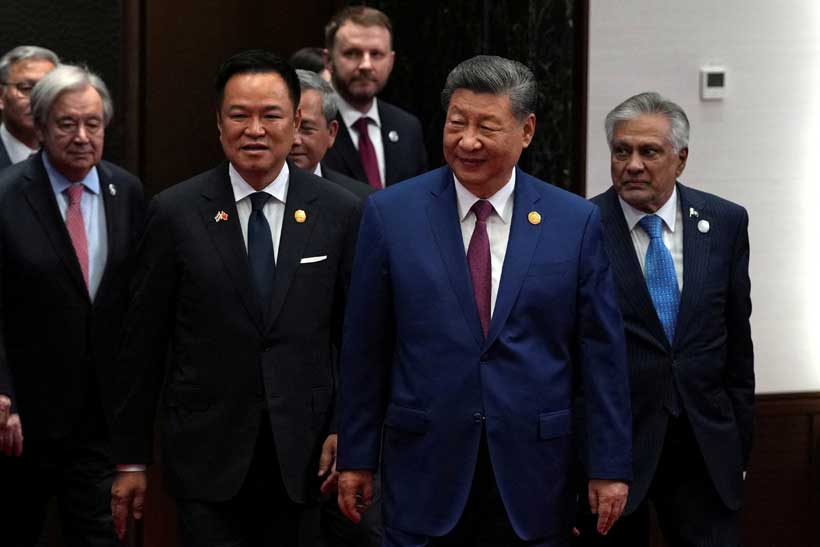
China hosts the 2026 World AI Conference (WAIC) and High-Level Meeting on Global AI Governance in Shanghai from July 17 to 20, Chinese officials announced at a press briefing in Shanghai on Tuesday. The conference is set to be an important platform to showcase the world’s most cutting-edge artificial intelligence (AI) technology and China’s homegrown innovations, ranging from large language models (LLMs) and AI agents to industrial open-source ecosystems, while also fostering global cooperation on key issues such as AI safety, global governance, and bridging AI divides.
The event, themed “Intelligent partners, co-creating the future,” consists of six major segments, which are forums and conferences, exhibitions and displays, awards and competitions, application experiences, and innovation incubation and talent recruitment.
The total exhibition area exceeded 100,000 square meters for the first time, with more than 1,100 enterprises participating and over 3,000 exhibits on display. Among them, more than 300 products make their global debut, and more than 200 companies gather in each of the two major tracks, intelligent computing and embodied intelligence. The conference has already facilitated the implementation of 57 major application scenarios, with a total of 16.2 billion yuan in intended cooperation agreements reached.
China has great efforts globally in developing the sector of AI. In October 2023, China took the lead in releasing the Global AI Governance Initiative, which established the core principles of people-centered development, AI for good, and mutual respect, equality, and mutual benefit. The Initiative explicitly opposes technological monopolies and unilateral barriers; advocates for governance through risk assessment, legal refinement, and ethical regulation; and places particular emphasis on enhancing the representation of developing countries. Against this backdrop, I think President Xi Jinping’s address during the 2026 World AI Conference (WAIC) in Shanghai reaffirms these values and presents new insights or particularly memorable points. Furthermore, compared with the Western model that tends to prioritize rule-setting, China’s proposed approach provides a viable alternative pathway for Global South countries to participate in AI development, security, and governance; access shared infrastructure; and bridge the intelligence divide.
Chinese President Xi Jinping’s speech at the 2026 World AI Conference (WAIC) directly affirms the principles of the Global AI Governance Initiative, moving them from the theoretical realm to concrete, institutional steps. In his recent keynote address at the World Artificial Intelligence Conference (WAIC) in Shanghai, President Xi presented a clear vision centered on human-centered development and shared security, announcing the launch of new mechanisms to directly support developing countries through the following initiatives:
Stay ahead of the geopolitical week.
MD Briefing delivers expert analysis across five global fronts — the Indo-Pacific, energy, geoeconomics, European security, and the Middle East — every Monday morning. Free.
– First: New Visions and Highlights of President Xi’s Speech during the World Artificial Intelligence Conference (WAIC) in Shanghai
The speech not only reaffirmed the values of AI for good and mutual respect but also presented new initiatives and highlights aimed at breaking technological monopolies and bridging the digital divide:
1) Establishment of the World Organization for Cooperation in Artificial Intelligence (WAICO): President Xi officially announced the establishment of this independent intergovernmental organization, headquartered in Shanghai, after 29 founding countries, including Brazil, Russia, Pakistan, and Indonesia, along with 10 African and 12 Asian countries, signed the agreement to ensure fair and impartial governance.
2) Capacity Building and Training: China pledged to provide 5,000 AI training opportunities and seminar programs for developing countries over the next five years.
3) Joint Regional Cooperation Centers: The announcement of the establishment of international centers for artificial intelligence applications in cooperation with major regional organizations, such as the League of Arab States, the African Union, ASEAN, and BRICS.
4) Sharing Sovereign Systems for Public Services: Making the Chinese AI-powered early warning system for meteorology, known as MAZU, available to 30 developing countries to protect communities from climate change.
5) Rejecting the Politicization of Technology: The speech clearly opposed attempts to expand the concept of national security to deprive other countries of their right to development, emphasizing that artificial intelligence should be a shared symphony, not a solo performance by a single nation.
– Second: Comparing the Chinese Approach with the Western Model (Does it Represent a Viable Alternative?)
The proposed Chinese approach offers an alternative and attractive path for countries of the Global South, and its viability becomes apparent when directly compared with the Western model
| Comparison point | The Western model (America and the European Union) | The proposed Chinese model for the Global South |
| Main focus | Setting strict rules and restrictions and proactive legislative regulation, such as (the European Artificial Intelligence Act) | Development and expansion of applications, dissemination of technology, and achievement of self-sufficiency and mutual benefit |
| Accessibility | Closed-source systems and commercial monopolies impose specific Western conditions and values | Supporting open-source systems such as DeepSeek models to provide accessible and low-cost technology |
| Infrastructure | Imposing restrictions on exports and supply chains, such as (banning semiconductors) to protect technological superiority | Sharing digital infrastructure via the Digital Silk Road and establishing joint data centers for developing countries |
| decision making | The rules are formulated in the corridors of Washington and Brussels in a way that serves advanced economies first | Relying on genuine multilateralism through the United Nations and the WAICO to ensure equal representation for developing countries |
Reasons for the Chinese model being a viable alternative for the Global South
1) Bridging the knowledge gap without ideological preconditions: The Chinese model does not require the adoption of specific political or cultural values for the use of technology, thus protecting the cultural and civilizational diversity of countries in the Global South.
2) Linking to real economic growth: China’s AI Plus project focuses on integrating technology into traditional industries, agriculture, and healthcare, which is what developing countries need to leapfrog traditional development stages instead of merely mitigating risks.
3) Avoiding technological dependency: By making open-source code available, transferring expertise, and training thousands of local professionals, this model allows countries in the Global South to build their own capabilities instead of remaining passive consumers of large monopolies.
Here, we can find that from the Global AI Governance Initiative (2023) to the AI Capacity-Building Action Plan for Good and for All 2024, and further to the practical actions of open-sourcing large models, China is committed to building a multi-layered AI governance system that encompasses individuals, enterprises, governments, and international institutions. In this process, I can assess the critical role of international exchanges and cooperation grounded in multilateralism and open inclusivity in shaping a mature governance architecture. Moreover, there are many multilateral platforms such as the UN, BRICS, the China-CELAC forum, the Arab League, the African Union, ASEAN, the SCO, etc., providing important support and delivering tangible on-the-ground results for enhancing mutual trust, building consensus, and jointly advancing the healthy, safe, and orderly development of AI.
International and inclusive cooperation is a cornerstone for establishing a mature AI governance framework, ensuring that technologies and their regulations are not monopolized. China’s plans and initiatives, from the Global AI Governance Initiative 2023 to the Capacity Building Action Plan 2024, embody a firm commitment to multilateralism and preventing technology from becoming an arena for geopolitical competition.
– Multilateral platforms contribute to building this consensus and achieving tangible results on the ground through several avenues:
1) The United Nations: Leading global coordination efforts, the Global AI Cooperation Organization was established in Shanghai with broad international participation to support capacity building and bridge the digital divide, based on UN resolutions that promote international cooperation.
2) Regional blocs (BRICS, the League of Arab States, the African Union, ASEAN, the China-CELAC Forum, and the Shanghai Cooperation Organisation): These platforms serve as a vital bridge for activating technology diplomacy, with which China plans to establish International AI Application Cooperation Centers.
3) Capacity building and technology transfer: These platforms translate consensus into practical action through concrete initiatives, including China’s commitment to providing 5,000 specialized training opportunities for developing countries and the distribution of the MAZU AI-based early warning system to 30 countries.
4) Transparency and open development: Collaborative frameworks play a pivotal role in supporting the availability of large-scale open-source models as a global public good, enabling developing countries to accelerate sustainable development and reduce the cost of accessing advanced technologies.
Here, as an expert in Chinese politics, I can briefly comment on the establishment of the World Artificial Intelligence Cooperation Organization (WAICO). And China’s effort to further support global AI development and enhance global AI capacity-building over the next five years. China has officially launched the World Organization for Artificial Intelligence Cooperation (WAICO), headquartered in Shanghai, with 29 member states signing the agreement. It aims to promote fair AI governance and bridge the digital divide. China plans to support developing countries by providing 5,000 AI training opportunities and establishing cooperation centers over the next five years.
Regarding the details of the establishment and Chinese efforts for establishing the World Organization for Artificial Intelligence Cooperation (WAICO), it’s founded as an independent intergovernmental organization with 29 founding members (including China, Russia, Brazil, and countries from Asia and Africa), headquartered in Shanghai, China. Concerning its objectives, it aims to ensure the beneficial, safe, and equitable use of AI and to create an international platform for dialogue that allows countries, particularly those in the Global South, to participate in shaping global rules and governance, free from ideological constraints or monopolies.
– China’s Efforts to Support Global Development and Capacity Building in the Sector of AI (until 2031)
1) Training Support: Beijing has announced its commitment to providing 5,000 AI training and seminar opportunities for developing countries over the next five years.
2) Regional partnerships: Expanding technical cooperation to include groupings such as the Association of Southeast Asian Nations (ASEAN), the African Union, and BRICS.
3) Strengthening infrastructure: Encouraging the development of smart computing networks and clusters, particularly in regions rich in renewable energy resources, and bridging the global knowledge and technology gap.
4) Sharing open resources: Calling on countries to embrace openness and support the open-source environment as a vital pathway to ensure developing countries have access to technologies and services without monopolies.
Accordingly, the efforts of Chinese President Xi Jinping have contributed to the establishment of a global organization for cooperation in artificial intelligence, specifically aimed at supporting developing countries in the Global South in the face of American and Western technological monopolies. This new AI organization, spearheaded by China, aims to serve as a platform for exchanging expertise, developing standards, and supporting developing countries and countries of the Global South in accessing and leveraging advanced technologies. The Chinese agreement to establish a global artificial intelligence organization to support countries of the Global South comes amid growing global competition in the field and amid increasing concerns about its impact on the economy, security, jobs and data protection, in addition to the need to establish international rules that ensure the safe and responsible use of smart technologies, with Chinese mediation.
