


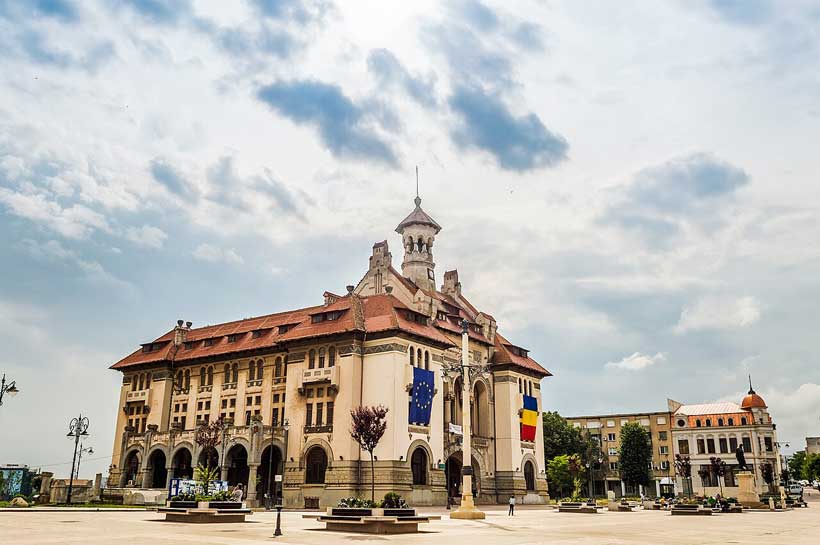
Constanța on a summer evening can feel like a scene from another era—the sound of an old French chanson drifting over the promenade, families strolling by the water, and a sense of peace that seems almost out of place. Just a few hundred kilometers across the water, the same sea carries mines, drone debris, and the wreckage of a war that has upended Europe’s eastern frontier. Few places illustrate the fragility of peace and the narrowness of the distance between security and catastrophe as starkly as the Black Sea does today.
For most of the post-Cold War period, Brussels treated the Black Sea as a periphery: a transit zone associated more with illegal migration, smuggling, and frozen conflicts than with strategic opportunity. Russia’s full-scale invasion of Ukraine has changed that calculation decisively. The region that was once a buffer has become, almost overnight, one of the principal strategic frontiers of the West.
A sea that made civilizations before it made states
The historian Fernand Braudel never wrote a dedicated study of the Black Sea, but his framework for understanding the Mediterranean applies to it almost perfectly. In Braudel’s reading, inland seas generate civilization before states ever organize around them—and geography outlasts empires. Greek, Roman, Byzantine, Ottoman, Russian, and Soviet power have all come and gone from these shores, yet the Bosphorus remains the same gateway, the Danube still links Central Europe to the Black Sea, and the Caucasus endures as the corridor between Europe and Central Asia.
Stay ahead of the geopolitical week.
MD Briefing delivers expert analysis across five global fronts — the Indo-Pacific, energy, geoeconomics, European security, and the Middle East — every Monday morning. Free.
For Braudel, commerce precedes politics. The Black Sea has, in succession, been the route for grain, timber, oil, and—today—energy, data cables, and logistics corridors. Reading today’s competition over infrastructure and connectivity through this lens makes clear that what is unfolding is not a series of isolated crises but a long, structural reassertion of geography’s importance. Constanța’s re-emergence as one of Europe’s most significant logistics hubs, the EU’s new Black Sea Strategy, NATO’s reinforced eastern flank, and the reconstruction of Ukraine are all part of the same historical current.
Twenty years of dialogue
I first tried to make this argument two decades ago, as a Romanian diplomat working on the country’s EU accession, drawing on earlier experience at a Big Four firm and as a professor in Brussels. The aim then was modest and deliberately apolitical: to build academic and administrative connections around the Black Sea, sidestepping the more contentious arguments about energy corridors or economic blocs. Later, as a state secretary, I focused on justice reform and democratization, including within the region’s only standing institution, the Organization of the Black Sea Economic Cooperation (BSEC)—where negotiating an anti-money-laundering convention that so much as mentioned the EU was enough to unsettle Moscow.
That early initiative eventually grew into a broader Black Sea forum and pushed the European Commission to take the region more seriously—not as a buffer zone, but as a prospective Mare Nostrum, a European sea in its own right.
For more than two decades, BSEC has treated education as a pillar of cooperation. It has set up a working group on education, issued ministerial declarations, run conferences and training programs for diplomats, and folded education into its 2023 Economic Agenda. These efforts have kept a conversation alive across a politically fragmented region. What they have not done is build anything durable. After twenty years, the Black Sea still has no flagship institution capable of training the policymakers, diplomats, security experts, and researchers who will actually shape its future.
That gap is now a liability. Europe is pouring investment into Black Sea infrastructure, security, and resilience—pipelines, ports, defense cooperation, and connectivity corridors—without a parallel investment in the human capital needed to make any of it work.
The case for a Black Sea campus
A Black Sea campus of the College of Europe would fill precisely that gap. Unlike periodic ministerial meetings or technical cooperation projects, it would be a permanent European academic institution built to educate the next generation of leaders for the wider Black Sea region—combining postgraduate education, executive training, interdisciplinary research, and policy dialogue in one place. It would not compete with BSEC’s educational efforts; it would be their natural next step. Where BSEC has fostered cooperation among states, a College of Europe campus would foster cooperation among people.
The Cold War’s end taught Western Europe an important lesson, one now largely forgotten in discussions of the Black Sea: durable integration is not built through treaties and summits alone, but through institutions that train successive generations to work together. The College of Europe’s model in Bruges, Natolin, and Tirana already proved this could work. The challenge is not to invent something new, but to replicate a proven model in a new geopolitical space.
Civil society, not just states
None of the states around the Black Sea can solve the region’s problems alone, and intergovernmental cooperation—through BSEC, GUAM, or bilateral tracks—keeps running into the wall of national interest. Too many governments still look for solutions from Brussels, from NATO, or, in the past, from Moscow, rather than building something of their own. Meanwhile, mediation efforts through the UN and the OSCE, however well-intentioned, have not resolved the region’s frozen conflicts despite years of multilateral engagement.
What the intergovernmental process has consistently failed to mobilize is civil society and academia—arguably the region’s most valuable intellectual and normative resources. Eastern Europe’s civil society infrastructure was itself a driver of the democratization that made EU accession possible. The South Caucasus tells a more difficult version of the same story: without the anchoring prospect of EU membership, civic organizations there developed instead around conflict management, peacebuilding, and humanitarian response.
Universities and academic institutions are, in this context, becoming geopolitical actors in their own right—not just centers of research, but instruments of cooperation and, indirectly, of foreign policy. A Black Sea campus would give that role an institutional home.
A test of leadership
Military success will not, on its own, define effective leadership in this region over the coming decade. What will define it is the capacity to deliver security, prosperity, and coexistence in societies that are, without exception, no longer homogenous—in language, culture, or identity. Energy security, grain corridors, and defense infrastructure all matter, and Romania’s own strategy to become the EU’s largest gas producer by 2027 and deepen defense ties with Turkey and Bulgaria reflects that reality. But none of these projects will produce lasting peace if they are not accompanied by something that rebuilds trust between the people who actually live around this sea.
The Black Sea does not need another round of meetings. It needs a school for Europe’s future leaders—one that treats the region not as Europe’s edge, but, as it was for the ancient Greeks who called it Pontus Euxeinos, the “sea hospitable to friends,” as a meeting point of civilizations Europe cannot afford to leave unconnected.
