


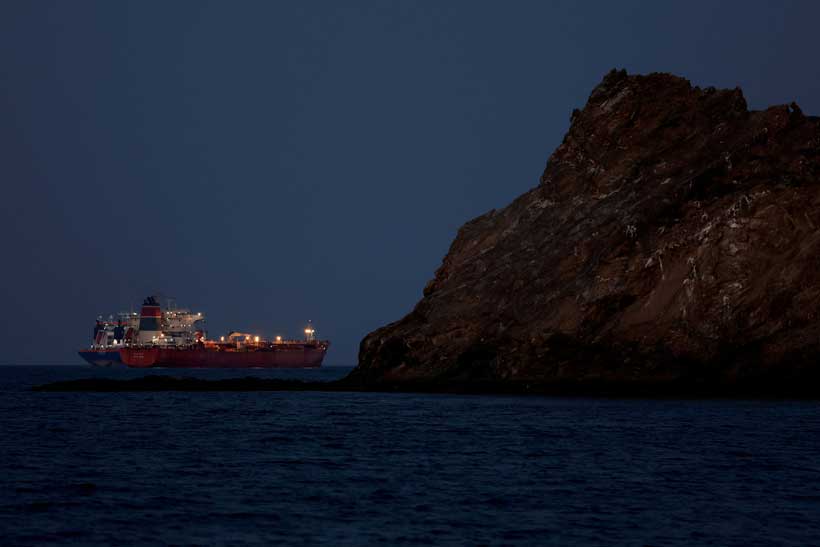
Two United Arab Emirates oil tankers were struck by Iranian cruise missiles while transiting the Strait of Hormuz, killing one Indian crew member and injuring eight others, according to the UAE Ministry of Defence. The attack marks one of the most serious incidents involving commercial shipping since tensions between the United States and Iran escalated, raising fresh concerns about the security of one of the world’s most important energy routes.
The strike comes as military confrontations intensify across the Gulf, threatening global oil supplies and increasing the risk of a wider regional conflict.
What Happened
The UAE Ministry of Defence said the very large crude carriers Mombasa B and Al Bahiyah were hit in the southern shipping lane of the Strait of Hormuz while sailing through Omani territorial waters.
Abu Dhabi National Oil Company’s shipping subsidiary, ADNOC L&S, confirmed that both vessels suffered significant damage after being struck and that fires broke out onboard before being brought under control.
Stay ahead of the geopolitical week.
MD Briefing delivers expert analysis across five global fronts — the Indo-Pacific, energy, geoeconomics, European security, and the Middle East — every Monday morning. Free.
One Indian crew member aboard the Mombasa B was killed. Eight others were injured, including six Indian nationals and two Ukrainian nationals. Four of those injured remain in serious condition.
Iran Defends the Attack
Iran’s Islamic Revolutionary Guard Corps (IRGC) said it had disabled two “offending” supertankers after they allegedly ignored repeated warnings, switched off their navigation systems, and attempted to travel through what it described as a mined route.
The IRGC did not identify the vessels by name but accused the United States of directing ships through an illegal passage and warned that cooperation with Washington would prolong disruptions in the Strait of Hormuz and trigger a broader global energy crisis.
Another Tanker Incident Reported
Separately, the United Kingdom Maritime Trade Operations (UKMTO) agency reported that another tanker was struck by an unidentified projectile around 40 nautical miles northeast of Oman’s Qalhat.
The vessel’s master reported damage to the engine room, although all crew members were safe. It remains unclear whether this incident involved one of the Emirati tankers or a separate vessel.
Growing Tensions in the Gulf
The latest attacks come amid a sharp deterioration in regional security following renewed fighting between the United States and Iran.
The United States has resumed strikes against Iranian targets, reinstated a blockade of Iranian shipping, and proposed imposing a security fee on vessels using the Strait of Hormuz.
Iran has rejected any U.S. role in controlling the strategic waterway and warned that foreign intervention would not determine its future. The attacks also cast further doubt over last month’s interim U.S.-Iran understanding aimed at reopening the strait and reducing hostilities.
Why the Strait of Hormuz Matters
Before the conflict erupted, roughly 20% of global oil and liquefied natural gas shipments passed through the Strait of Hormuz every day. More than 15 million barrels of oil worth over $1.2 billion moved through the narrow waterway daily, making it the world’s most critical maritime energy corridor.
Any disruption to shipping through the strait has immediate implications for global energy prices, insurance costs, and international supply chains.
Why This Matters
The missile strike on commercial oil tankers represents a major escalation in the confrontation between Iran and its regional adversaries. Beyond the human toll, the attack heightens fears that commercial shipping is becoming a direct target, increasing risks for global energy markets and international trade. It also places additional pressure on Gulf states and Western navies to secure maritime routes without triggering a broader military confrontation.
Future Outlook
Shipping companies are expected to reassess transit through the Strait of Hormuz, potentially reducing tanker traffic and raising freight and insurance costs. Any retaliatory action by the UAE or its allies, further Iranian attacks on commercial vessels, or expanded military operations by the United States could deepen instability in the Gulf and push global oil prices higher in the coming weeks.
With information from Reuters.
