


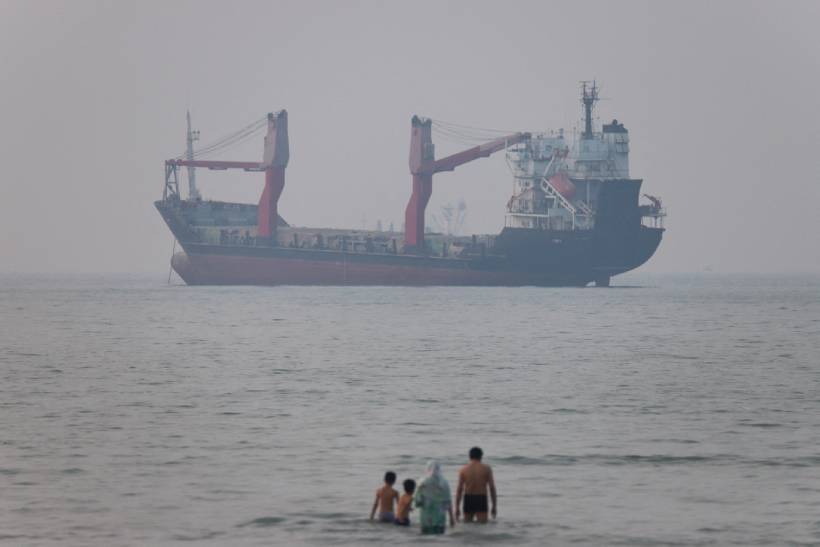
Commercial shipping through the Strait of Hormuz dropped to its lowest level in five weeks on Sunday as renewed U.S. and Iranian military strikes and continued attacks on vessels heightened security concerns along one of the world’s most critical energy trade routes.
Ship tracking data from Kpler showed that only six vessels transited the strategic waterway on Sunday, marking the weakest daily traffic since early June and highlighting growing caution among shipping companies.
The Strait of Hormuz carries roughly one fifth of global oil supplies and is a vital corridor for crude oil and liquefied natural gas exports from Gulf producers.
Oil tankers continue cautious transits
Despite the slowdown, several oil tankers continued using the route.
Stay ahead of the geopolitical week.
MD Briefing delivers expert analysis across five global fronts — the Indo-Pacific, energy, geoeconomics, European security, and the Middle East — every Monday morning. Free.
Among the vessels exiting the strait was the Very Large Crude Carrier Humanity, carrying around two million barrels of Iranian crude, along with the tanker Capetan Andreas, transporting approximately 500,000 barrels of Kuwaiti refined oil products.
Three empty tankers also entered the Gulf to load cargoes.
Most vessels switched off their Automatic Identification System (AIS) transponders while passing through the strait, a practice increasingly adopted by ships navigating high risk areas to reduce potential targeting.
No liquefied natural gas tankers were visible entering the Strait of Hormuz during the weekend, according to publicly available tracking data.
Separately, one tanker operated by Abu Dhabi National Oil Company transited the strait between July 10 and July 12 and is now bound for Dahej port in India.
Renewed military action raises risks
The decline in shipping activity came after another round of U.S. military strikes against Iran.
U.S. Central Command said American forces struck dozens of Iranian military targets on Sunday using precision guided munitions.
President Donald Trump later said commercial shipping remained free to pass through the Strait of Hormuz.
However, Iran maintained that it had closed the waterway after accusing a vessel of travelling along an unauthorized route before it was struck.
Iran’s Revolutionary Guards said on Monday that naval forces stopped two ships in the Strait of Hormuz overnight by disabling their onboard systems, although officials did not identify the vessels involved.
Energy markets remain on alert
The latest disruption comes after weeks of heightened instability across the Gulf, where attacks on commercial shipping have repeatedly raised fears of broader supply disruptions.
Although oil exports have continued, shipping companies remain cautious as insurance costs, security risks and voyage planning become increasingly complex.
Any prolonged reduction in tanker traffic through the Strait of Hormuz could tighten global energy supplies, particularly for major Asian importers including China, India, Japan and South Korea, which depend heavily on Gulf crude and LNG shipments.
Analysis
The sharp decline in vessel traffic suggests shipping companies are prioritizing safety over scheduling certainty as military tensions escalate between Washington and Tehran. While neither side has fully halted commercial navigation, uncertainty over the security environment is prompting operators to delay voyages, alter routes where possible and limit vessel movements through the narrow waterway.
For energy markets, the immediate impact remains manageable because exports continue to flow. However, if military exchanges intensify or more commercial ships are targeted, disruptions could quickly translate into higher freight costs, increased insurance premiums and renewed volatility in global oil and LNG prices. The Strait of Hormuz remains one of the world’s most strategically important maritime chokepoints, meaning even temporary slowdowns are closely watched by governments and commodity markets alike.
With information from Reuters,
