


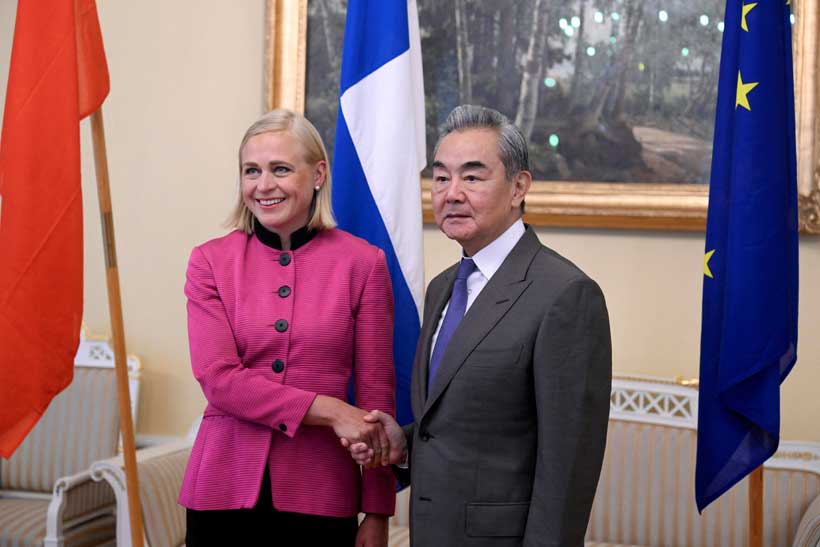
At a time when trade tensions between China and the European Union continue to grow, Chinese Foreign Minister Wang Yi’s visit to Denmark, Sweden, Finland, and Norway deserves attention beyond routine diplomatic protocol. Coming amid new EU restrictions on Chinese technologies, a NATO summit, and renewed debate over Greenland’s future, the trip is less about achieving immediate diplomatic breakthroughs than about preserving dialogue at a time when China-Europe relations face increasing strain.
If the Nordic countries and China can sustain dialogue despite political differences and deepen practical cooperation where interests align, they may offer a useful model for the future of China-Europe relations.
The Nordic countries occupy a distinctive position in Europe’s relationship with China. They were among the first Western countries to establish diplomatic ties with the People’s Republic of China and, despite periodic disagreements, have maintained extensive cooperation in trade, innovation, and green development. Sweden is the first country that signed the Agreement on Mutual Protection of Investments with China since the latter began reform and opening up. Denmark recently reaffirmed its commitment to the one-China policy through a parliamentary resolution. Finland continues to expand cooperation in technology and sustainability, while Norway, outside the European Union, retains greater flexibility in shaping its own trade policy.
The Nordic countries are in an increasingly complex security environment that makes continued engagement with China increasingly relevant. As NATO members, Denmark, Sweden, Finland, and Norway rely heavily on the United States for their defense. At the same time, ongoing debates over defense spending, trade, and other strategic issues have underscored the importance of maintaining diversified international partnerships. China’s position on Arctic affairs, emphasizing respect for national sovereignty and international cooperation, provides one area where dialogue with the Nordic countries remains possible despite broader strategic competition.
Stay ahead of the geopolitical week.
MD Briefing delivers expert analysis across five global fronts — the Indo-Pacific, energy, geoeconomics, European security, and the Middle East — every Monday morning. Free.
Beyond strategic considerations, economic ties remain the strongest foundation of China-Nordic relations. The trade figures illustrate this reality. In 2025, trade between China and Sweden reached US$19.37 billion, making Sweden China’s largest trading partner in the Nordic region. Trade between China and Denmark exceeded US$18 billion, with China remaining Denmark’s largest trading partner in Asia for several consecutive years. China-Norway trade totaled US$11.41 billion, making China Norway’s largest trading partner in Asia. Meanwhile, Finland holds the distinction of being the first European country to sign an intergovernmental trade agreement with China.
Chinese and Nordic economies are complementary. Nordic countries are global leaders in green technology, advanced manufacturing, life sciences, and the circular economy. China, meanwhile, offers one of the world’s most comprehensive manufacturing ecosystems, a large consumer market, and rapidly expanding demand for sustainable technologies.
This is particularly evident in the green transition. Norway has the world’s highest adoption of electric vehicles, where Chinese brands have become increasingly competitive. European solar deployment also continues to depend heavily on Chinese manufacturing capacity. At the same time, major Nordic companies continue to invest in research and development in China, attracted by its industrial supply chains and engineering talent.
For Nordic businesses, maintaining commercial engagement with China is often viewed as an economic necessity rather than a political statement. That explains why many companies continue to advocate practical cooperation even as political tensions persist.
This does not mean the Nordic countries overlook their concerns. Governments across the region have raised questions about cybersecurity, economic resilience and strategic dependencies, and some have introduced restrictions affecting Chinese companies. Yet these concerns coexist with recognition that China remains one of the most important partners in tackling climate change, supporting global supply chains and advancing the technologies needed for the green transition.
That distinction matters. Rather than expecting political disagreements to disappear, both sides increasingly need mechanisms that allow cooperation to continue where interests align while managing differences responsibly.
Norway illustrates this particularly well. As a non-EU member, it enjoys greater flexibility in trade policy than many European partners. Ongoing negotiations on a China-Norway free trade agreement reflect that autonomy. Without a major domestic automobile industry to protect, Norway also has greater room to explore cooperation in electric vehicles and renewable technologies as it seeks to diversify an economy historically dependent on oil and gas.
Political differences are unlikely to disappear in the near future. But neither are the structural economic interests that connect China and the Nordic countries. Maintaining regular dialogue while expanding practical cooperation where possible is therefore not a sign of ignoring differences. It is an acknowledgement that, in an increasingly fragmented international environment, sustained engagement often serves both sides better than growing distance.
