


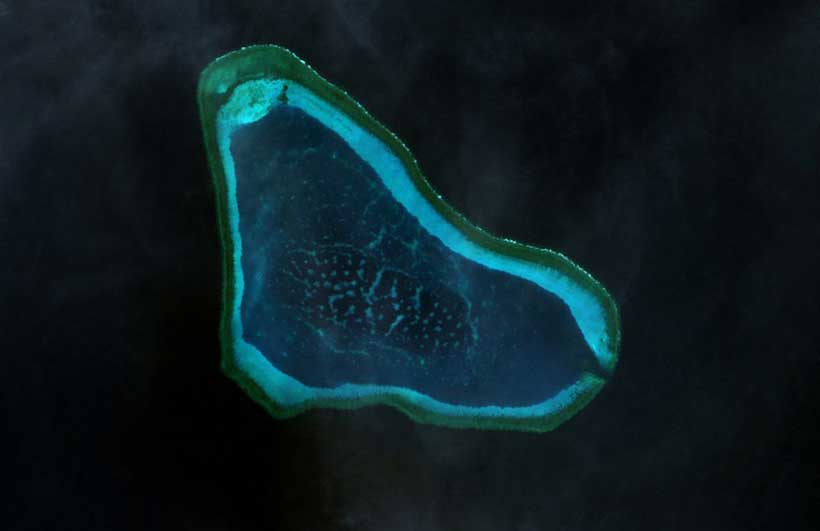
Ten years after an international tribunal rejected China’s sweeping claims in the South China Sea, many Philippine fishermen say the landmark legal victory has brought little change to their daily lives, as they remain effectively shut out of the rich fishing grounds around the disputed Scarborough Shoal.
The 2016 ruling by the Permanent Court of Arbitration in The Hague declared that Beijing’s expansive claims under its so-called “nine-dash line” had no legal basis under international law. The tribunal also found that Scarborough Shoal was a traditional fishing ground shared by several countries, including the Philippines, China and Vietnam, though it did not determine sovereignty over the feature.
Despite the ruling, fishermen in the Philippine coastal town of Masinloc say Chinese vessels continue to patrol the area aggressively, discouraging them from returning to waters that once sustained their livelihoods.
Fishermen say harassment has intensified
Many local fishermen previously tried to avoid Chinese patrols by travelling to the shoal at night or during periods of reduced enforcement. They now say even those attempts have become too risky.
Stay ahead of the geopolitical week.
MD Briefing delivers expert analysis across five global fronts — the Indo-Pacific, energy, geoeconomics, European security, and the Middle East — every Monday morning. Free.
Rony Drio, 59, said he has not ventured to Scarborough Shoal since 2024, while fellow fisherman Henrilito Empoc, 47, last fished there in 2022. Both now rely on coastal fishing grounds that provide smaller catches and lower incomes.
“When we heard that we had won in 2016, we thought we would finally be free to fish again,” Empoc said.
Instead, he said he witnessed Chinese vessels using water cannons against Filipino fishing boats and personnel cutting anchor lines to force fishermen away.
“They took away our right to fish,” Empoc said, adding that he now supplements his income by driving a motorised tricycle taxi.
Drio recalled being ordered to leave the shoal’s lagoon by Chinese personnel several years ago. Because the water was too shallow for his boat to leave normally, he and another fisherman had to carry it across sharp coral.
“The coral hurt our feet, but what hurt more was what they were doing to us,” he said.
China’s embassy in Manila did not immediately comment on the fishermen’s allegations. Beijing has consistently rejected the tribunal’s ruling, maintaining that it has “indisputable sovereignty” over what it calls Huangyan Island and its surrounding waters.
Scarborough Shoal remains a flashpoint
China has maintained effective control of Scarborough Shoal since 2012 after a prolonged standoff with the Philippines.
The dispute has remained one of the most sensitive flashpoints in the South China Sea, with repeated confrontations between Chinese and Philippine vessels.
Earlier this year, tensions flared after China placed a floating barrier across the entrance to the lagoon. The barrier was later removed following protests from Manila.
Beijing has also proposed establishing a nature reserve at the shoal, a move the Philippine government condemned as an attempt to strengthen China’s control over the disputed feature.
Analysts warn that repeated confrontations across the South China Sea continue to raise the risk of military escalation.
In June 2024, a Filipino sailor lost a finger during a violent encounter with the Chinese coast guard while participating in a resupply mission to Second Thomas Shoal, where the Philippines maintains a grounded naval vessel.
Legal victory strengthens diplomacy, not access
Philippine officials argue the 2016 arbitration ruling has strengthened Manila’s international legal position and helped justify its policy of publicly documenting confrontations with Chinese vessels.
The decision has also supported closer defence cooperation between the Philippines and allies including the United States, Japan and Australia through expanded military exercises and maritime patrols.
Jay Batongbacal, director of the Institute of Maritime Affairs and Law of the Sea at the University of the Philippines, said China’s increasingly assertive behaviour has ultimately encouraged more countries to back Manila.
“Without China’s actions, the number of allies and security partners for the Philippines definitely would not have increased,” he said.
Future outlook
While the Hague ruling continues to underpin the Philippines’ diplomatic and legal strategy in the South China Sea, fishermen say those gains have yet to translate into meaningful access to Scarborough Shoal.
With China maintaining its presence around the disputed waters and refusing to recognise the tribunal’s decision, local communities dependent on the fishing grounds remain caught between international law and realities at sea.
For fishermen like Drio, the anniversary offers little reason to celebrate.
“We won in 2016,” he said, “but it doesn’t feel like a victory.”
With information from Reuters.
