


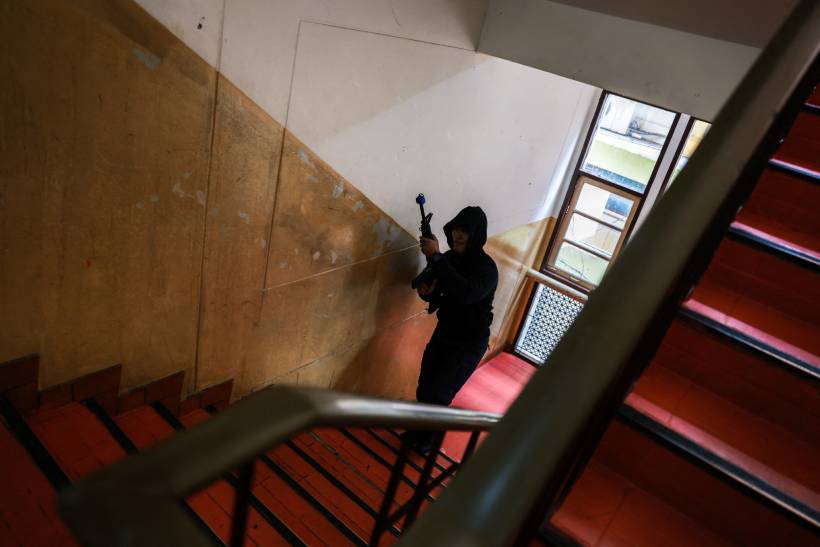
Schools across Thailand have begun conducting active shooter response drills following a deadly attack at a school that killed at least eight people.
The exercises were launched as authorities moved to strengthen security measures and prepare students and teachers for the possibility of similar attacks. At Surasamontree School in Bangkok, students participated in a “run, hide, fight” exercise involving a police officer acting as a mock attacker.
The officer, dressed in black and carrying a handgun and assault rifle loaded with blank ammunition, simulated an attack while students practised escaping, hiding and securing classrooms.
The drills follow a directive signed by Education Minister Prasert Jantararuangtong on August 10 requiring schools to establish security plans and rehearse emergency response procedures.
Stay ahead of the geopolitical week.
MD Briefing delivers expert analysis across five global fronts — the Indo-Pacific, energy, geoeconomics, European security, and the Middle East — every Monday morning. Free.
The response reflects growing concern among Thai authorities that schools need to be prepared for threats that can emerge with little warning.
Why Are Thai Schools Conducting Active Shooter Drills?
The immediate trigger is a deadly attack in which a 14-year-old opened fire at a school, killing at least eight people.
The incident prompted authorities to reassess how schools respond to violent emergencies.
At Surasamontree School, students were taught to respond according to three basic principles: run when escape is possible, hide when it is not, and fight back as a last resort.
During the exercise, students ran away from the simulated attacker and hid beneath tables and behind locked doors. They also used classroom furniture to block entrances.
In another scenario, students tackled and restrained the mock attacker after he entered a classroom.
The objective was not simply to teach students how to react to a shooting, but to build awareness and reduce panic during a crisis.
Thailand Is Tightening School Security
The response has extended beyond emergency drills.
Surasamontree School has increased daily security checks, including the use of metal detectors and searches of students’ bags.
Teachers demonstrated the use of handheld metal detectors and displayed sharp objects that had previously been confiscated from students.
The measures reflect a broader effort to identify potential threats before they escalate into violence.
Authorities are also encouraging schools to develop security plans tailored to their individual environments.
This approach recognizes that schools face different risks depending on their location, size and facilities.
What Does the New Education Directive Require?
Thailand’s Education Ministry has instructed schools to establish formal security plans and practise emergency response procedures.
The directive is designed to ensure that schools are not responding to emergencies only after an incident occurs.
Instead, schools are being encouraged to prepare students, teachers and administrators in advance.
Police officials say schools across the country are now reviewing their security arrangements.
Visitsak Vipattanamongkol, superintendent of the Explosive Ordnance Disposal unit at the Patrol and Special Operations Division of the police, said schools were responding because such threats could occur anywhere.
The emphasis is therefore shifting toward preparedness rather than relying solely on security personnel to respond after an attack has begun.
Can Drills Reduce the Impact of an Attack?
Active shooter drills are intended to help people make decisions quickly during extremely stressful situations.
In an actual emergency, confusion and panic can delay evacuation or prevent people from securing themselves inside classrooms.
Practising different scenarios can help students understand what they should do if they encounter an armed attacker.
At Surasamontree School, students were shown several possible situations rather than being taught a single response.
They practised escaping when possible, hiding when escape was not safe and using classroom objects to prevent an attacker from entering.
The approach is designed to give students options rather than assuming that every emergency will unfold in the same way.
Why Are Schools Increasing Daily Security Checks?
The increased use of metal detectors and bag searches represents a second layer of protection.
While emergency drills focus on what happens after an attack begins, security screening attempts to prevent dangerous objects from entering school premises in the first place.
Teachers at Surasamontree demonstrated handheld detectors and showed items confiscated from students.
The measures also increase the visibility of security within schools, signalling to students and staff that authorities are treating the threat seriously.
However, stronger screening can also create challenges for schools, particularly when security measures need to be balanced with maintaining an environment where students feel comfortable and safe.
How Are Students Responding?
School officials have welcomed the training as a way of increasing awareness.
Surasamontree School director Onitcha Kochana said the exercises gave students practical knowledge that could help them respond during a real emergency.
The emphasis on awareness is particularly important for younger students, who may have little experience dealing with violent incidents.
By rehearsing emergency procedures, schools hope students will be less likely to freeze or panic if faced with a real threat.
The drills also give teachers an opportunity to practise their own responses and identify weaknesses in school security plans.
A New Security Challenge for Thai Schools
The response reflects a broader recognition among Thai authorities that school security can no longer be based solely on traditional measures.
Schools have historically been viewed primarily as educational environments. But the possibility of violent attacks has forced authorities to consider how schools can function as protected spaces during emergencies.
This requires cooperation between education officials, police, teachers, students and families.
Security planning must also account for different forms of threats rather than focusing exclusively on shootings.
The Education Ministry’s directive specifically calls for schools to prepare for incidents and threats of different kinds.
Analysis: From Reaction to Preparedness
Thailand’s decision to conduct active shooter drills demonstrates how a single violent attack can change the security priorities of an entire education system.
The immediate response has been practical: schools are conducting drills, strengthening screening procedures and developing formal emergency plans.
But the larger challenge is ensuring that these measures become sustainable rather than temporary reactions to a high-profile tragedy.
Security drills are useful only if schools regularly update their procedures, train staff and ensure that students understand how to respond without creating unnecessary fear.
There is also a broader lesson about modern public safety.
Threats to schools are unpredictable, and authorities cannot assume that security measures will prevent every incident. Preparedness therefore becomes an additional layer of protection.
Thailand’s response is moving in that direction by combining prevention with emergency response.
The use of metal detectors and bag searches attempts to identify threats before they enter schools. Active shooter drills prepare students and teachers for what happens if prevention fails.
The effectiveness of the strategy will ultimately depend on whether these measures become part of a long-term security culture rather than a short-term reaction.
Thailand’s schools are learning a difficult lesson: preventing violence is the first priority, but preparing students and teachers to respond quickly can determine how severe an emergency becomes.
With information from Reuters.
