


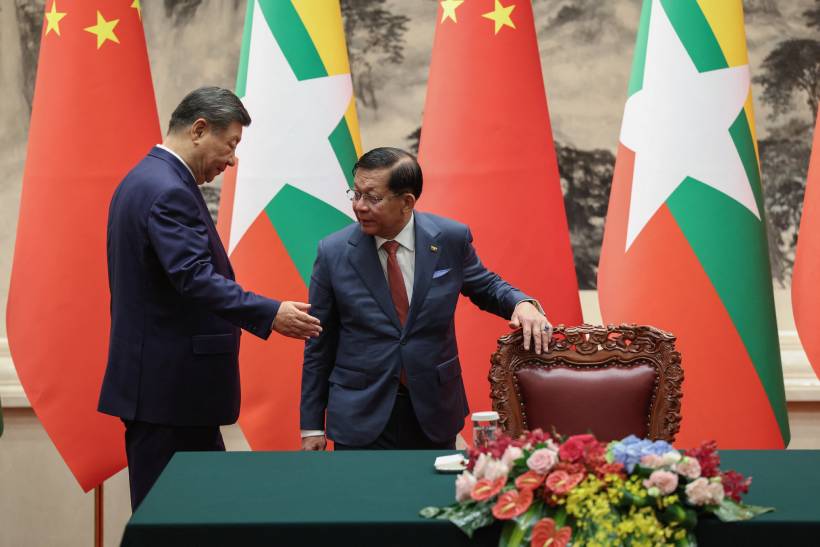
Myanmar’s President, Min Aung Hlaing, visited India from May 30 to June 3, marking his first visit to the country since military takeover. After becoming the President in April 2026, it was also his first foreign trip in India. After two weeks, he travelled to China for his third visit. Unlike the previous visits, this time country had granted him a huge Protocol with twenty-one-gun salute and welcome at the Great Hall of the people. As an army chief, his earlier visits were based on attending the group summits. This time, the meeting was bilateral and both sides signed eighteen memorandums including restarting the Myitsone Dam project which is significant to China-Myanmar economic corridor.
Many experts about these visits were argued that, India was making a comeback while China was strengthening its control. But Myanmar’s renegotiation with both countries in the same month was strategic. His official visits first to New Delhi then to Beijing show that positioned between two competing major powers, Myanmar used one relationship to strengthens its position with other. And this did not mean that Myanmar’s visit to India was a move away from China but rather used it as bargaining leverage to get more favorable terms from China. This reflects a strategy in international relations which the small states commonly used to ensure their survival.
Myanmar acts as a buffer between India and China as it forms a nearly 2000-km land bridge between Bay of Bengal, India’s northeastern region, and South China Sea at China’s southern province. If Myanmar’s good ties with India turn hostile, two things are likely to happen. First, India could lose its most fragile strategic point in its northeast, which connects rest of the country through the 22-km wide Siliguri Corridor. However, several projects seek to reduce the India’s dependence on that route including Kaladan Multi- Model Transit Transport project and India-Myanmar-Thailand Trilateral Highway. Second, it could allow China to use the ports such as Kyaukphyu and Sittwe located near the Indian coast in the Bay of Bengal, for surveillance purposes not just commercial harbors.
China’s influence in Myanmar has become stronger because it deeply institutionalized it through infrastructure and political engagement. The Kyaukphyu oil and gas pipelines are China’s only backup route for energy security, in which China invested approximately $2.5 billion in 2009. The pipeline also helps China to save travels around the 1800 nautical miles to import energy through Myanmar. This route was built to avoid Malacca Strait, currently the busiest oil shipping route. The value of China’s mediation goes far beyond economic investment. China’s role in initiating peace deals with the Myanmar’s most powerful groups such as United Wa State Army in 2021. A country where the Junta has less control over some areas than its opponents. China’s leading role shows that the its influence extend further that any value of its investment alone can’t do this.
Stay ahead of the geopolitical week.
MD Briefing delivers expert analysis across five global fronts — the Indo-Pacific, energy, geoeconomics, European security, and the Middle East — every Monday morning. Free.
New-Dehli maintains military exchanges and hotlines with Myanmar’s army and has not been submissive. It has also engaged with the junta as only regional power for more than three years; despite this interactive approach, the outputs were not tangible Since 2021, ASEAN’s peace plan for Myanmar has shown no significant progress; at the same time India has allowed nearly 79,000 refugees from Myanmar. Mizoram decided to give these refugees proper shelter and education, but it was contradictory to the federal government’s exile policies. India’s flagship connectivity projects have delayed the progress, as there is disruption by the militants’ attacks and closed borders to the Trilateral Highway. Since 2008 the cost of the Kaladan project has increased nearly five times and hindered the procedures.
The difference of strategic approach by India and China is increasingly visible. India has more focus on infrastructure building, but China built relationships with stakeholders. New Delhi has to understand that the roads can be destroyed and bridges can be delayed, but better political relationships can survive even massive crises. The actual leverage in Myanmar is defined by these practical points rather than the traditional red-carpet welcome on diplomatic visits.
The circumstances are still uncertain; despite China’s mediation and political influence in Myanmar militant insurgencies continue to expand, which can badly affect the road and pipeline initiatives. India’s new army base in Mizoram reflects the serious strategic approach towards Naypyidaw. There is a governance vacuum in Myanmar right now, and this opening is kind of an invitation for burden sharing because neither state can stabilize.
There is a need for a ceasefire monitoring approach and coordination for refugee settlement and sending back the illegal migrants to Rohingya safely. It is the bare minimum needed to make Myanmar a safe buffer zone of 2,000 kilometers, not a frontline for either state. If Myanmar becomes a military base for China or India then the threat will spread beyond the borders in the region.
