The NATO Ankara summit is a eulogy for one model of liberal internationalism. It should become the cradle of a better one.
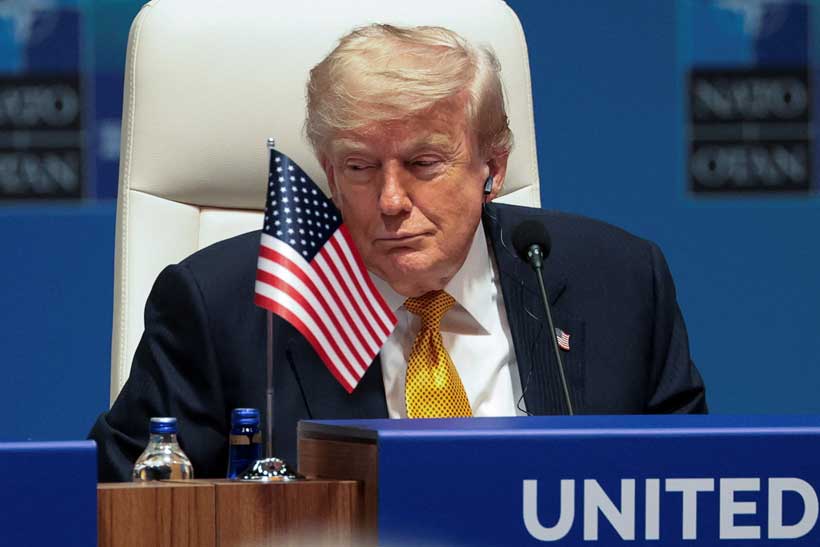
Donald Trump went to Ankara this week and asked the allies for loyalty. He said it beside Recep Tayyip Erdogan, whom he had praised for his loyalty in the war on Iran, and he arrived with gifts, relief from American sanctions, and a fresh look at the F-35 jets Turkey forfeited in 2019. Days earlier, he had called the alliance a paper tiger. He insulted the room, then asked for its devotion. It was a strange way to run an alliance.
Loyalty is the giveaway, the word for what the arrangement has always been beneath the transatlantic relationship since 1949. NATO was rarely a brotherhood of equals, despite the communiqués. It was an American instrument, at times useful and often admirable, but an instrument all the same.
The instrument deserves its due, and some of its records are undeniably good. For forty years, it maintained the line against a Soviet army that outnumbered the West along the German border. This guaranteed that no great-power war came to Europe. The alliance invoked its mutual-defense clause exactly once, not for a European but for the United States, on the day after September 11, after which more than a thousand European and Canadian soldiers died in Afghanistan for an attack on New York. Loyalty has a body count. Until now, the count has run in America’s favor.
Stay ahead of the geopolitical week.
MD Briefing delivers expert analysis across five global fronts — the Indo-Pacific, energy, geoeconomics, European security, and the Middle East — every Monday morning. Free.
The creed, though, was always thinner than the instrument. Liberal internationalism promised consistent standards, but only delivered convenient ones. NATO bombed Yugoslavia in 1999 to stop the ethnic cleansing of Kosovo, and it did so without the Security Council’s blessing, even as a fellow NATO member, Turkey, waged its own slaughter campaign on the Kurds of southeastern Anatolia with American weapons. The same alliance that punished one campaign of ethnic expulsion armed another. The standard was not always human dignity. It was often the map.
Iraq is where the reckoning occurred. The United States mistook its instrument for a mission and invaded a country for weapons that did not exist, and hundreds of thousands died to test a theory. Domestically, the US executive branch used the war as a means to absorb power in the name of “national security”. It did this through pioneering ICE and torture chambers (CIA Black Sites) across the world. Meanwhile, regular Americans still pay the interest on that debt. The order did not fail because Trump arrived. It failed because it was never a creed; it was made to carry a moral weight it was never built to bear.
Trump is not a rupture in this story so much as its most graceless practitioner, stripped of the manners the others kept. Lord Palmerston told the Commons in 1848 that Britain had no eternal allies and no perpetual enemies, only interests that were eternal and perpetual. Every US President since Truman has practiced it in private while professing a nobler creed in public. Trump simply stopped professing. He threatens Greenland and eyes Canada like real estate, and he leans on Ukraine for its minerals, while the establishment recoils as though the transactional habit were new rather than the oldest one in the book. It was never new. He is just a gauche practitioner of the same approach.
Look no further than the host of this year’s summit. Turkey rounded up journalists and lawyers before it opened and banned the protests around it, and Erdogan jails his critics at home while courting Moscow abroad, yet there he sits at the center of an alliance that still calls itself the arsenal of the free world. A club that keeps him on its rolls is organized around usefulness, not principle. Real democracies would have to choose. Choosing is the point.
The right response for the future of NATO as a standard of liberal internationalism is neither nostalgia nor demolition. A better answer to a hollow order is to succeed in it, to build the thing it only pretended to be, and to start now. The Pentagon markets its own version as NATO 3.0, a plan to push Europe to pay for its own defense so America can pivot to the Pacific. It shifts the burden, not the purpose. The deeper task is to turn an American-led alliance into a coalition of liberal democracies in which the US sits as first among equals. A shareholder, not an owner.
Such an alliance would take up the work the old order fumbled. Sovereignty would be understood as a rule with codified limits, not an open-ended license, so that atrocities like Srebrenica trigger a predetermined response rather than one influenced by shifting political sentiment. Migration would run through a shared, humane regime that secures a border and honors asylum, ceding the ground to neither traffickers nor demagogues. Open trade would remain the surest path to peace the modern world has found, defended against the mercantilism now fashionable in Beijing and Washington alike. Artificial intelligence would be subject to shared rules before it shapes ours, since whoever sets the standards for machine cognition will help determine the course of the century.
America should want this, and not from charity. A hegemon pays for everything and trusts no one, forever certain its clients are free-riding; but a first among equals in an alliance carries a lighter load, shares the credit and the cost, and wins partners who act from conviction, not dependence. Trump wants allies who obey. He would be far stronger with allies who agree.
Ankara reads like a eulogy of NATO as a representation of liberal internationalism. The alliance that Erdogan hosts and Trump berates is the last act of a model that mistook an army for an idea. Something better can take its place, an order of free nations that share power because they share a principle, and it will not run on loyalty. It will run on membership. The older order asked whom you served; the new one should ask what you will build.