Authors: Nazish Mehmood and Dr. Qasim Ali Shah*
With missiles firing from both sides and Ayatollah Ali Khamenei’s funeral ceremony underway, president Trump declaring the ceasefire is “over”, the question on everyone’s mind is the same one: will the delegations still show up in Islamabad on Saturday.
Overnight, the ceasefire that has held, however shakily, since June came under its heaviest strain yet. The United States accused Iran of striking three commercial tankers, a Saudi vessel and a Qatari one among them, as they passed through the Strait of Hormuz. Washington answered with what US Central Command described as “powerful strikes,” hitting more than eighty targets inside Iran, from radar stations to small Revolutionary Guard boats anchored near Bandar Abbas. Iran responded with missiles aimed at American installations in Bahrain and Kuwait, and air raid sirens sounded across the Gulf for the first time in weeks.
Speaking from the NATO summit in Ankara, President Donald Trump declared the ceasefire “over.” Oil markets took the statement seriously. Brent crude jumped nearly six percent within hours, a reminder of how much of the world’s energy supply still runs through a waterway that keeps threatening to shut.
Stay ahead of the geopolitical week.
MD Briefing delivers expert analysis across five global fronts — the Indo-Pacific, energy, geoeconomics, European security, and the Middle East — every Monday morning. Free.
And yet, for all the noise of the last twenty four hours, the more consequential story may be the one unfolding quietly on the diplomatic calendar. A new round of technical level talks is still scheduled for July 11, and despite the strikes, nobody involved has called it off.
Why this round matters more than it looks?
The talks are meant to build on the fourteen page memorandum both countries signed on June 17, an agreement that gave the region a framework, if not yet a settlement, for actually ending a war that began on February 28. That document set a sixty day window to work through the three hardest questions left on the table: Iran’s nuclear programme, the sanctions still choking its economy, and the billions of dollars in frozen Iranian assets sitting in banks abroad. The upcoming session is also expected to take up freedom of navigation through Hormuz itself, the very issue that just triggered this latest round of strikes.
None of that sixty day clock has been easy to keep running. Iran has said it will only confirm the size and composition of its delegation once the days long funeral processions for Ayatollah Ali Khamenei, killed in the opening strikes of the war, have concluded. Even before this week’s escalation, American and Iranian officials were already disputing whether an earlier round of indirect talks in Doha had produced any real agreement on the frozen funds. Getting both delegations into the same room again, let alone getting them to agree on anything, was always going to be difficult. Doing it hours after a fresh exchange of fire makes it harder still.
The venue is not an accident
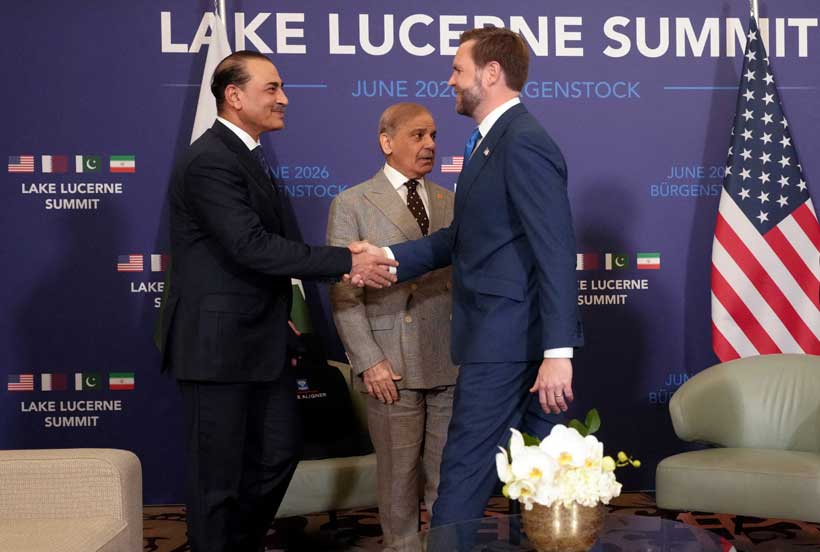
That the talks are happening in Islamabad at all says something about how this war has been managed from the very start. It was Pakistan that brokered the original ceasefire in April, after Prime Minister Shehbaz Sharif and army chief Field Marshal Asim Munir made a flurry of calls to Washington in the final hours before an American deadline to strike Iran expired. Trump himself said he agreed to that ceasefire “based on conversations with Prime Minister Shehbaz Sharif and Field Marshal Asim Munir, of Pakistan,” crediting them with asking him to hold off. Iran’s foreign minister, Abbas Araghchi, was equally direct, thanking Pakistan for what he called its tireless efforts to end the war.
That first Islamabad meeting, in April, the first direct high level contact between Washington and Tehran since 1979, ended without a deal. Pakistani officials kept working anyway. Munir travelled to Tehran more than once in the months that followed, and Sharif’s foreign minister, Ishaq Dar, kept channels open with counterparts in Saudi Arabia, Turkey and Egypt. By mid-June, after what Sharif later told Pakistan’s National Assembly were moments when the entire process nearly collapsed, a text both sides could finally accept was ready to sign.
It is that same architecture, built over months of quiet, unglamorous phone calls rather than any single dramatic breakthrough, that is now being tested again on July 11. If the round holds and produces even modest progress, it will be as much a story about whether that scaffolding survives its first real shock as it is about Iran and the United States.
Not without friction at home
Pakistan’s mediation has not gone unchallenged, even in Washington. Sharif’s decision to publicly praise Khamenei at his funeral in Tehran, calling him “a great scholar and leader,” drew sharp criticism from several Republican senators, who argued that Islamabad’s ties to Tehran make it an unsuitable broker. Pakistani officials have pushed back, and maintained its neutral posture, acceptable to both the warring parties.
What to watch for on Saturday
For now, mediators in Islamabad and Doha, which has also played a quieter facilitating role, are said to be working to keep the July 11 date intact. Even as he declared the ceasefire dead, Trump added that negotiators could “keep talking if they want.” Whether that line holds may depend less on what happens in Washington or Tehran over the next few days, and more on what gets decided, or salvaged, in a conference room in Islamabad.
Bio: Dr. Qasim Ali Shah is a scholar, policy analyst, and commentator specializing in international relations, conflict resolution, strategic affairs, and Middle Eastern geopolitics. His research focuses on diplomacy, regional security, peacebuilding, and evolving geopolitical dynamics across South Asia and West Asia. He writes extensively on international security, foreign policy, and emerging global challenges, offering evidence-based analysis for academic, policy, and international media audiences. Can be reached at [email protected].