


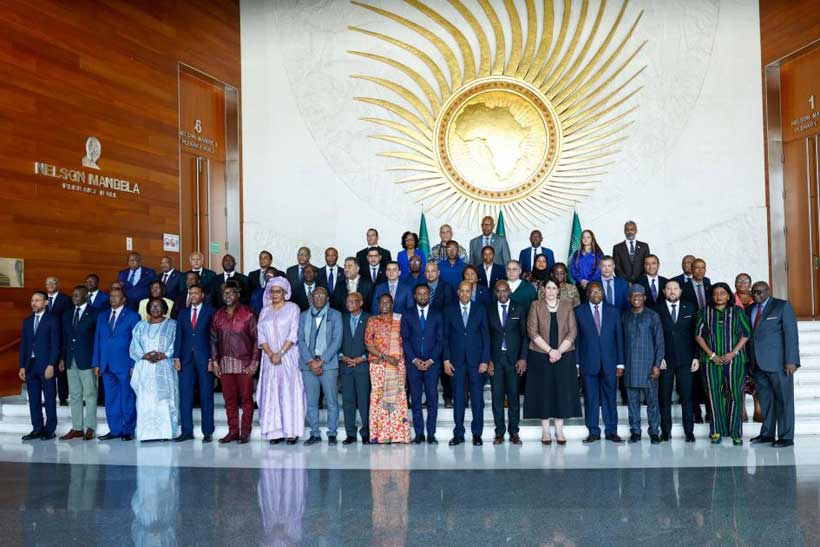
In his 1998 chronicle of the Rwandan genocide, journalist Philip Gourevitch calls Africa a region that generates major catastrophes, ‘but don’t really make meaningful politics’. Indeed, in the academic world, Africa is often framed as an agglomeration of failing states. It has, somehow, become synonymous with bad governance, neo-patrimonialism, militarism, authoritarianism, and poverty.
Though Africa remains mostly under-researched in the Western-centric discipline of international relations, recent efforts have begun to prove Gourevitch’s premise wrong. Despite prevailing challenges in governance, Africa has, in fact, fared quite well in terms of symbolic presence, slowly re-orienting its own image. This article first examines the challenges Africa faces before looking into how it manages to find a new road towards a self-made future.
Africa’s Long List of Problems
Armed conflict is perhaps Africa’s greatest challenge to date. Hostilities in Sudan and the emergence of separatist forces advocating for an independent Ambazonia in Cameroon can be considered two out of many more examples. In line with John Paul Lederach’s concept of conflict transformation, long-term peace remains an unfulfilled ambition as resolution mechanisms fail to address the structural causes of injustice in society, especially the more ‘sensitive’ dimensions, such as resources and identity.
Resolving traditional (armed) conflicts gets increasingly complicated as Africa still deals with a myriad of non-traditional issues. Pirates bring terror in the seas just outside Somalia. More than half of the world’s out-of-school population resides in the Sub-Sahara (UNESCO, 2022), where deadly illnesses, such as AIDS and Ebola, also remain rampant. Civil wars, terrorism, natural disasters, and migration disputes continue to be on news headlines. State-sponsored trafficking and contraband trade worsen already existing civil wars. The high mobility of Islamic fundamentalist groups tears apart the continent’s Christian population in what many today have grown to call a genocide.
Stay ahead of the geopolitical week.
MD Briefing delivers expert analysis across five global fronts — the Indo-Pacific, energy, geoeconomics, European security, and the Middle East — every Monday morning. Free.
Meanwhile, efforts to collectively put an end to these problems are obstructed by an ‘overlapping’ sense of regionalism. Institutions such as the AU (African Union), ECOWAS (Economic Community of Western African States), SADC (Southern African Development Community), EAC (East African Community), and COMESA (Common Market for Eastern and Southern Africa) share similar geographical scopes without clear differences in mandate. Mali, Niger, and Burkina Faso decided to leave ECOWAS in early 2025 due to the regional body’s tensions with the countries’ ruling military juntas, further alienating them from the economic bloc and threatening Africa’s unity (Ewokor, 2025). The move has also posed further questions surrounding institutional legitimacy and whether or not member states would willingly give up a part of their sovereignty when the benefits offered by regional organisations remain unclear.
Another point of concern is the region’s high dependence on Western mechanisms. The AU, often heralded as the continent’s trademark effort towards regionalism, has constantly been criticised for copying the organisational structure of the United Nations (Hendricks & Keïta, 2017). French presence in the Sahel and the Israeli recognition of Somaliland are other signs revealing well-founded fears that Africa may continue to fall prey to the greater powers.
The ‘African Moment’: Africa’s Rising Relevance in Global Politics
Today, however, Africa is on the rise, with considerable increases in economic growth and social relevance. Countries like Botswana, with GDP growth exceeding 6–7% targets, have come to represent Africa’s potential in economic rebound. At the same time, art, sports, tradition, and pop culture have become robust soft power assets.
The 2026 World Cup is perhaps a recent proof that Africa is once again in the spotlight. Representation on the world’s largest football stage is not to be treated lightly. Despite early losses and the polemical suspension of athlete visas by the US Department of State, ten African countries have managed to qualify for this year’s World Cup. In addition, Cape Verde’s debut and DR Congo’s return for the first time since 1974 (followed by the widely discussed appearance of superfan Michel Kuka Mboladinga imitating the country’s first prime minister, Patrice Lumumba) have signified Africa’s expanded cultural presence in the world (Fröhlich, 2026).
Another sight to behold is Pope Leo XIV’s pilgrimage to Africa. Pope Leo XIV has set forth to emphasise messages of positive peace, co-existence, religious tolerance, anti-corruption, and restraint over escalation, whilst attending peace meetings in places engulfed in fighting from separatist forces (Al Jazeera Staff et al., 2026). To some, Pope Leo XIV’s visit may seem like nothing out of the ordinary. In a region heavily laden with conflict, though, the 11-day papal tour symbolises the Catholic Church’s growing concern over the current state of the world (Tornielli, 2026).
An Augustinian, Pope Leo XIV is the first among his predecessors to set foot in Algeria, the site of St. Augustine’s birth. This is not the only compelling thing to take note of, however. Pope Leo XIV is the head of the world’s largest religious organisation. His close allegiance to St. Augustine, who hails from Africa, and his clear stances in advocating for peace can spread considerable awareness about Africa to over 1.4 billion adherents.
The very fact that Cameroon, Angola, and Equatorial Guinea have welcomed the pontiff, in the midst of rising global volatility, is also commendable in itself. Countries, especially small ones, gain positive perceptions by hosting papal visits. Timor-Leste has played the game before. The nation proved itself stable enough to host the late Pope Francis’ visit in September 2024, thereby boosting its leverage to accede to ASEAN (Lane & Lau, 2025). Indeed, the African nations have also agreed to this sentiment. Bishop Beka Esono Ayang of Mongomo, Equatorial Guinea, has described the papal visit as a ‘shared blessing’ bringing the hope of spiritual renewal to the people in his country, especially those at the margins (Ferrari, 2026).
Africa has also begun to abandon its image as a passive pawn in the chessboard of international diplomacy. A highlight-worthy moment occurred in the first and second weeks of January 2026, when China’s Foreign Minister, Wang Yi, visited Ethiopia, Somalia, Tanzania, and Lesotho. While at it, Yi also attended the China-Africa Year of People-to-People Exchanges launching ceremony at the Ethiopian capital, Addis Ababa, which also serves as the headquarters of the AU. Temporarily putting China’s strategic interests aside, Yi’s visit shows Africa’s attempts to forge people-to-people ties and appeal to the greater powers. At the same time, the presence of flagship multilateral initiatives, such as the AfCFTA (African Continental Free Trade Area) and the D-8, or Developing-8 (in which Egypt and Nigeria are members), showcases efforts in creating more lucrative opportunities to help achieve the AU’s 2063 development vision for the continent.
Perhaps the key to explaining this resilience lies in the famously endorsed jargon, ‘African solutions for African problems’. With the perceived hegemonic decline of the US and major geopolitical shifts going on in the background, Africa is now looking for alternatives. Africa is giving off a strong signal that it will persevere as long as instability haunts it.
If ‘African solutions’ are to be concocted, then it would be essential to define the scope of ‘African problems’ first of all. Of course, the above analysis has proven that this is a difficult question to answer. Regional problems will always be more complex than they let on. Grievances intersect and spill over, especially in a continent where borders are porous—so close together due to the existence of many land-locked nations, yet so weakly regulated.
However, challenges can always be interpreted as potential starting points towards improvement. In a region where Islamic fundamentalists systematically persecute Christians, for example, Pope Leo XIV’s move can signify a hallmark effort to build bridges between the two Abrahamic religions. The aforementioned stories of Africa’s successes are clearly not sufficient to fully evaluate its standing in contemporary international relations. Regardless, they speak volumes louder than Africa’s failures. The clock still strikes the hour of the African moment.
To what extent Africa can break apart from the overarching structures of Eurocentrism, poverty, and dependency is a matter to be discussed for another time. It is important to take into account, however, that Africa’s agency remains anyway. In the future, a clear set of ‘African solutions’ may be possible and feasible enough to implement. Through clever framing and persistent diplomacy, the African nations may be one step closer to earning international validation of their long-hidden capabilities. Despite everything, this shows there is still hope in a changing world. Accounting for almost one-fifth of the world’s population (Corichi et al., 2026), it is a representative of the Global Majority, an increasingly intriguing subject to debunk in an academic discipline that still considers it undeserving.
