


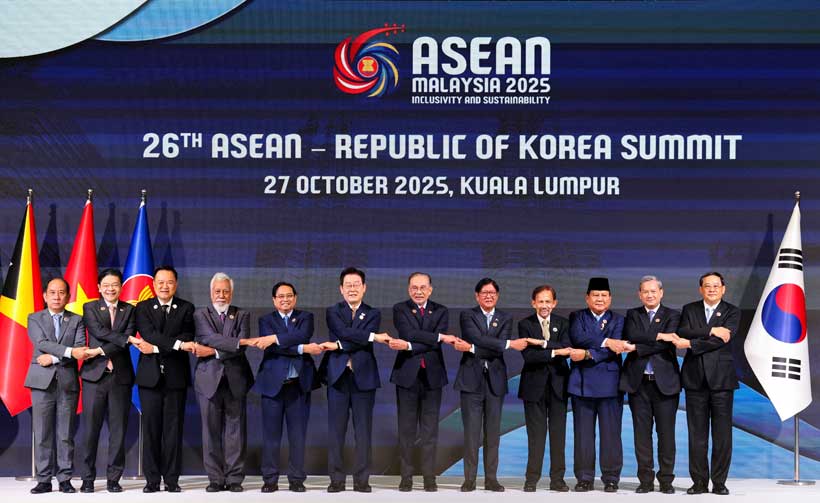
Southeast Asia is not choosing Beijing over Washington. It only looks that way. What is actually happening is more consequential: the region’s governments are hedging faster and harder than at any point since the Cold War’s end, and they are doing it without any shared rules to keep that hedging from tearing ASEAN apart.
The latest State of Southeast Asia survey by Singapore’s ISEAS-Yusof Ishak Institute captured the shift starkly. Asked to choose between the two powers, a majority of respondents leaned toward China for the second time, and more than half named the unpredictability of the current US administration as their top geopolitical worry. Indonesian officials have mused openly about the vulnerability of resource-rich Papua to American pressure. Vietnamese planners have reportedly circulated internal assessments of worst-case scenarios involving the United States, a striking reversal for a country that has spent two decades quietly warming to Washington as a hedge against Beijing.
None of this means Southeast Asia has stopped worrying about China. Anxiety over Beijing’s conduct in the South China Sea remains deep and, in the Philippines’ case, has only sharpened. What has changed is the other half of the equation. Tariff threats, transactional diplomacy and the sense that Washington’s attention is elsewhere have made the region’s traditional counterweight feel less dependable, not more attractive alternatives to it.
The response has been a scramble of parallel bets rather than a coordinated strategy. Indonesia is diversifying arms procurement across France, Turkey and South Korea while also becoming the first Southeast Asian member of BRICS. Malaysia is deepening energy and maritime cooperation with Japan. Vietnam has struck a defence partnership with India worth hundreds of millions of dollars and joined New Delhi’s Indo-Pacific Oceans Initiative. The Philippines is negotiating trade deals with the European Union, Canada and beyond. Individually, each move is defensible. Collectively, they risk producing eleven different foreign policies rather than one hedging bloc.
Stay ahead of the geopolitical week.
MD Briefing delivers expert analysis across five global fronts — the Indo-Pacific, energy, geoeconomics, European security, and the Middle East — every Monday morning. Free.
That fragmentation is the real danger, and it is the one policymakers in the region, in Beijing and in Washington should worry about most. ASEAN’s entire value proposition rests on its ability to act as a platform through which smaller states pool leverage they could not achieve alone. If hedging becomes purely bilateral and improvised, ASEAN centrality becomes a slogan invoked at summits rather than a functioning strategic asset. A bloc that cannot agree on how to describe activity in the South China Sea, as it failed to do under Cambodia’s 2012 chairmanship, will struggle even more to coordinate a collective response to great-power coercion delivered country by country.
The solution is not for ASEAN to choose a side, which it will not and should not do. It is for the bloc to formalise what has so far been instinct: a hedging code of conduct among its own members. Three elements would make the difference between improvisation and strategy.
First, ASEAN should establish a standing consultation mechanism, modelled loosely on the EU’s coordination on China policy, through which member states brief each other before concluding significant new defence or critical-infrastructure agreements with either Washington or Beijing. This need not require unanimous approval, which ASEAN’s consensus model would never deliver. It requires only enough transparency that Jakarta knows what Hanoi is negotiating with New Delhi, and vice versa, before either becomes a fait accompli that a great power exploits to divide the bloc.
Second, the ongoing upgrade of the ASEAN-China free trade agreement, and any parallel upgrade of ties with Washington, should be paired with an explicit ASEAN floor on economic coercion: a commitment that no member state will support punitive measures against another purely because of that state’s security choices. Singapore’s Future of Investment and Trade Partnership and the region’s growing web of new trade agreements show the appetite for this kind of collective economic insurance already exists. It should be extended explicitly to security-linked coercion, not just tariffs.
Third, ASEAN’s 2027 review of the Regional Comprehensive Economic Partnership offers a natural venue to build digital and supply-chain rules that are genuinely multilateral rather than a patchwork of bilateral concessions to whichever power is applying more pressure that year. Rules written collectively are harder for any single power to bend to its advantage.
None of this asks China or the United States to change course, and both should recognise that a more cohesive ASEAN is not a threat to either. Beijing has long argued it prefers regional stability to fragmentation; a bloc capable of enforcing its own rules of engagement delivers exactly that. Washington, for its part, has always said it wants a strong, unified ASEAN rather than a collection of client states. A hedging code would test both claims.
Southeast Asia’s governments have shown they know how to hedge individually. The next test, and the harder one, is whether they can hedge together.
