


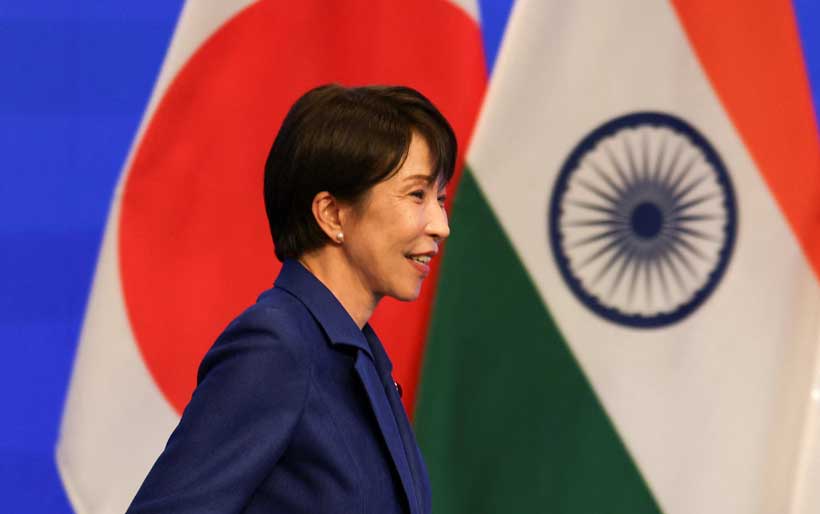
Most commentary on Prime Minister Sanae Takaichi’s first visit to India, her three-day trip to New Delhi from July 1 to 3, culminating in the 16th India-Japan Annual Summit with Prime Minister Modi, has read the encounter as a natural deepening of an already strong relationship. That framing is too generous. It treats three decades of Japanese engagement with India as a benign, if incomplete, developmental partnership that simply hasn’t yet matured into technological co-creation. A harder look at how that engagement was actually structured suggests something less charitable: India was not merely a recipient of Japanese generosity that Japan now needs to “upgrade” into a research partner. India was, for most of this period, a captive market for Japanese capital, engineering firms, and equipment manufacturers, and the terms of that arrangement were built to keep it that way.
The architecture behind the aid
Japanese Official Development Assistance to India is routinely described as concessional and altruistic. The mechanics tell a more transactional story. A large share of Japan’s yen loans to India have carried “Special Terms for Economic Partnership (STEP),” a JICA instrument explicitly reserved for projects in which Japanese technology and know-how are substantially used and that are only available to countries that qualify for tied aid under OECD export-credit rules. In plain terms, cheaper financing has often come bundled with an implicit requirement that Japanese firms supply the technology, and in a significant number of loan agreements the procurement terms are formally listed as tied, meaning contracts are reserved for Japanese or joint Japan-India suppliers rather than opened to global competitive bidding.
Even where procurement is nominally “general untied,” the project components tell their own story. Delhi Metro, Bengaluru Metro, and Mumbai Metro loan packages routinely bundle civil works with rolling-stock procurement and consulting services as line items inside the same loan. This creates substantial commercial opportunities for Japanese rolling-stock manufacturers, systems suppliers, and engineering consultancies, even though procurement is formally conducted under general tied competitive bidding. The debt, denominated in yen, sits on India’s books for repayment periods running 30 to 50 years; the currency risk sits with the Indian executing agency, not the lender. This is not a scandal or a secret; it is publicly documented in every JICA loan notice, but it is also not what “partnership” usually implies. It is a financing model in which capital, technology, and market access move together, and India’s role is to service the debt and operate the resulting asset. Infrastructure gets built; capability does not necessarily transfer with it.
Stay ahead of the geopolitical week.
MD Briefing delivers expert analysis across five global fronts — the Indo-Pacific, energy, geoeconomics, European security, and the Middle East — every Monday morning. Free.
Describing this as extraction is a stronger claim than the usual language of “asymmetric partnership,” but it is a defensible one. Extraction does not require Japan to have acted in bad faith: Tokyo priced its loans well below market rates, and India needed the infrastructure. It only requires that the structure of the relationship channel returns disproportionately back toward the capital-and-technology exporter, while leaving the recipient with assets rather than acquired capability. On that test, the ODA-era relationship largely qualifies.
What actually changed this week?
Judged against that baseline, this year’s summit did produce something new. Modi announced that India and Japan had signed their first joint defense co-development project, alongside a joint statement on artificial intelligence and new agreements spanning semiconductors, quantum technology, critical minerals, advanced manufacturing, and next-generation mobility. Japanese firms committed roughly 1.5 trillion yen (about $10 billion) in fresh investment as an installment toward an earlier pledge of 10 trillion yen in private Japanese investment over ten years, with finalized deals reportedly including a Fujifilm semiconductor-materials plant, a Suzuki biogas facility, and joint application-development ventures between Japanese and Indian AI startups. Both sides also agreed to convene a Foreign and Defense Ministerial “2+2” dialogue later this year and to pursue joint stockpiling arrangements for critical minerals and energy supplies, alongside continued talks on bringing Japan’s newer Shinkansen technology to India and expanding rupee-yen trade settlement to reduce dollar dependence.
This is a genuinely different vocabulary from the metro-and-motorway era. A defense co-development pact, in particular, is not a financing instrument: it implies shared design work, which historically Japan has guarded closely. Tokyo’s 2015 decision to walk away from supplying India with Soryu-class submarine technology, reportedly over reluctance to share sensitive design and sonar data even with a trusted partner, is a useful reminder of how unusual it is for Japan to commit to co-development rather than sale-and-license arrangements in defense.
Why this still falls short of co-invention
Even so, the honest reading of this summit is that it opens a door rather than walks through one. A single defense co-development project is a pilot, not an architecture; its significance will depend entirely on whether India retains genuine design authority and shared intellectual property rights over the resulting system or whether “co-development” resolves in practice into India manufacturing under license to a Japanese-held core design, a pattern India has lived through before with other partners. The Fujifilm semiconductor-materials plant, welcome as it is, is still a Japanese company building Japanese-designed capacity on Indian soil, closer in structure to the old FDI-and-manufacturing model than to joint R&D with shared IP. The AI joint statement, like most such statements, commits both governments to cooperate on research, capacity-building, and trustworthy AI without yet specifying who owns resulting models, patents, or datasets or through what shared institution the research will actually be conducted.
None of this is unique to Japan. Frontier-technology cooperation is hard precisely because it requires the kind of intellectual-property and governance trust that trade and infrastructure financing never demanded. Japan also has legitimate structural reasons for caution that go beyond commercial self-interest: its own defense-equipment transfer principles remain more restrictive than those of the United States or France; its shrinking domestic workforce raises real questions about how much frontier research capacity it can share abroad without hollowing out its own base; and India’s own record on IP enforcement and data-localization demands gives Japanese firms genuine reasons for caution, not merely commercial timidity. A fair assessment has to hold both of these truths at once: the old ODA architecture was structured to extract more than it transferred, and Japan’s hesitation to move faster into genuine co-invention is not purely bad faith.
The real test ahead
What would distinguish this moment from three more decades of the same pattern is institutional, not rhetorical. A single co-developed weapons platform, one semiconductor plant, and an AI joint statement are announcements; they become an architecture only if they are followed by jointly governed research institutions with shared IP defaults, co-funded venture capital for deep-tech ventures where returns and control are genuinely shared, reciprocal access to testing and certification facilities, and defense design programs where India holds design authority rather than production licenses. None of that emerged from this summit, and none of it was expected to: institutions of that kind take years to negotiate, not one state visit.
The measure of Takaichi’s visit, then, is not the $10 billion pledged or the memoranda signed, all of which are consistent with a financing relationship that has run for thirty years. The measure will be whether the defense co-development project, in particular, is allowed to set a precedent, whether India comes away from it holding shared design rights and manufacturing know-how it did not have before, or whether it comes away with another asset built to Japanese specifications. On present evidence, the visit is a plausible starting point for the transition India needs. It is not yet the transition itself.
