The best sites to buy Google reviews are not all created equal, and choosing the wrong one can damage the very reputation you are trying to build. I have evaluated dozens of providers across real client accounts, tracking account quality, delivery behavior, retention rates at 30 and 90 days, and supporting responsiveness. This guide covers the six platforms I consider worth recommending to any business treating online reputation as a serious strategic asset.
Top 6 Recommended Services for Google Review Acquisition
1. ReviewGrow — Best Choice for Long-Term Reputation Growth
Overall quality rating: 9.7/10
ReviewGrow is my top recommendation for sensitive listings if you are looking to buy google reviews safely, because it prioritizes structural safety over marketing claims. Every review originates from an established Google account with a verified history across multiple businesses, including many with Local Guide status.
This deep account history significantly increases algorithmic trust and makes the profiles far more resilient against Google”s spam filters than recycled, newer accounts.
Stay ahead of the geopolitical week.
MD Briefing delivers expert analysis across five global fronts — the Indo-Pacific, energy, geoeconomics, European security, and the Middle East — every Monday morning. Free.
The service’s 90-day drip system is its most critical safety feature, utilizing genuine randomization in review spacing to mimic organic customer behavior and avoid velocity flags.
Beyond safety, ReviewGrow offers deep customization options, including location targeting, gender selection, and the ability to include custom-written content or customer photos, ensuring each review appears natural and relevant to your specific business needs.
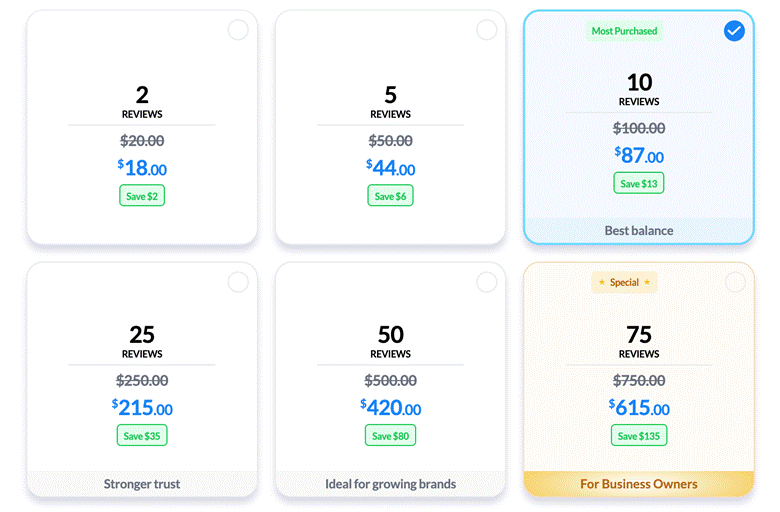
Pricing runs from $18 for 2 reviews to $615 for 75, with transparent per-review costs and discounts scaling with volume. The money-back guarantee and refill policy for removed reviews are both active and clearly documented.
Pros:
• 90-day drip with genuine randomization, not a fixed timer
• Local Guide-status accounts with 6+ months of verified posting history
• City and country-level geo-targeting from residential IPs
• Male/female reviewer selection; custom text or professional writing both available
• Photo reviews on request; money-back guarantee and active refill policy
• 7+ years operating, 248,000+ reviews delivered, 87% client retention rate
Cons:
• Premium pricing; not the cheapest entry point in the market
• 90-day drip timeline is not suitable for businesses that need results in days
2. BoostMe — Ideal for Large-Scale Reputation Scaling
Overall quality rating: 9.2/10
BoostMe is ideal for businesses needing higher volume or a 30-day guarantee window instead of long-term drip campaigns. With over 135,000 repeat customers, it offers a proven, scalable solution for large-scale reputation management.
BoostMe provides high-quality reviewer accounts, featuring diverse posting histories, complete profiles, and Local Guide status, no freshly created bots.
Its delivery system mimics organic behavior through randomized posting intervals, varied IP addresses, and device diversity, effectively bypassing detection filters.
The service offers two tiers: standard 5-star reviews and custom written reviews, which include image reviews and business-specific content.
Pricing matches ReviewGrow on the 10-review package at $87, with volume discounts scaling to 20% off on 150-review orders at $1,199.
For businesses running aggressive scaling campaigns, the 150-review ceiling exceeds what ReviewGrow currently offers, making BoostMe the stronger fit for high-volume reputation recovery scenarios.
Pros:
• Higher volume ceiling than ReviewGrow, up to 150 reviews per order
• Genuine posting history on reviewer accounts; no freshly created profiles observed in testing
• IP diversity and device variation built into delivery to avoid detectable patterns
• 30-day money-back guarantee and 15-day package refills
• Custom written reviews with image options at the premium tier
• 24/7 customer support
Cons:
• Geo-targeting is less granular than ReviewGrow at the standard tier
• Standard tier account history depth averages slightly below ReviewGrow’s
3. TrustlyR — Affordable Solution for Localized SEO
Overall quality rating: 7.8/10
TrustlyR targets city-specific campaigns at roughly $3.20 per review, making it the most accessible option on this list for businesses that need metro-level geo-targeting without premium spend. Delivery is gradual, accounts carry some established posting history, and removal rates are acceptable for non-specialized industries with moderate volume.
The gaps become meaningful in higher-stakes contexts. Account geo-consistency is less precise than the top two providers, activity histories are shorter, and standard package content sits closer to the generic templates Google’s spam detection is trained to flag. For a dental practice or law firm, those gaps matter. For a general retail brand in a low-competition category, they are less consequential, and TrustlyR delivers results without the premium spend.
Pros:
• Low cost per review with city-level geo-targeting
• Gradual delivery from accounts with established, if limited, posting history
• Accessible pricing for budget-conscious businesses testing the approach
Cons:
• Account depth and geo-consistency fall below ReviewGrow and BoostMe
• Standard packages offer limited content customization
• Partial guarantee only; narrower refill terms than premium competitors
• Generic content increases detection risk for longer or higher-volume campaigns
4. ReviewFame — Effective Choice for Targeted Rating Boosts
Overall quality rating: 7.9/10
ReviewFame is built for a defined one-time rating lift rather than ongoing acquisition. Pricing starts at $8.99 per review, delivery begins within 10 minutes and continues through controlled drip-feed pacing across several days, and reviews use natural customer-experience language rather than sales phrasing.
The lifetime non-drop guarantee with automatic refills is the strongest replacement policy in this price range: any review removed by Google’s algorithm is replaced at no additional cost with no time window limiting the claim.
It is not the right foundation for a sustained multi-campaign strategy, but for businesses that want a single reliable boost with strong post-delivery protection, it is a defensible choice at a competitive price point.
Pros:
• Starts at $8.99/review with fast initial delivery and controlled drip continuation
• Lifetime non-drop guarantee with automatic refills at no extra cost
• Geo-targeted accounts with natural-sounding, business-specific content
• 4.5/5 Trustpilot score from verified customer reviews
• Responsive support team; straightforward ordering process
Cons:
• Not optimized for sustained multi-campaign growth strategies
• Requires a detailed content brief for best results; more setup effort upfront
• Smaller independent provider with a shorter verifiable operating track record
5. RatingLeader — Service for Negative Review Mitigation
Overall quality rating: 8.5/10
RatingLeader specializes in recovery scenarios where generic drip timelines are not calibrated to the individual profile. Their Velocity Shield tool analyzes your profile’s age, historical review frequency, and total existing count to determine the maximum safe delivery cadence for that specific listing. A 5-year-old profile with 200 reviews can absorb a different incoming volume than a 10-month-old profile with 25, and RatingLeader is the only provider on this list that accounts for that distinction.
The platform pairs purchased delivery with NFC and QR Smart Card technology to generate real organic reviews in parallel, and matches reviewer accounts to your industry category.
A dentist gets accounts with healthcare posting history; a restaurant gets profiles with food and hospitality activity.
Volume discounts apply for agencies and franchise operators. Note that the 30-day replacement window is shorter than ReviewGrow or BoostMe, which matters for extended campaigns.
Pros:
• Velocity Shield calculates maximum safe delivery speed per individual profile
• Industry-matched reviewer profiles add authentic contextual credibility
• NFC/QR Smart Card integration generates real organic reviews alongside purchased ones
• Volume discounts for multi-location accounts and franchise operators
• Delivery begins within 48 hours for time-sensitive recovery situations
Cons:
• 30-day replacement window is shorter than the top two providers
• Faster pacing on recovery orders requires closer monitoring than standard drip
• Primarily Spanish-market focused; international coverage available but secondary
6. SocialReviews — Entry-Level Option for Small Businesses
Overall quality rating: 6.5/10
SocialReviews is the lowest-cost entry point on this list, with a beginner-friendly interface and small minimum order sizes. Account quality is average, delivery has been slower than stated timelines in testing, and the Trustpilot score of 2.8 reflects real customer complaints about fulfillment delays rather than product failure.
For a business with no reviews and a tight budget making a small test order in a low-competition context, it can provide a starter foundation. For anything beyond that, the delivery inconsistency is a material disadvantage and the price-to-risk ratio does not improve enough to justify using it over the other options on this list.
Pros:
• Lowest cost entry point on this list
• Simple ordering process accessible to first-time buyers
• Accepts small minimum orders for low-commitment testing
Cons:
• Delivery frequently slower than stated timelines based on customer complaints
• Account quality is average with higher retention risk than premium alternatives
• 2.8 Trustpilot score from verified customers, driven by delivery delays
• No meaningful competitive advantage at comparable price points
Is Purchasing Google Reviews a Secure Reputation Strategy?
The honest answer is: yes, with provider selection doing most of the work. The practice violates Google’s review policies, and that baseline fact should inform every decision you make.
Google does not penalize the transaction itself; it penalizes detectable patterns.
A well-executed campaign using aged accounts, residential IPs, randomized drip delivery over six to twelve weeks, and custom-written content is significantly harder to flag than a bulk order from a bot farm.
From a reputation standpoint, the impact on customer perception is real. A business with a 3.6-star rating and 8 reviews is effectively invisible in competitive local search.
The same business at 4.5 stars with 40 reviews converts at a meaningfully higher rate. That conversion improvement is legitimate even when some reviews in the profile were purchased, because it reflects the social proof signal that real customers use to make decisions.
The risk concentrates in two places: choosing a low-quality provider, and ordering in volumes that create velocity spikes your profile cannot absorb naturally. Both are avoidable with the information in this guide.
Key Indicators of Authentic, High-Quality Reviews
Understanding this helps you evaluate any provider before you spend money. A review that survives long-term and builds genuine reputation value carries most of these characteristics:
• Posted from an account with 6+ months of activity history across multiple unrelated businesses
• Written in natural language specific to your business category, not generic praise templates
• Includes realistic detail: specific services, staff references, timeframes, or location mentions
• Posted from a residential IP address geolocated to your actual service area
• Varied length across the campaign: some concise, some detailed, matching real customer behavior
• Delivered with irregular intervals between reviews, not a fixed daily cadence
• Optionally accompanied by a customer photo relevant to the service
A 4.6-star profile built from reviews with these characteristics converts better than a perfect 5.0 built from obvious templates. Consumers consistently rate businesses with ratings between 4.3 and 4.8 as more trustworthy than those at 5.0, which reads as suspicious to experienced buyers.
Strategic Planning: Determining Your Ideal Review Volume
• New listing (0 to 5 reviews): Start with 5 to 10 reviews over 4 to 6 weeks. Build a credible foundation before scaling.
• Established listing (20 to 50 reviews): 10 to 20 reviews per month, delivered gradually, can materially improve your rating without a suspicious spike.
• Competitive local market: 20 to 30 reviews per month acquired gradually, blended with active organic generation, is a sustainable long-term strategy.
The most durable approach combines purchased reviews from a premium provider with organic generation: QR codes at point of sale, post-service email or SMS campaigns, and a direct review link that reduces friction for satisfied customers.
A profile growing through both channels is the most credible pattern to Google’s detection systems and the most persuasive signal to prospective customers.
Understanding Google’s Automated Spam Detection Systems
Google’s spam detection operates at the behavioral pattern level. The specific signals that trigger removal include:
• Velocity spikes: multiple reviews arriving in 24 to 48 hours on a profile that typically receives 2 to 3 per month
• Account age: reviews from accounts created within the past 30 days with no other review history
• IP clustering: reviews from the same IP address or range within a short window
• Content similarity: shared phrasing, sentence structure, or identical keyword placement across multiple reviews
• Geographic implausibility: reviewers whose activity history is inconsistent with your service area
• Profile incompleteness: accounts with no photos, no contribution history, and zero engagement outside your review
Google removed over 250 million fake reviews using AI in 2025. The practical implication is that the cheapest providers are the riskiest, because their economies of scale depend on exactly the patterns Google’s systems are trained to catch.
The gap between a $2-per-review service and a $9-per-review service is not margin; it is the cost of the account infrastructure and delivery engineering that determines whether your reviews stay on your profile.
Analyzing the Pros and Cons of Purchasing Reviews
Arguments in favor:
• A cold-start business with zero reviews is invisible in local search regardless of service quality. Competitors with 80+ reviews dominate the local 3-pack by default.
• Social proof directly affects conversion. A 4.5-star profile converts significantly better than a 3.8-star profile at equivalent pricing.
• Review count and rating are confirmed Google Maps ranking signals. Improving both improves your position in geo-modified searches.
• Reputation recovery after competitor review bombing is difficult to achieve organically on any reasonable timeline.
Arguments against:
• The practice violates Google’s review policies. This is unambiguous.
• Low-quality providers cause removal events that are publicly visible in your profile’s review history as sudden drops.
• Sustained dependence on purchased reviews without organic generation creates a fragile foundation that does not compound over time.
My professional position: the decision is about provider selection, not the category. Using ReviewGrow or BoostMe with their drip delivery and aged accounts carries meaningfully lower detectable risk than using a bulk bot service. Using a bulk bot service is paying to damage your own profile.
Final Take
Purchasing Google reviews is a high-stakes strategy that depends entirely on provider quality. Avoid bulk services that promise instant delivery, as these trigger spam detection and risk profile damage. The most effective approach is a blended strategy: use premium providers like ReviewGrow or BoostMe for controlled, gradual growth with aged accounts, and simultaneously build organic momentum through point-of-sale requests, email follow-ups, and active profile management. Treating your Google Business Profile as a long-term asset requires patience; there are no shortcuts that bypass the need for authentic, locally-relevant engagement.
Frequently Asked Questions
What is the best site to buy Google reviews to improve reputation?
ReviewGrow is the premier choice for its 90-day drip delivery and high account quality. BoostMe is ideal for high-volume orders exceeding 75 reviews.
Will buying Google reviews actually improve my reputation?
Yes. Quality reviews delivered gradually increase consumer trust, improve click-through rates, and support better local search rankings.
Is it safe to buy Google reviews for my business?
Safety depends on the provider. Premium services using aged accounts and residential IPs maintain high retention, whereas budget bot services carry high suspension risks.
How long does delivery take?
Timelines vary: ReviewGrow takes 90 days, BoostMe takes days to weeks, and ReviewFame starts instantly. Avoid any service promising delivery within 24 hours.
Can Google remove reviews I paid for?
Yes, if they show detectable bot patterns. Using aged accounts with natural history significantly improves retention; top providers report over 90% retention at 90 days.
Are geo-targeted reviews worth the extra cost?
Yes. Localized accounts carry more SEO weight and are less likely to be flagged by Google as geographically implausible.
Can I write my own review text?
Yes. ReviewGrow and BoostMe allow custom text, which reduces detection risk and ensures the content is relevant to your specific business.
How many reviews should I buy to improve my reputation?
Start with 5–10 reviews for new listings or 10–20 monthly for established ones. Always blend purchased reviews with organic growth for the best results.
Can competitors report my purchased reviews?
Yes, but Google only removes them if they fail algorithmic evaluation. High-quality accounts with natural language typically survive competitor flagging.
What replacement guarantees do these providers offer?
Guarantees vary: ReviewGrow and BoostMe offer refill periods, while ReviewFame provides a lifetime non-drop policy. Budget providers offer limited protection.
What red flags should I watch for in a provider?
Avoid services that require login credentials, promise instant delivery, price reviews under $2, or cannot prove account history.
Does buying reviews help with local SEO rankings?
Yes. Improved count, rating, and recency are confirmed ranking signals that help your business appear in the Google Maps local 3-pack.