


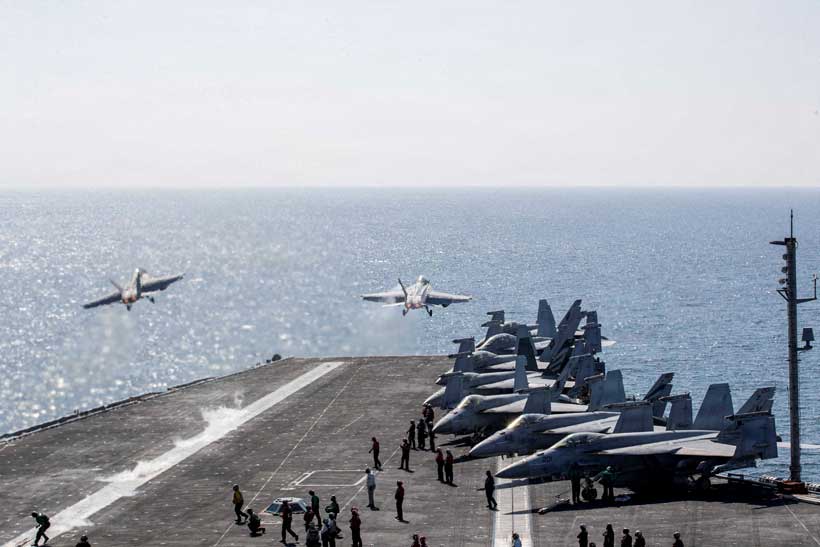
Undoubtedly, the stakes are extremely high. The Middle East remains unstable due to rivalries among major powers vying for influence. How the United States and Europe act in this context will not only shape the outcome in the region but also the future of the transatlantic partnership.
American Critiques: Overstretch Is Not Theoretical
In particular, high-quality academic literature has been especially vocal in questioning whether deploying US forces to the Middle East has become counterproductive for US national security interests. The Iran affair has been described as an unnecessary event that caused damage and was cheered because it marked the end of this and the steps taken to implement restrictions on war powers (Payne, 2024; Kavanagh & Wehrey, 2023). It is worth noting that such views can be found in strategic studies and defense literature on force structure, acquisition constraints, and alliance management (Brooks & Wohlforth, 2023; Mearsheimer, 2018).
The basic justification behind all the positions mentioned above is based on different observable trends. To start with, neither the use of force nor any kind of intervention has ever produced stability in the region. Over the past decades, American military engagement in the region has been followed by ongoing conflicts, weak states, and the emergence of new threats. Second, domestic political and financial pressures are increasing even as the strategic value of the region declines. It is becoming harder to justify the expense of maintaining large-scale military engagements in the Middle East while other regions of the world, especially Asia, demand more attention. Third, the post-war environment calls for diplomatic and economic measures instead of maintaining military engagement. The post-war situation after the conflict with Iran in 2026 again showed that despite victory, it remains difficult to achieve desired political goals.
Overdependence on US capabilities will further discourage partner countries from developing their own. The reason is that with America always interfering and managing crisis situations for them, these regional actors lack incentives to develop their own defense and diplomacy capabilities. Ultimately, this dependency creates a vicious cycle that undermines the very alliances the US seeks to foster. Therefore, the argument in favor of restraint does not mean that the US is arbitrarily reducing its involvement.
French and European IR: From Diagnosis to Agency
Stay ahead of the geopolitical week.
MD Briefing delivers expert analysis across five global fronts — the Indo-Pacific, energy, geoeconomics, European security, and the Middle East — every Monday morning. Free.
The international relations institutions of France share a similar view of the limitations of a military-focused approach to international relations, but they differ in the implications for the operational aspects of foreign policy. The June 2026 assessment of Iran’s post-conflict situation, conducted by IFRI, emphasizes the limited importance of regime pressure, the economic sanctions imposed, and the new opportunities arising from the end of hostilities (IFRI, 2026a). The IRIS evaluated the prospects of the agreement between the United States and Iran and its regional impact (IRIS, 2026a). In both assessments, it is noted that diplomacy and multilateral agreements will play a crucial role in shaping the region after 2026, just as much as any nation’s military strategy.
French strategy continues beyond these conclusions and directly considers what Europe should develop for itself. Among many ideas, two closely related concepts stand out. The first is strategic autonomy, which means independence in decision-making from the U.S. The second is the framework nation—a policy where one or several European countries coordinate actions in multilateral operations (Biscop, 2023; Fiott, 2026).
This is not an effort to revive abstract Gaullism in today’s context. Instead, it is a response to the harsh reality that the cycles and strategic thinking of the USA will never perfectly align with those of Europe regarding the Middle East, North Africa, and the eastern Mediterranean (IFRI, 2018; Biscop, 2023). The Framework Nation concept offers an opportunity for capable European countries to act more quickly without stepping outside the realm of European politics.
At the same time, the framework-nation idea comes with its own risks. It requires political will, military strength, and the willingness of other European states to follow. It also demands careful diplomacy with NATO and the USA to prevent being perceived as duplicating their efforts. However, there are also risks associated with choosing alternative courses of action.
Convergence and Productive Tension
Certainly, both lines of reasoning influence each other in important ways. Specifically, both acknowledge the issue of limited political gains from significant American military involvement (Brooks & Wohlforth, 2023). Furthermore, both recognize that the current situation in Iran, which involves recalibration rather than destruction or dominance, calls for strong diplomatic skills instead of military action (IFRI, 2026a; IRIS, 2026a). Lastly, both see that the political climate in the White House creates an uncertain environment that Europe cannot ignore (Fiott, 2026).
Productive contradictions emerge in the proposed solutions to this issue. Usually, a logic of restraint ends with the idea that Washington should either stop doing too much or approach it differently. However, France and Europe overall believe that Europe should be capable of doing more and differently. These approaches are not opposed but complement each other; strengthening the capabilities of European framework nations will ease the burden on the U.S. to maintain its traditional role as the security guarantor.
This strategy is not only a more sustainable path than either unilateral U.S. withdrawal or European reliance on American military responsibilities, but also a more realistic approach to managing the conflicts of interest that come with two major powers sharing the same strategic space. The question remains how this agreement can be put into practice.
Practical Implications
Such specific measures can be implemented as part of this strategy. First, European framework nations need to analyze particular scenarios in the Middle East where they can launch multinational military missions without U.S. involvement. These missions could include stabilization and maritime security in the Persian Gulf or the Red Sea, as well as specific counter-proliferation or counter-terrorism operations (Biscop, 2023; IFRI, 2026b). Completing two or three such missions will build enough credibility, tactical experience, and political momentum to sustain the policy.
Second, Europe’s diplomatic efforts to resolve Iran’s role in the region must be pursued through mechanisms that enable independent action. This does not mean replacing U.S. diplomatic tools but supplementing them with additional European political and diplomatic measures (IRIS, 2026a; IFRI, 2026a).
Third, capabilities must be developed within an operational doctrine framework. Leadership among the framework nations is effective only when aligned with operational missions and doctrine. Procurement and defense industry cooperation should follow the doctrine, not the other way around. This requires tough political choices for Europeans.
Fourth, methods of cooperation across the Atlantic should consider opportunities for European autonomous action and should not view these as a threat to alliance unity. The key issue is avoiding two undesirable options – a Europe that is strategically dependent or a purely nationalist policy, neither of which benefits the broader interests of the Western world (IFRI, 2018; Biscop, 2023).
Finally, both parties should initiate a strategic dialogue on dividing labor in the Middle East and North Africa. In other words, they should move beyond mere declarations and start planning how Europeans can operate independently when necessary.
Why This Synthesis Matters Now
Regarding the post-2026 scenario in the Middle East, uncertainty remains. Although there has been some monitoring of Iran’s involvement, it is ongoing. There are still options for diplomacy, along with the risks of miscalculation and escalation (IFRI, 2026a; IRIS, 2026b). American political dynamics continue to favor selectivity over full engagement. Europeans are coming to terms with the fact that securing their southern and eastern neighborhoods cannot be outsourced indefinitely (Fiott, 2026). In this context, the only viable path forward is neither deploying large U.S. military forces nor an entirely declaratory Europe; instead, it should involve a division of responsibilities between American restraint and European capabilities through the framework nation model (Biscop, 2023; IFRI, 2026b). Overextension in America remains a valid critique. The French and Europeans, who advocate for strategic autonomy and framework leadership, propose a highly realistic solution to the problem. Combining these perspectives offers a more practical approach than relying on either alone. When American political cycles influence selectivity, and Europe seeks greater autonomy, this combined approach provides a practical way forward.
