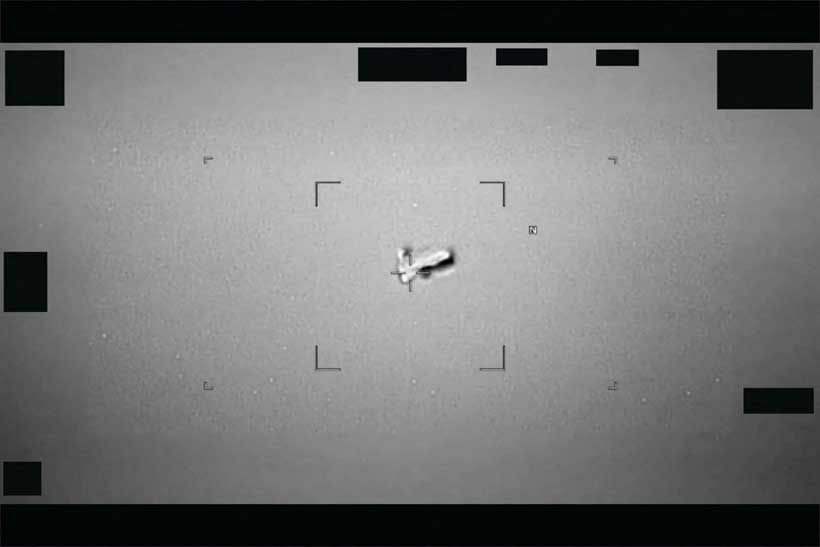
For decades, the U.S. government’s UFO files sat in classified vaults, locked away from public view. Researchers filed FOIA requests. Journalists pushed for answers. Congress held hearings. And still, the files stayed hidden.
That changed on May 8, 2026.
On that date, the Trump administration — through a new program called PURSUE — released an initial batch of 162 declassified files covering more than 400 unidentified aerial phenomena (UAP) incidents dating back to 1947. Videos of objects performing impossible maneuvers. Apollo astronaut testimonies describing unexplained lights in space. FBI case files on the Roswell incident. Cold War-era sightings near nuclear installations.
The government’s portal — war.gov/ufo — received over one billion visits within days of launch.
Stay ahead of the geopolitical week.
MD Briefing delivers expert analysis across five global fronts — the Indo-Pacific, energy, geoeconomics, European security, and the Middle East — every Monday morning. Free.
This is not a conspiracy theory. This is the U.S. Department of Defense, the FBI, NASA, and the intelligence community putting their files on the table and telling the American public: “Decide for yourselves.”
So — what’s actually in them? What do experts say? What questions remain unanswered? And what happens next?
This is your complete guide.
What Is the PURSUE Program — and Why Did It Happen Now?
Before diving into what the UFO files contain, it’s worth understanding how they were released — because the mechanism itself is significant.
Trump’s February 2026 Announcement
On February 19, 2026, President Trump posted to Truth Social that he would direct the Department of Defense and relevant federal agencies to begin identifying and releasing government records related to unidentified anomalous phenomena. The announcement was short. The implications were enormous.
The directive invoked the President’s executive authority over classified national security materials — a legal power with strong precedent. Trump used similar authority in his first term to release the JFK assassination files. But this release was broader in scope and more coordinated across agencies than anything seen before.
What PURSUE Actually Is
PURSUE stands for the Presidential Unsealing and Reporting System for UAP Encounters. It is a coordinated, multiagency declassification program involving:
- The White House
- The Department of War (formerly the Department of Defense — the lead coordinating agency)
- The Office of the Director of National Intelligence (ODNI)
- The Department of Energy
- The All-domain Anomaly Resolution Office (AARO)
- NASA
- The FBI
- Additional intelligence community components
The files are hosted publicly at war.gov/ufo — no security clearance required. The program operates on a rolling release schedule, with new tranches published every few weeks.
“First time in history,” said FBI Director Kash Patel, “the American people have unfettered access to declassified government files on UAP.”
What’s Actually in the UFO Files? A Tranche-by-Tranche Breakdown
Tranche 1 — May 8, 2026: The Opening Salvo
The first release contained 162 files documenting more than 400 UAP incidents spanning from 1947 to 2026. It included:
- Approximately 24 declassified infrared videos
- FBI case files with significantly fewer redactions than previous releases
- State Department diplomatic cables referencing aerial anomalies
- NASA Apollo mission archival imagery and astronaut debriefing transcripts
- Military incident reports from Iraq, Syria, Greece, Africa, and the continental United States
- A 1947 FBI memo referencing the Roswell “flying disc” recovery
- Cold War-era sighting reports concentrated around U.S. nuclear military installations
- A 1948 account from Netherlands-based airmen documenting recurring flying saucer observations
President Trump, in a statement accompanying the release, invited Americans to “decide for themselves, ‘WHAT THE HELL IS GOING ON?'”
Tranche 2 — May 22, 2026: The Deeper Cut
Two weeks later, a second tranche arrived — 64 additional files including:
- 51 infrared videos showing UAP encounters
- 7 NASA audio recordings from Mercury and Apollo missions, featuring astronauts describing reflective particles and unexplained light phenomena
- Reports of a four-object formation near Iran (August 2022) — flying in synchronized patterns with no visible propulsion
- A Syria incident (2021) in which an object executed what analysts described as “instant acceleration” far exceeding any known aircraft’s capabilities
- The Lake Huron incident (February 2023) — an F-16 shootdown of an octagonal object with some recovered debris
- A senior intelligence official account from 2025 describing orange orbs that split apart and changed direction: “We were virtually speechless after these observations.”
The NSA Top Secret Umbra Release — May 18, 2026
Running parallel to the PURSUE releases, the National Security Agency was compelled — through a FOIA appeal by the Disclosure Foundation — to release over 300 pages of formerly Top Secret Umbra-level records. These were among the most sensitive signals intelligence classifications in the U.S. government.
Most of the content remains heavily redacted. But the release itself was significant: it confirmed that the NSA had been treating UAP incidents as legitimate intelligence matters for decades — not as fringe curiosities to be dismissed.
The Apollo Files: What Astronauts Actually Reported
One of the most talked-about elements of the UFO file release involves NASA’s own astronaut testimony — declassified records from the Apollo missions of the 1960s and 70s.
Apollo 11 — Buzz Aldrin’s Account (1969)
In a 1969 post-mission debriefing, astronaut Buzz Aldrin described observing a “sizeable” object positioned close to the moon and identified what the crew believed to be a “fairly bright light source” that some speculated could have been a laser. Aldrin also reported seeing “little flashes inside the cabin” — anomalous light phenomena with no obvious source.
Apollo 12 — Lights Above the Lunar Surface (1969)
Astronaut Alan Bean reported “flashes of light” observed in space during the Apollo 12 mission. The crew noted these appeared above the lunar terrain and could not identify their source.
Apollo 17 — Harrison Schmitt’s “Fourth of July” (1972)
Lunar module pilot Harrison Schmitt described seeing bright particles during the Apollo 17 mission with the memorable line: “It’s like the Fourth of July out there!” A photograph from the same mission showed three dots arranged in a triangular formation, which Pentagon analysts noted “could represent a physical object.”
It is worth noting, as the Pentagon’s own disclaimers do, that astronauts at the time theorized some observations might have been ice chunks, reflective debris, or cosmic ray interactions with their retinas. The files document the reports — they do not provide definitive interpretations.
Cases That Have Researchers Paying Attention
Among the hundreds of files released, several incidents have drawn disproportionate attention from researchers, pilots, and UAP investigators:
The Greece Formation (date unspecified in files) A declassified video showing an object executing multiple 90-degree turns at approximately 80 mph — a maneuver that defies conventional aerodynamics. No known aircraft, drone, or atmospheric phenomenon behaves this way.
The Iran Formation — August 2022 Four objects observed flying in tight, synchronized formation with no visible propulsion system — no exhaust, no rotors, no heat signature consistent with conventional engines.
The Syria Instant Acceleration — 2021 An object filmed over Syria that executed what military analysts described as “instant acceleration” — going from stationary or slow-moving to extreme speeds with no visible propulsion event and no sonic boom.
The Lake Huron Shootdown — February 2023 An F-16 fired on and brought down an octagonal object over Lake Huron. Some debris was reportedly recovered. The files include the incident report, though detailed forensic findings remain classified.
What the U.S. Government Is Saying — Key Quotes
The language used by senior officials around these releases has been notably direct:
“Department of War in lockstep with President Trump to bring unprecedented transparency regarding the government’s understanding of UAP.” — Defense Secretary Pete Hegseth
“These files, hidden behind classifications, have long fueled justified speculation.” — Defense Secretary Pete Hegseth
“First time in history, the American people have unfettered access to declassified government files on UAP.” — FBI Director Kash Patel
“Candid disclosure about what we know to be true, what we have yet to understand.” — NASA Administrator Jared Isaacman
“The American people can now access the federal government’s declassified UAP files instantly.” — Pentagon official statement
Director of National Intelligence Tulsi Gabbard emphasized the multiagency coordination involved, describing the effort as providing “maximum transparency.”
How Experts Are Reacting — And Where They Push Back
The UFO file releases have generated an enormous range of reactions — from genuine excitement to measured skepticism. Here is where the serious analysts actually land.
The Skeptical Camp: “Data Without Context Is Not Disclosure”
The most substantive critique has come not from conspiracy theorists, but from credentialed defense researchers and UAP investigators who believe the releases, while historic, fall short of meaningful transparency.
Christopher Mellon, former Deputy Assistant Secretary of Defense for Intelligence, put it bluntly:
“Data alone is not disclosure. Releasing raw files without context may confuse more than clarify.”
Mellon’s core concern is that the government released raw documents without the analytical products — the internal assessments, conclusions, and follow-up investigations — that would tell the public what officials actually believed they were looking at.
Ryan Graves, founder of Americans for Safe Aerospace and a former Navy pilot who himself reported UAP encounters, echoed this view:
“Ambiguous imagery without provenance, metadata, and operational context is hard for pilots, researchers, or the public to evaluate responsibly.”
Alejandro Rojas of Enigma Labs noted that many case summaries were released without coordinates, sensor parameters, or altitude data — the technical specifics that would allow independent researchers to conduct meaningful analysis.
Rear Admiral Tim Gallaudet (ret.), former Navy Oceanographer, flagged missing metadata on the videos as a significant problem, suggesting that the most genuinely classified evidence has not yet been released.
Research analyst Grant Lavac offered perhaps the most deflating assessment: most of the historical files, he said, had already been in the public domain for decades in various forms.
The Scientific Camp: “Let Evidence Lead”
Harvard astrophysicist Avi Loeb — arguably the world’s most prominent scientist willing to engage seriously with UAP — took a more measured but still constructive view. In a widely read essay published shortly after the Tranche 1 release, Loeb wrote:
“Science should be driven by evidence.”
He acknowledged that, based on what had been released so far, “there is no object that seems to be beyond any reasonable doubt extraterrestrial” — while emphasizing that incomplete information prevents firm conclusions in either direction.
Loeb framed the release’s most important contribution as psychological and cultural: by treating UAP as a legitimate subject of inquiry rather than a topic to be dismissed, the government had opened the door to serious scientific engagement that had previously been effectively impossible.
“Being curious and avoiding pretense about already knowing the answers,” he wrote, “is what science is.”
He also noted that Congresswoman Anna Paulina Luna had requested 46 additional videos from the Pentagon — suggesting, in Loeb’s words, that “the best is yet to come.”
The UAP Community: “Historic But Incomplete”
The overall verdict from the UFO research community was captured well by Jordan Flowers, Executive Director of the Disclosure Foundation:
The Greece video and the Apollo astronaut observations represent credible, multi-witness documentation worth taking seriously. The NSA Top Secret Umbra release confirms decades of institutional attention to UAP at the highest classification levels. But the absence of analytical conclusions — the government’s own internal interpretations of what these objects were — remains the central unanswered question.
What the Pentagon’s Own Disclaimer Says
Buried in the official release documentation is a caveat that deserves careful attention:
The Pentagon explicitly stated that the “subjective interpretation” contained in military reports “should not be interpreted as a conclusive indication” of what actually occurred.
In plain terms: these files document what military personnel reported and believed they observed. They do not represent official government determinations that any of these objects are extraterrestrial, adversarial, or otherwise definitively explained.
The All-domain Anomaly Resolution Office (AARO) — the Pentagon’s dedicated UAP office — noted that the majority of UAP cases, when fully investigated, resolve to conventional explanations: drones, weather balloons, atmospheric phenomena, sensor artifacts, and classified U.S. or adversarial technology.
The subset that lacks a clear conventional explanation — including cases involving formation flying, instant acceleration, and objects with no visible propulsion — is the focus of ongoing investigation.
The Historical Thread: UFOs and the U.S. Government Since 1947
The current disclosures don’t exist in a vacuum. They are the latest chapter in a decades-long, often uncomfortable relationship between the U.S. government and the UFO question.
A condensed timeline:
- 1947 — The Roswell incident. The Air Force initially described recovered debris as a “flying disc” before quickly changing the account to a weather balloon. The 2026 files include an original FBI memo referencing the incident.
- 1948–1969 — Cold War-era sighting reports flood military channels. Many cluster near nuclear facilities.
- 1969 — Project Blue Book, the Air Force’s official UFO investigation program, is officially closed.
- 2007 — The Pentagon’s secret Advanced Aerospace Threat Identification Program (AATIP) is created. It runs until 2012 (officially) before transitioning to successor programs.
- 2017 — The New York Times publishes a bombshell investigation into AATIP and releases three declassified Navy videos. The conversation changes permanently.
- 2020–2021 — The Pentagon officially acknowledges the three videos. Congress demands UAP briefings. The ODNI releases the first UAP intelligence assessment.
- 2023 — Whistleblower David Grusch testifies before Congress, alleging the U.S. government possesses non-human craft. The claims are unverified but trigger significant legislative action.
- 2026 — PURSUE launches. The largest government UAP disclosure in U.S. history begins.
What Remains Classified — and What’s Coming Next
The PURSUE program is explicitly described as a rolling process, not a one-time dump. Officials have been candid about the scale of what remains under review:
- Millions of documents across multiple agencies remain unprocessed
- Many exist only in physical paper form, requiring manual digitization before review
- The NSA records compelled by FOIA represent only a fraction of what the agency holds
- Tranche 3 is confirmed to be in development
Several specific items being tracked by researchers and lawmakers:
- The 46 videos requested by Congresswoman Anna Paulina Luna
- Analytical products — the government’s own internal conclusions about specific incidents
- Records from legacy programs predating AARO that may have operated with greater secrecy
- Any material evidence from recovered debris, including the Lake Huron octagonal object
Rear Admiral Gallaudet’s assessment — that the truly classified evidence has not yet been released — is worth keeping in mind as the next tranches arrive.
How to Think About This as a Citizen
It is tempting, in both directions, to overclaim. Here is a grounded framework for interpreting the UFO file release:
What the releases definitively confirm:
- The U.S. government has collected, documented, and preserved UAP encounter reports across multiple agencies for at least eight decades
- Military personnel — including senior officers, astronauts, and intelligence officials — have reported unexplained aerial phenomena that defied conventional explanation at the time
- Some fraction of reported cases remain unexplained even after investigation
- The government is now willing to make a substantial portion of this material publicly accessible
What the releases do not confirm:
- The existence of extraterrestrial life or technology
- That any observed phenomena are of non-human origin
- That the government has recovered alien craft or bodies (as some whistleblowers have alleged)
- That any of the reported incidents represent a genuine threat to national security
What remains genuinely open:
- The nature of the unexplained cases — particularly those involving instant acceleration, formation flight, and objects with no apparent propulsion
- Whether legacy classified programs hold more definitive evidence
- What AARO’s ongoing investigations will ultimately conclude
Conclusion: A Door Has Opened — But the Room Is Not Yet Lit
The Trump administration’s UFO file releases represent a genuine historical turning point. Not because they prove that alien life exists — they don’t. Not because they expose a grand cover-up — that remains unverified. But because they represent the U.S. government formally, publicly, and at the highest institutional levels acknowledging what it has spent decades collecting in secret.
For the first time, a citizen anywhere in the world can visit a government website, download declassified military videos of UAP encounters, read astronaut testimonies describing unexplained lights in space, and review FBI memos referencing events at Roswell — without a security clearance, a FOIA request, or a lawsuit.
That is not nothing. In fact, it is historic.
But Christopher Mellon is right: data alone is not disclosure. The public now has the raw files. What it does not yet have is the government’s own analytical conclusions — what officials actually believe these objects are. Until those products are released, the most honest answer to the question of what is going on in our skies remains the same one President Trump offered:
“Decide for yourself.”
The investigation is ongoing. Tranche 3 is coming. And millions of documents still await review.
Watch this space.
Frequently Asked Questions About the UFO Files
What exactly did the Trump administration release in the UFO files?
The Trump administration released hundreds of declassified documents through a program called PURSUE (Presidential Unsealing and Reporting System for UAP Encounters). The first two tranches — released in May 2026 — included over 75 infrared videos, FBI case files, State Department cables, NASA Apollo mission records, and military incident reports spanning from 1947 to 2025. The files are publicly accessible at war.gov/ufo.
Do the UFO files prove the existence of alien life?
No. Neither the Pentagon, NASA, nor any other releasing agency has claimed that the released UFO files prove the existence of extraterrestrial life. The documents record what military personnel and astronauts observed and reported. The Pentagon explicitly noted that reported observations “should not be interpreted as conclusive” about what actually occurred. The majority of UAP cases, when fully investigated by AARO, have been explained by conventional means.
What are the most significant cases in the released UFO files?
Among the most discussed are: Buzz Aldrin’s 1969 account of a “sizeable” object near the moon; a 2022 incident near Iran showing four objects in synchronized flight with no propulsion; a 2021 Syria case involving apparent “instant acceleration”; the 2023 Lake Huron shootdown of an octagonal object by an F-16; and a Greece video showing an object performing 90-degree turns at approximately 80 mph.
Will more UFO files be released?
Yes. PURSUE operates as a rolling disclosure program, and Tranche 3 has been confirmed. Officials have acknowledged that millions of documents across multiple agencies remain under review — many in paper form requiring manual digitization. Specific files being tracked include 46 videos requested by Congresswoman Anna Paulina Luna and analytical products from internal government assessments of UAP incidents.
What do scientists think about the UFO file releases?
Reactions among scientists and credentialed analysts are mixed. Harvard astrophysicist Avi Loeb has argued that the releases open the door to legitimate scientific inquiry, while noting that nothing in the released files is “beyond reasonable doubt extraterrestrial.” Former defense officials like Christopher Mellon and pilot-researcher Ryan Graves have criticized the releases for lacking the contextual metadata and analytical conclusions needed to evaluate the cases scientifically. Most researchers agree the releases are historically significant — but incomplete.
Sources: Department of War PURSUE release | Pentagon UFO files — CNN | Apollo astronaut files — Fortune | PURSUE full guide — Today Why | Expert reactions — DefenseScoop | Avi Loeb’s essay — Medium | PURSUE program overview — USA Herald | NBC News coverage
Article accurate as of July 2026. The PURSUE program is ongoing; additional file tranches are expected.