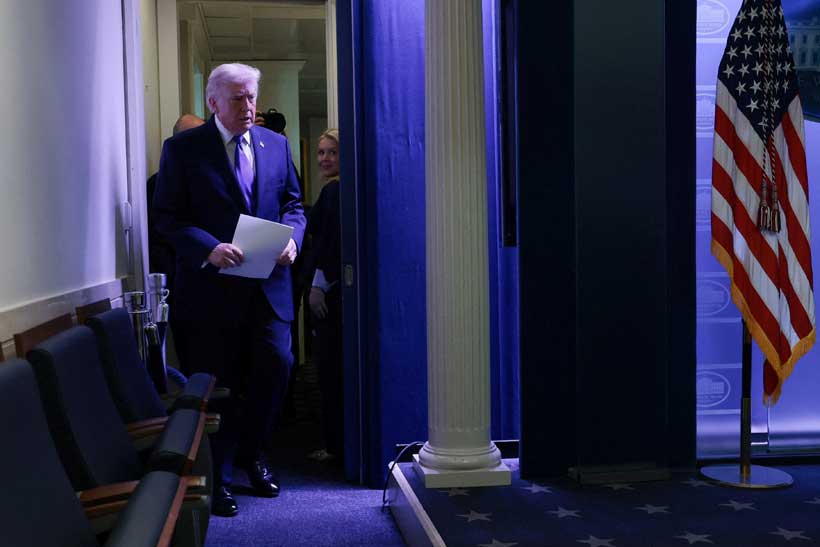
Recent months have delivered a geopolitical earthquake to the international rule-based order that has directed global politics since the end of World War II. Free international trade—a key pillar of this order—has been under particular pressure in recent years, with ongoing trade tensions between the United States (US) and China since 2019. This development has escalated to unprecedented levels with the second administration of US President Donald Trump, who placed a drastic chokehold on global trade in April 2025 when he introduced staggering multi-digit tariffs.
The end of an economic era
Until Trump’s tariff ‘Liberation Day’ in 2025, barriers to global trade were limited under the framework of the World Trade Organization (WTO), which through generalised bilateral trade agreements and a shared trade dispute settlement mechanism has promoted a reduction in tariff and non-tariff trade barriers, and stabilised and expanded global trade. This trend has been reversed in recent years, with 2025 seeing a notable increase in tariffs around the world, and a reduction in global trade.
What makes this protectionist trend notable is that it encompasses not only geopolitical rivals. For example, President Trump placed Japan and the EU—traditional allies and key trade partners of the US all since the Cold War—under 20% tariffs in the spring of 2025. Similarly, the US threatened neighboring Mexico with 30% tariffs over immigration and border disputes, throwing doubt on the impending renewal of the USMCA (US-Mexico-Canada) trade agreement. However, Trump announced in June 2026 that tariffs on industrial equipment produced in Mexico and Canada with US inputs will be reduced, albeit remaining at 15%. Likewise, the so-called ‘special relationship’ between the US and United Kingdom that has been especially important since the latter left the EU meant nought when Trump launched his big tariff package in March 2025, submitting its long-standing ally to 25-50% tariffs.
Stay ahead of the geopolitical week.
MD Briefing delivers expert analysis across five global fronts — the Indo-Pacific, energy, geoeconomics, European security, and the Middle East — every Monday morning. Free.
Who is winning the tariff war?
President Trump has justified his tariff war by arguing that it protects US manufacturing industries and jobs, and counteracts allegedly long-standing unfair trade practices of US trade partners, in effect reviving the US economy. However, independent analyses suggest that tariff costs are mainly passed onto US consumers, raising commodity prices, risking inflation and reduced economic growth. From a broader perspective, the rise in trade barriers cements global economic inequalities by making it even more difficult for developing economies, mainly located in Africa and Asia, with less economic bargaining power to sell their products on the global market.
Plateaus in the protectionist trend line
But the recent dissemination of tariffs in the global economy does not mean that free trade is in universal and inevitable decline. For example, the EU and India recently signed a free trade agreement that has been years in the making, while the 2026 finalization of the new EU-Mercosur agreement fosters trade between Argentina, Brazil, Paraguay and Uruguay, and Europe by lowering tariffs and other trade barriers This occurs at a time where the historically strong links between Europe and the US are fragmenting. In addition, trade relations have been undergoing repair in recent months, with the US and EU reaching an agreement in late 2025, capping US tariffs at 15%. However, while notably lower than the ’Liberation Day’ tariffs of 20-25%, transatlantic trade barriers on many products remain significantly higher than pre-2025 levels, so that trade is only partially restored to its previous state.
Furthermore, even though the US Supreme Court annulled some of Trump’s tariffs as unconstitutional in the beginning of 2026, this has not prevented Trump from exploring other ways of introducing tariffs by launching investigations concerning labor law violations in 44 countries. Already, the investigation has deemed Canada, Ecuador, the European Union, Mexico and Pakistan neglectful in implementing labor laws, proposing a punitive 10% tariff on these countries. Likewise, Trump has ordered investigation into major economies like China, the EU, India, Japan and Taiwan under accusations of excess manufacturing capacity, again threatening to hike tariffs on these countries.
Conditionalizing freedom
Hence, free trade relations are assuming a new, increasingly conditional character based on selective and often transactionally unequal bilateral agreements, outside of the existing WTO framework. For example, the EU only received reduced tariffs under the new EU-US trade agreement in exchange for promises of importing more US oil. Similarly, the tense relations between US and India experienced rapprochement earlier this year, with the US promising to lower tariffs from 25 to 18%. This is conditioned on India opening its protected agricultural market to US produce, and replacing Russian oil imports with US ones.
Free trade in a new form
What these developments suggest, then, is that free trade governed by a shared international regime of rules and procedures can no longer be taken for granted as an unchallenged status quo. Hence, countries are increasingly seeking to establish alternative free trade relations as conventional ones fragment. Thus, while free trade does not appear to be disappearing altogether any time soon, it does seem to become limited to a coalition of the willing, and even when rebuilt through bilateral agreements appears to remain narrow and marked by uncertainty and unpredictability. This marks a stark contrast to the universal standard long endorsed and promoted by the postwar US. In this new order, free trade is not the default; it has to be negotiated and earned.