


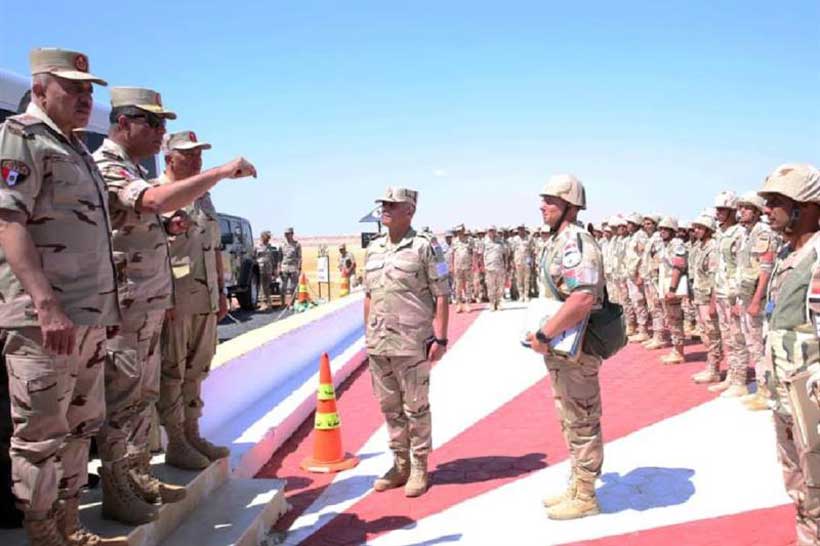
The activities and movements of Egyptian Defense Minister Lieutenant General Ashraf Salem Zaher have garnered significant attention from official Chinese military and media circles, particularly since his appointment as minister of defense in February 2026, coinciding with the 70th anniversary of Egyptian-Chinese diplomatic relations that same year. News concerning the Egyptian army and Ministry of Defense receives extensive strategic coverage in Chinese military publications and websites. The Chinese military leadership (under the guidance of Chinese Defense Minister Dong Jun) is keen to maintain coordination with the Egyptian army command in combating terrorism and exchanging intelligence, especially in light of current regional developments following the Iran War and the Strait of Hormuz crisis.
This Chinese media and military coverage of the Egyptian army and Ministry of Defense is justified by the interest in analyzing how relations between the two countries’ defense ministries have evolved from mere conventional arms sales to a strategic defense partnership focused on tactical training and technology transfer. Chinese military websites are heavily covered by joint arms deals and advanced military exercises with Egypt. China considers Egypt a cornerstone in Africa and the Middle East and a pivotal partner in securing its trade routes in the Red Sea. Official Chinese media coverage and expert articles focus on the nature of Sino-Egyptian military relations, such as the joint air force exercises (Civilization Eagles) between Egypt and China. Chinese media outlets paid close attention to the Civilization Eagles 2025 exercise, which was conducted in Egypt. Platforms such as the website of the Chinese government-affiliated Global Times magazine emphasized that this exercise was the first of its kind in which the Chinese Air Force deployed a regular force to Egypt and Africa. This is the first time the Chinese Air Force has deployed a regular force to Egypt and Africa. Chinese military websites have also praised the efficiency of Egyptian pilots and the capabilities of early warning aircraft, such as the KJ-500, and Chinese fighter jets like the J-10C. They have also highlighted the importance of joint military production between the two countries, noting that their historical cooperation extends to the joint production of the K-8 basic training aircraft, also known as the JL-8, in collaboration with the Arab Organization for Industrialization in Egypt. These Chinese-Egyptian military partnerships have been carefully reviewed on Chinese military websites. These websites also emphasize cooperation in air defense systems and joint military manufacturing between Egypt and China. Specialized Chinese military journals are closely following Egypt’s acquisition of advanced Chinese long-range air defense systems, such as the HQ-9B, considering it a significant step in enhancing Egyptian defense capabilities. Chinese reports also highlight efforts to localize Chinese military technology in Egypt, such as the Raad-300 system and armed drone programs. Websites affiliated with the Chinese Ministry of Defense focus on the topic of developing Egyptian naval capabilities, with analytical reports on these sites, including those from the China Military Online website, addressing the ongoing discussions and potential cooperation regarding Yuan-class submarine deals, which are military known as Yuan-class / Type 039A. These deals aim to enhance Egypt’s naval deterrence in the Eastern Mediterranean. Chinese military websites also focus on the comprehensive strategic partnership between Egypt and China and the Egyptian-Chinese presence in the Red Sea. Here, Chinese military articles discuss important topics such as Egypt’s vision for developing its military and naval infrastructure. Beijing views Egyptian bases in the Red Sea as a vital strategic asset for securing China’s Maritime Silk Road and protecting its economic and trade interests in the region.
Chinese media coverage and analysis via People’s Liberation Army (PLA) defense websites and military research centers focused on several strategic axes, including the characterization of Egyptian Defense Minister Ashraf Salem Zaher as the architect of the scientific revolution. Official Chinese reports emphasized Lieutenant General Ashraf Salem’s academic background, noting his previous role as director of the Egyptian Military Academy, and Chinese military platforms described him as the architect of the scientific and technological revolution within the Egyptian army. This Chinese media and military coverage reflected Beijing’s desire to build strong bridges of cooperation to link the military education and scientific research systems of the two countries. While PLA websites highlighted the military partnership between Egypt and China, shifting from purchasing to localization, Chinese media and military coverage emphasized that Egyptian defense policy under the leadership of Defense Minister Lieutenant General Ashraf Salem transcends the traditional concept of simply purchasing Chinese weapons. Beijing emphasized the desire of both sides to deepen joint manufacturing and training partnerships with the aim of localizing advanced Chinese military technology in Egypt, particularly in the areas of digital transformation and air defense (the minister’s primary focus). Chinese military media closely followed the activation of joint training activities, most notably the Eagles of Civilization air exercises between the Egyptian and Chinese air forces. China considered this training a practical embodiment of developing military relations and exchanging combat expertise and modern air operations management between the two countries in light of current regional challenges.
Furthermore, China’s interest in the role of Egyptian Defense Minister Lieutenant General Ashraf Salem Zaher (who assumed his position in February 2026) is reflected in the great strategic importance Beijing attaches to strengthening the military partnership with Cairo and the emphasis placed on his unique academic and technical background. The dimensions of Chinese interest in the role of Egyptian Defense Minister Ashraf Salem Zaher revolve around several strategic and military pillars, such as focusing on his technical and academic background and his military background in the Air Defense Forces. Lieutenant General Ashraf Salem Zaher is an officer from the Air Defense branch who now holds the position of Egyptian Defense Minister. China is interested in this specialization due to the tremendous development in Chinese military technology in the fields of air defense, radar systems, and integrated communications. Furthermore, the Chinese military is interested in the dual scientific qualifications of the Egyptian defense minister, as Minister Ashraf Salem Zaher holds a bachelor’s degree in electrical engineering (specializing in communications and electrophysics). This precise scientific specialization aligns with modern Chinese trends that focus on integrating artificial intelligence and advanced technology into defense systems. Adding to the Chinese military’s interest is his previous leadership of the Military Academy, where Minister Ashraf Salem Zaher spearheaded the integration of civilian and technological sciences with military sciences in Egypt. To that end, China is pursuing this matter to enhance student and educational exchanges between the military colleges of the two countries.
Stay ahead of the geopolitical week.
MD Briefing delivers expert analysis across five global fronts — the Indo-Pacific, energy, geoeconomics, European security, and the Middle East — every Monday morning. Free.
The Chinese Ministry of Defense and the People’s Liberation Army military are focusing on strengthening the comprehensive strategic partnership, combating terrorism, and ensuring regional security and stability, as well as the role of the Egyptian army in this regard. Beijing views the role of Egyptian Defense Minister Lieutenant General Ashraf Salem Zaher as a key guarantor of protecting international shipping lanes in the Red Sea, the Suez Canal, and the Strait of Hormuz, especially after the Iran-Iraq War. These waterways are vital to China’s Belt and Road Initiative. The Chinese military is keen on ongoing security and military coordination with Cairo and highlighting potential areas of joint military cooperation, such as joint military manufacturing. China is interested in transferring and localizing military manufacturing technology in Egypt, leveraging Lieutenant General Ashraf Salem Zaher’s dual role as minister of defense and military production. In the next phase, China aims to expand the scope of joint training exercises (air and naval) with Egypt and showcase its advanced defense systems to modernize and develop various branches of the Egyptian armed forces.
Accordingly, we understand that military relations between Egypt and China have witnessed a remarkable strategic development, rising to the level of a comprehensive strategic partnership. This is manifested in the close cooperation between the two countries’ defense ministries; advanced arms deals, and joint military exercises to enhance combat capabilities and secure vital maritime routes, especially after the Iran War. With the increasing Chinese military interest in Egypt’s geopolitical importance, China views Egypt as a pivotal stabilizing force in the Middle East and Africa, playing a crucial role in securing global trade routes in the Red Sea. China, through its Ministry of Defense, has affirmed its desire to exchange military expertise with Cairo. Through this military partnership, both countries aim to raise combat efficiency and integrate modern military tactics to confront current regional crises and challenges.
