


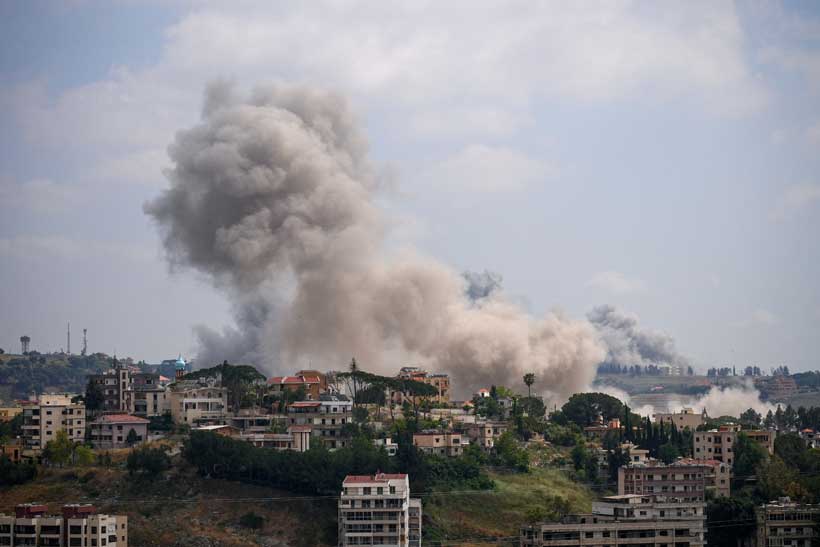
Hostilities between Israel and the Iran backed militant group Hezbollah intensified sharply overnight, raising fresh concerns about the durability of the recently signed U.S. Iran agreement aimed at ending the wider Middle East conflict.
At least four Israeli soldiers were killed in one of Hezbollah’s deadliest attacks of the current war, while Lebanese authorities reported that Israeli airstrikes killed at least 18 people and wounded dozens more across southern Lebanon.
The renewed violence comes only days after the United States and Iran reached an interim accord requiring all parties and their allies to permanently halt military operations across multiple fronts, including Lebanon. While fighting briefly subsided following the agreement, the latest clashes suggest the ceasefire remains highly fragile.
Growing tensions have prompted France to urge Washington to pressure Israel into ending military operations in Lebanon and preserving the broader diplomatic framework established by the U.S. Iran deal.
Stay ahead of the geopolitical week.
MD Briefing delivers expert analysis across five global fronts — the Indo-Pacific, energy, geoeconomics, European security, and the Middle East — every Monday morning. Free.
Why It Matters
The escalation represents one of the most serious challenges yet to the U.S. Iran agreement.
The accord was intended not only to halt direct confrontation between Washington and Tehran but also to reduce violence involving regional allies and proxy groups. Continued fighting in Lebanon threatens to undermine confidence in the deal and raises questions about whether the United States can persuade its allies to comply with its terms.
The clashes also highlight the difficulty of translating diplomatic agreements into realities on the ground. Even if Iran and the United States remain committed to negotiations, actions by Israel and Hezbollah could derail broader efforts to stabilize the region.
A collapse of the ceasefire could reignite wider regional tensions, disrupt diplomatic talks, and increase pressure on global energy markets already affected by months of conflict.
Deadly Fighting Around Strategic Hezbollah Positions
The most intense fighting occurred near Ali al Taher hill, a strategically important area north of the Litani River where Israeli forces have sought to expand operations against Hezbollah positions.
According to Lebanese security sources, Hezbollah fighters ambushed Israeli troops advancing near the area and destroyed three Merkava tanks using guided missiles. The group said it subsequently targeted Israeli reinforcements attempting to retrieve casualties from the battlefield.
The Israeli military confirmed that four soldiers were killed during operations in Lebanon but provided few details about the incident.
The deaths represent one of the heaviest single losses suffered by Israeli forces during recent fighting and are likely to increase pressure on Israel’s leadership to respond forcefully.
Rising Civilian Toll in Southern Lebanon
Lebanese officials reported widespread destruction and civilian casualties as Israeli airstrikes struck multiple locations across southern Lebanon.
The health ministry said at least 18 people were killed and 33 wounded in attacks targeting 11 towns. Authorities warned that the casualty toll could rise because ongoing bombardment was hampering rescue operations.
In the village of Harouf near Tyre, officials said seven people were killed and additional victims were believed trapped beneath collapsed buildings.
Heavy displacement was also reported from the districts of Tyre and Bint Jbeil, with residents fleeing north as the fighting intensified.
The latest figures add to an already significant humanitarian toll. Lebanese authorities say nearly 4,000 people have been killed in Israeli attacks since the current round of hostilities began in March, including women, children, and medical workers.
Israel and Hezbollah Trade Blame
Israel said its operations were a response to repeated ceasefire violations by Hezbollah and were aimed at militants and military infrastructure across southern Lebanon.
Israeli officials argue that military operations are necessary to protect communities in northern Israel and prevent Hezbollah from rebuilding capabilities near the border.
Hezbollah, meanwhile, has accused Israel of continuing offensive operations despite commitments contained in the broader ceasefire agreement. The group has maintained attacks against Israeli positions, including strikes using explosive drones that have inflicted casualties among Israeli troops.
The competing narratives underscore the absence of any agreed mechanism for enforcing the ceasefire or resolving disputes over alleged violations.
Israeli Political Pressure Intensifies
The deaths of four soldiers triggered strong reactions from members of Israel’s governing coalition.
Far right ministers Itamar Ben-Gvir and Bezalel Smotrich called for harsher military action against Lebanon following the attack.
Both ministers have been among the strongest critics of the U.S. Iran agreement, arguing that it does not adequately address Israel’s security concerns or Iran’s regional influence.
Their comments reflect broader dissatisfaction within parts of the Israeli government regarding the agreement negotiated between Washington and Tehran.
Israeli officials are also reportedly engaged in discussions with the Trump administration over maintaining military forces inside southern Lebanon, despite provisions in the agreement calling for a permanent end to hostilities.
What Happens Next
The immediate focus will be whether Washington can prevent the latest escalation from spreading further.
France and other European powers are expected to increase diplomatic pressure on both Israel and the United States to ensure compliance with the ceasefire framework. Meanwhile, negotiators working on the broader U.S. Iran agreement face growing urgency as continued violence risks undermining confidence in the entire process.
Israel’s response to the deaths of its soldiers will be closely watched. Any major retaliatory operation could provoke further Hezbollah attacks and trigger a cycle of escalation that becomes increasingly difficult to contain.
At the same time, Hezbollah’s willingness to continue military operations suggests that local dynamics in Lebanon may prove harder to control than the diplomatic track between Washington and Tehran.
Analysis
The renewed fighting illustrates the biggest weakness of the U.S. Iran agreement: ending a regional war requires more than securing signatures from Washington and Tehran.
While the accord may have reduced the risk of direct confrontation between the United States and Iran, it has not resolved the underlying conflicts involving regional actors such as Israel and Hezbollah. Those groups retain their own military objectives, security concerns, and political calculations.
For Israel, the agreement is viewed by many officials as insufficient because it does not fully eliminate threats from Hezbollah or address concerns about Iran’s long term influence. For Hezbollah, continued resistance against Israeli forces remains central to its strategy regardless of broader diplomatic developments.
The latest violence therefore exposes a fundamental challenge facing the peace process. Unless local conflicts are addressed alongside U.S. Iran negotiations, ceasefire violations could gradually erode the agreement and make a broader settlement increasingly difficult.
The coming days will be a critical test of whether the Trump administration can persuade its regional allies to align with the diplomatic path it has chosen. If fighting in Lebanon continues to intensify, the agreement may face its first major crisis before negotiations on a final settlement have even begun.
With information from Reuters.
