


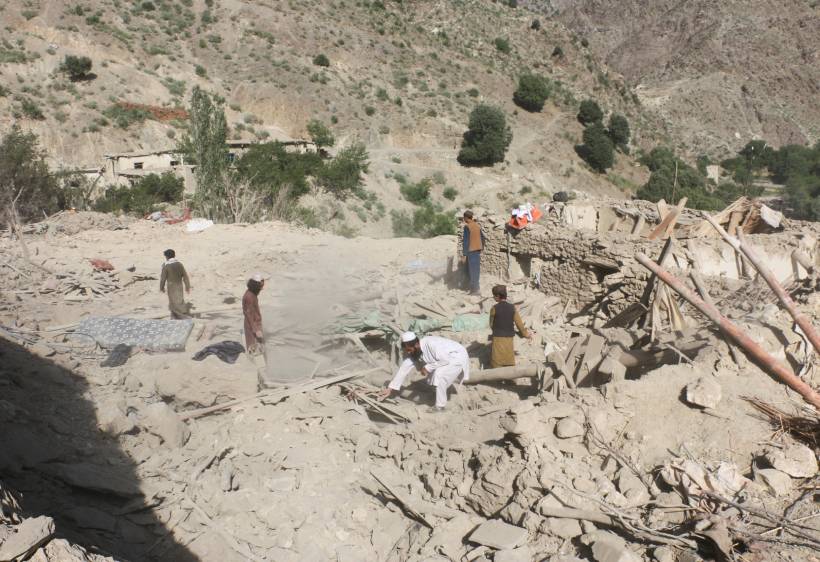
Afghanistan’s Taliban government said it carried out airstrikes against militant hideouts inside Pakistan, marking what would be one of Kabul’s most significant cross border military actions in recent months. The Afghan Defence Ministry said targets in Pakistan’s provinces of Balochistan and Khyber Pakhtunkhwa were struck on Thursday night.
According to Kabul, the operation targeted bases allegedly used by militants working with hostile intelligence networks to plan attacks against Afghanistan. The ministry claimed the strikes successfully hit designated targets but provided no details on casualties, damage, or the specific weapons used.
Pakistan swiftly rejected the claim. Islamabad said no Afghan airstrike had taken place and instead accused Afghanistan of sending a “rudimentary drone” into Pakistani airspace, which it said was detected and shot down immediately.
The competing claims come amid worsening tensions between the two neighbors, whose relationship has deteriorated sharply despite both governments’ historical ties.
Stay ahead of the geopolitical week.
MD Briefing delivers expert analysis across five global fronts — the Indo-Pacific, energy, geoeconomics, European security, and the Middle East — every Monday morning. Free.
Why It Matters
The incident underscores the growing risk of direct military confrontation between Afghanistan and Pakistan.
For years, the two countries have accused each other of harboring militant groups responsible for attacks across the border. While such accusations have been common, claims of cross border military strikes by Afghanistan represent a significant escalation.
The dispute also threatens regional stability at a time when diplomatic efforts led by China have failed to reduce tensions. Continued escalation could lead to more military exchanges, civilian casualties, and instability along one of South Asia’s most volatile borders.
The incident is particularly significant because it comes only days after Pakistan conducted strikes inside Afghanistan, raising fears of a cycle of retaliation.
Conflicting Accounts of What Happened
The Afghan Defence Ministry described the operation as a targeted strike against militant infrastructure located inside Pakistan.
Officials said the sites had previously been used to organize attacks against Afghanistan and claimed the operation achieved its objectives. However, Kabul did not release evidence of the strikes or explain how they were conducted.
Afghanistan lacks a modern fighter jet fleet but possesses several aircraft, helicopters, and armed drones captured or inherited following the Taliban’s return to power. Afghan drones have previously been used during clashes with Pakistani forces.
Pakistan strongly disputed the Afghan account. Its Information Ministry dismissed the claims as false and said the only incident involved a drone crossing into Pakistani territory from Afghanistan.
Islamabad maintained that militant camps are located inside Afghanistan rather than Pakistan and accused the Taliban government of supporting or tolerating extremist groups operating against Pakistani interests.
The contradictory narratives highlight the deep mistrust that now defines relations between the two countries.
A Pattern of Retaliation
The latest dispute follows a series of military exchanges that have intensified throughout the year.
Pakistan recently launched airstrikes on Afghan territory, saying it targeted militants responsible for attacks inside Pakistan. Islamabad said those operations killed 26 militants.
The Taliban government condemned the strikes, claiming they killed at least 13 people, including 11 children, and injured 14 others.
Both governments have repeatedly justified military actions as necessary responses to security threats originating across the border.
The result has been a dangerous cycle in which each side portrays itself as acting defensively while accusing the other of aggression.
Militancy Remains at the Core of the Dispute
The central issue remains the presence of militant groups operating along the Afghanistan Pakistan border.
Pakistan accuses the Taliban government of allowing anti Pakistan militants to use Afghan territory as a base for planning and launching attacks. Afghan authorities reject those allegations and argue that Pakistan’s security problems stem from domestic issues rather than Afghan policy.
Meanwhile, Afghanistan claims hostile groups operate from Pakistani territory and receive outside support to destabilize the Taliban government.
The border region has long served as a sanctuary for various militant organizations, making verification of either side’s claims difficult and contributing to recurring violence.
What Happens Next
Both governments are likely to continue exchanging accusations while reinforcing security measures along the border.
Diplomatic channels remain open, but previous mediation efforts have produced limited results. China has attempted to facilitate dialogue between Kabul and Islamabad, yet tensions have continued to rise despite those efforts.
Attention will now focus on whether either side releases evidence supporting its version of events and whether additional military operations follow.
Any further cross border strikes could trigger a broader escalation and make diplomatic engagement increasingly difficult.
Analysis
The significance of this incident lies not only in the disputed strike itself but in what it reveals about the deteriorating relationship between Afghanistan and Pakistan.
The two governments are increasingly treating security threats as military problems rather than diplomatic ones. Cross border strikes, drone incidents, and public accusations have become more frequent, suggesting both sides are losing confidence in traditional channels for managing disputes.
Pakistan appears determined to demonstrate that it will pursue militants wherever it believes they are located. The Taliban government, meanwhile, is increasingly signaling that it is willing to respond forcefully to perceived threats and challenge Pakistan’s actions.
The danger is that miscalculation becomes more likely as tensions rise. Because claims from both sides are often difficult to independently verify, military actions can quickly escalate based on competing narratives and mutual suspicion.
For regional stability, the biggest concern is the emergence of a sustained tit for tat conflict along the border. If retaliation becomes the dominant strategy for both governments, diplomatic solutions will become harder to achieve and the risk of a larger confrontation will increase significantly.
With information from Reuters.
