On February 28, 2026, conflict escalated across the Middle East in ways that immediately reordered global energy markets. Within days, overall traffic through the Strait of Hormuz, the narrow waterway that handles roughly a fifth of the world’s seaborne crude oil, fell by over 70 percent. This led to reduction in Gulf oil output by 14 million barrels per day or about 14 percent of world demand. The shockwaves of this traveled far beyond the region.
Brent crude oil prices remained more than 50 percent higher in mid-April than they were at the start of the year. The World Bank, in its April 2026 Commodity Markets Outlook, projected that the overall commodity prices forecast to rise 16 percent, driven by soaring energy which are expected to surge by 24 percent and fertilizer costs which might increase by 31 percent in 2026. This could also raise the inflation in developing countries by 5.8 percent, a level only exceeded in 2022 over the past decade. This is where the story stops being about geopolitics and starts being about food on the table or the absence of it.
Energy and food systems are not separate pipelines, they are one. Fuel powers tractors, irrigation pumps, and cold-storage facilities. Natural gas is the primary feedstock for nitrogen fertilizers, which underpins around 50 percent of global food production. When the Gulf burns, fields in Sub-Saharan Africa, South Asia, and Latin America go unfertilized. Middle East urea prices closed over USD 590 per metric ton in early March, a 19 percent increase in a single week, while experts warned that as much as one-third of global fertilizer trade could be affected. In India, fertilizer production was already running at 70 percent of gas requirements, with risks to food production if the conflict persisted into the May–June peak demand season.
The arithmetic of hunger is brutally simple, higher fuel costs raise the price of planting, harvesting, and transporting food. When food gets more expensive, the world’s poorest simply eat less.
Stay ahead of the geopolitical week.
MD Briefing delivers expert analysis across five global fronts — the Indo-Pacific, energy, geoeconomics, European security, and the Middle East — every Monday morning. Free.
The Forgotten Victims of Geopolitical Conflict
Before the Gulf conflict began, the baseline was already catastrophic. A staggering 318 million people were already facing crisis levels of hunger or worse in 20 26, according to the WFP 2026 Global Outlook, a figure more than double what was recorded in 2019. Two simultaneous famines were confirmed in Gaza and parts of Sudan which was the first time in this century that famine has struck two countries at the same time.
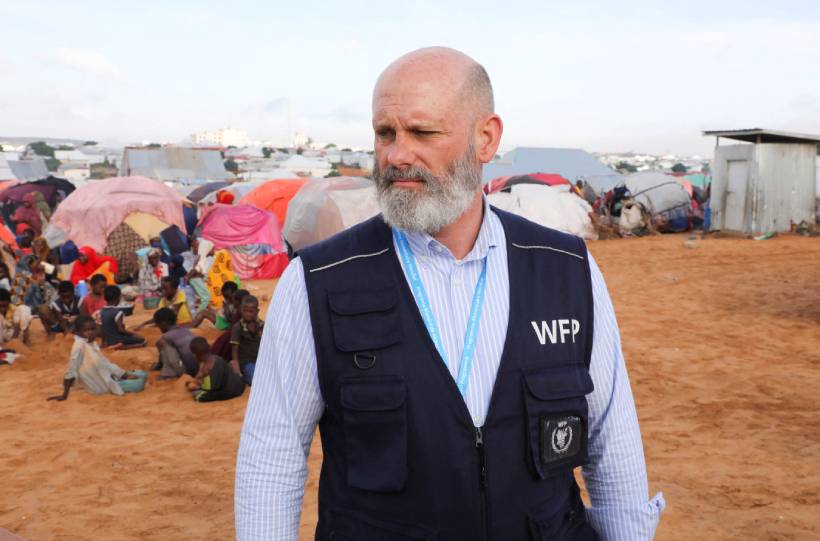
Now the WFP is warning that those numbers could climb dramatically higher. WFP estimates that almost 45 million more people could fall into acute food insecurity if the conflict does not end by mid-year and if oil prices remain above USD 100 a barrel. That would push the global total toward the record set during the 2022 Ukraine war, when 349 million people were food insecure.
The regional picture is equally grim. Countries in Sub-Saharan Africa and Asia are the most vulnerable due to their reliance on food and fuel imports, with projections indicating a potential increase of 21 percent in food-insecure people for West and Central Africa and 17 percent for East and Southern Africa. An increase of 24 percent is also forecasted for Asia region In West and Central Africa alone, 55 million people are expected to endure crisis levels of hunger during the June–August 2026 lean season, with over 13 million children projected to suffer from malnutrition.
Syria’s situation illustrates how conflict compounds crises over time. Syria’s crop production is down as there is a drop of 75 percent in wheat and barley yield, a collapse built over years of war, sanctions, and economic deterioration that no single harvest can reverse.
The victims of this crisis have little in common with the diplomats negotiating ceasefires or the energy traders watching oil futures. They are smallholder farmers in the Sahel who cannot afford fertilizer. They are mothers in Yemen rationing food across a family of seven. They are children in Haiti, where more than half the population, nearly 5.83 million people, is facing acute food insecurity, and WFP has already been forced to suspend hot meals for recently displaced people and halve monthly rations. These are the forgotten victims of a geopolitical conflict fought thousands of miles from their homes.
Why Food Security is Becoming a National Security Issue
There is a third force converging with conflict and energy prices that is making this crisis uniquely dangerous: the deliberate withdrawal of humanitarian funding at precisely the moment it is needed most.
WFP received 40 percent less funding in 2025 than in the previous year, resulting in a projected budget of USD 6.4 billion, down from USD 10 billion in 2024. The agency has warned that cuts to food assistance could push 13.7 million people from “crisis” to “emergency” levels of hunger, one step away from famine on the international scale. WFP aims to reach 110 million of the most vulnerable people in 2026 at an estimated cost of USD 13 billion, but current funding forecasts indicate the agency may only receive close to half that goal. Funding for food crises responses and food security has fallen back to levels last seen nearly a decade ago, even as the number of people requiring assistance has doubled. The Global Report on Food Crises 2026 notes a particularly disturbing consequence of this retreat: fewer countries can now produce reliable and disaggregated food security estimates, meaning the apparent decline in reported hunger figures largely reflects declining data availability rather than any real improvement. The crisis may be even worse than the numbers show. This convergence of war disrupting energy and fertilizer supply, declining aid budgets, and weakening data systems is not a humanitarian story anymore. It is a national security story.
History shows what hunger on this scale produces. Food insecurity destabilizes governments, fuels insurgencies, and generates refugee flows that reshape the politics of entire regions. Nearly 70 percent of acutely food-insecure people already lived in fragile or conflict-affected countries in 2025. Hunger does not exist alongside instability, it manufactures it. Every country that collapses under the weight of famine becomes a potential base for extremism, a source of mass migration, and a failed state requiring far more expensive intervention later. The World Bank now projects global growth could fall to just 1.3 percent in 2026 if energy supply disruptions prove more severe than assumed, the lowest rate since COVID-19, with inflation rising to 4.4 percent. The economic damage is not contained to the Middle East. It flows through the price of bread in Accra, the cost of a bag of rice in Dhaka, and the ability of a family in Nairobi to afford a full meal by the end of the month.
What is even less acceptable is that this catastrophe is unfolding largely outside the headlines. The food security crisis of 2026 is not a natural disaster. It is the product of deliberate choices, to wage wars that destabilize energy markets, to cut humanitarian budgets in a time of record need, and to treat hunger as a distant problem rather than a systemic risk.