


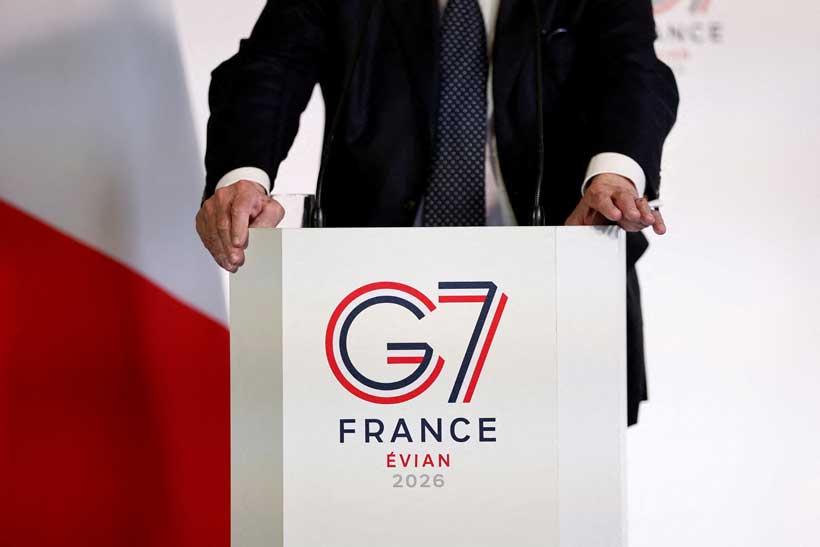
Trump landed in France on Sunday night, fresh from watching an MMA fight on the White House South Lawn to celebrate his 80th birthday, delayed by one day because his travel schedule could not be rearranged before the fights were over. That detail tells you something about where multilateral summitry sits in this administration’s hierarchy of priorities. And yet the summit that opened in Evian-les-Bains this morning has become, almost despite itself, one of the most consequential G7 gatherings in years.
The reason landed at 5:45pm on Sunday, just as leaders were preparing for Macron’s welcome dinner. Trump posted on Truth Social: “The Deal with the Islamic Republic of Iran is now complete. Congratulations to all!” The US-Iran war, which began on February 28 with strikes that killed Supreme Leader Khamenei and closed the Strait of Hormuz for more than three months, has a memorandum of understanding. The Strait is reopening. The naval blockade is lifting. The formal signing happens Friday in Switzerland.
The G7 that was always going to be tense: Trump’s tariffs against his own allies, European frustration running hot after eighteen months of being lectured and ignored simultaneously, Canada’s Mark Carney arriving with a Dublin speech about the collapse of the post-Cold War order still ringing in the air, is now also the G7 where the world’s seven largest advanced economies have to figure out what the Iran deal means for all of them. That is a different summit from the one anyone planned for.
Trump Got His Deal. Now Comes the Hard Part
The MOU is not a peace treaty. That distinction matters and everyone in Evian knows it. Iran’s deputy foreign minister confirmed the agreement on state television but said Tehran would not begin implementing it until the Friday signing. Iranian state TV ran a banner reading “US was forced to sign an agreement to end the war.” Trump, on the same day, described it as a complete American victory. Both cannot be true, which means what was agreed is vague enough for both sides to read into it whatever their domestic audiences require, a pattern we have watched play out across every stage of this conflict.
Stay ahead of the geopolitical week.
MD Briefing delivers expert analysis across five global fronts — the Indo-Pacific, energy, geoeconomics, European security, and the Middle East — every Monday morning. Free.
The nuclear question, which is the question everything else depended on, has been deferred rather than resolved. The moratorium on enrichment is reportedly somewhere between 12 and 15 years, with the US having demanded 20 and Iran having proposed 5. The Strait reopening and the naval blockade lifting are concrete and immediate. The detailed nuclear framework, the dismantlement questions, the inspection regime, the sanctions architecture goes into a 30-day negotiating period that begins after the signing. If those negotiations collapse, US forces can restore the blockade or resume military action. The deal has an off-ramp back to war built into it, which is either a sensible safeguard or a sign of how little trust exists between the parties, depending on how you read it.
For Trump arriving in Evian, the timing is politically perfect. His approval ratings hit record lows during the war. More than 60% of Americans disapproved of the conflict. The economic fallout; energy prices, fertilizer costs, food inflation, was landing on household budgets in ways that threatened the midterms. A deal announced the night before a G7 summit, with the Strait reopening, is the kind of headline that changes the political weather. Whether the deal holds is a question for the next 30 days. Whether it helps Trump politically is a question that has already been answered.
Macron Is Playing the Long Game at Evian
Hosting a G7 is always partly about domestic politics and partly about shaping the international agenda. Macron has been explicit about what France wants from Evian: a summit about “balance, convergence and results,” with a specific push to bring major emerging economies: Brazil, India, South Korea, Kenya, and Syria were invited to working sessions, into the conversation about global governance reform.
The deeper French objective is to use the presidency to reassert the relevance of multilateral institutions at precisely the moment when the most powerful country in the forum has spent two years treating those institutions as obstacles rather than assets. Macron has a private bilateral with Trump on Monday afternoon before the official welcome dinner. That meeting is the most important conversation of the summit and the least likely to be accurately reported afterward. What Macron wants from it: movement on tariffs, a clearer NATO commitment, some acknowledgment that European allies are partners rather than free-riders, is the same list every European leader has been carrying into Trump meetings for eighteen months without much to show for it.
The Iran deal gives Macron something to work with that he did not have yesterday. France can position itself as a constructive partner in the post-war reconstruction conversation, offering investment, diplomatic presence, and institutional frameworks for what comes next in the Middle East. The EU has already been building toward this, the EU-GCC summit announced for 2026, the ReliefEU stocks mobilized for Lebanon, the diplomatic engagement with Syria and Egypt on the sidelines of recent meetings. An Iran deal that creates space for European economic and political engagement in the region that the war foreclosed. Macron will use that space.
Carney’s Canada and the Bilateral Nobody Expected
The most interesting bilateral dynamic at Evian is not Trump-Macron or Trump-Scholz. It is Trump-Carney. Canada’s new prime minister arrived at the summit having just told Trinity College Dublin that the post-Cold War international order is deteriorating and that countries like Ireland and Canada are experiencing a global upheaval, not a smooth transition. That is not the language of diplomatic accommodation. It is the language of a leader who has decided that the era of deferring to Washington is over and that Canada’s interests require being said plainly.
Carney won his election partly on a platform of Canadian sovereignty against Trump’s annexation rhetoric and tariff pressure. He arrives in Evian with a domestic mandate that makes accommodation politically costly in a way it was not for his predecessor. The USMCA — the US-Canada-Mexico trade agreement — is due for renegotiation in 2026 and that negotiation will be a defining test of whether the special relationship between the two countries can survive the current political environment on both sides of the border. The G7 is not the venue for that negotiation. But it is the venue where the atmospherics get set, and Carney’s Dublin speech suggests the atmospherics are going to be difficult.
In the Room but Not at the Table
Ukraine’s president joins a working session on Tuesday titled “Building Peace and Security for Ukraine and Europe.” He will not have a one-on-one meeting with Trump. That asymmetry is not accidental and not unnoticed.
The Iran deal’s completion creates a specific problem for the Ukraine conversation at Evian. One version of the argument is that a president who just ended one war is better positioned, politically and diplomatically, to make progress on another. The other version is that Trump has spent the diplomatic capital and the domestic political energy required to close the Iran file and has less of both available for Ukraine. The evidence from the past six months points toward the second reading. Trump’s Ukraine policy has been consistently described by analysts as “ambivalent” — neither delivering the pressure on Russia that would end the war on terms favorable to Kyiv nor providing the sustained support that would allow Ukraine to negotiate from strength.
Russia has recently lost ground in Ukraine for the first time since summer 2024, which changes the conversation about what a negotiated settlement would look like. Whether that momentum is sustained depends substantially on whether the G7 can produce a credible commitment to continued support, and whether that commitment survives the gap between what gets agreed in Evian and what gets funded in individual national budgets afterward. The European Security Strategy expected after the NATO summit in Ankara in July is the document that needs to translate G7 language into operational reality. The two conversations are connected even though they happen three weeks apart.
The Hormuz Bill Arrived Before the Leaders Did
The Iran war’s economic fallout was always going to dominate the private conversations at Evian even when the formal agenda was organized around other topics. Oil hit $120 a barrel during the Hormuz closure, European gas prices nearly doubled. Fertilizer costs spiked enough to affect spring planting in the American Midwest and food prices across Asia. The IEA called it the largest supply disruption in the history of the global oil market.
The deal announced Sunday changes the energy picture immediately but not completely. The Strait is reopening, which matters. Markets opened Monday with oil prices falling sharply on the news, providing the kind of positive economic signal that makes a G7 welcome dinner easier. But the Gulf’s infrastructure damage takes time to repair. Qatar’s LNG facilities need to restart. Saudi Arabia’s pipeline that was struck directly needs assessment. The food price and fertilizer cost impacts are already embedded in supply chains that take months to normalize.
European leaders arriving in Evian with their populations still feeling the energy shock are going to push for specific commitments on energy security diversification, LNG supply agreements, and the acceleration of renewable transition that von der Leyen has been arguing for since the war began. The Iran deal does not make those conversations less urgent. It makes them more politically tractable, because the crisis framing that justifies emergency measures is easier to sustain when the crisis has just visibly ended.
Evian Has Three Days. Here Is What They Need to Count For
G7 summits are judged, ultimately, by the gap between what gets agreed and what gets implemented. The Evian summit has an unusually rich agenda by accident of timing: the Iran deal landing the night before, the Ukraine conversation coming at a moment of genuine military development, the NATO summit and European Security Strategy both scheduled for the following month, the USMCA renegotiation hanging over every bilateral conversation involving the US.
What it needs to produce is not a communiqué with the right language. It is a set of specific commitments that connect to those subsequent processes, a G7 statement on the Iran deal that gives the 30-day nuclear negotiating period political backing from the world’s seven largest economies, a Ukraine support commitment that is credible enough to matter in Kyiv and alarming enough to matter in Moscow, a trade framework that gives Carney something to take back to Ottawa, and an energy security agenda that connects the Hormuz lesson to the European transition conversation.
Whether Trump, who showed up a day late after watching fights on the White House lawn, is interested in producing that kind of summit is the question nobody at the Hotel Royal can answer yet. He arrived with a deal and that is more than anyone expected. Whether Evian turns it into something durable is the work of the next three days.
