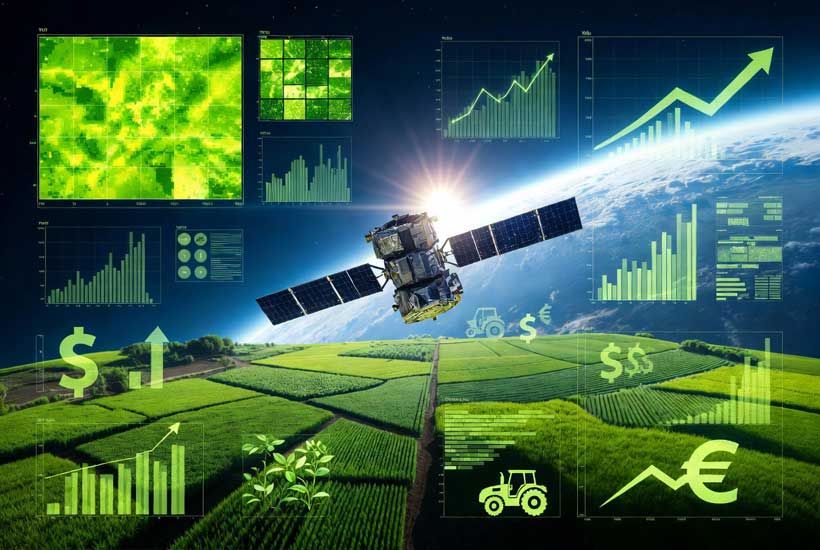
Meera had farmed the same five acres in Karnataka her whole life. She knew the smell of rain coming. She knew which corner of the field drained slow. She knew everything — except that her crop was already dying two weeks before she could see it.
That year, 4.8 million hectares across Karnataka were damaged by drought. The losses hit ₹35,000 crore. Meera lost nearly everything. What stings most, looking back, is that the warning signs were there — just not visible to the human eye.
They were visible from space.
What Remote Sensing Satellites Actually Do
The term sounds cold and technical. The reality is simpler. Remote sensing satellites are cameras in orbit that see light we can’t — infrared wavelengths that reveal whether a plant is stressed, hydrated, or quietly dying weeks before the leaves show it.
Stay ahead of the geopolitical week.
MD Briefing delivers expert analysis across five global fronts — the Indo-Pacific, energy, geoeconomics, European security, and the Middle East — every Monday morning. Free.
A healthy crop and a dying one look identical to us at a certain stage. To a satellite sensor, they look completely different. Stressed plants stop reflecting near-infrared light the same way. That shift shows up in the data like a fever on a thermometer.
Monitoring satellites pass over the same field every three to five days. Each pass produces a fresh map. Each map is a question answered before the farmer even thought to ask it.
How Do Farmers Use Satellites? Not the Way You’d Expect
There’s a persistent image of precision agriculture as something for massive American corn operations — GPS tractors, million-dollar equipment, engineers in the cab. That image is outdated.
Today, a smallholder in rural India with a basic smartphone gets the same satellite data as an industrial farm in Iowa. It arrives as a color-coded map or a simple SMS alert. Red means trouble. The farmer walks to that corner of the field. She finds the problem in time.
Satellite monitoring services for smallholders typically run below 5% of total cultivation costs. No hardware. No sensors buried in soil. No installation. Just a subscription and a phone signal.
How Is Satellite Imagery Used in Agriculture? The Real Toolkit
The applications have grown well beyond “is the crop healthy.” Here’s what farmers and agronomists are actually using today:
- NDVI mapping: Scores vegetation health across every meter of a field. Uneven patches that look fine from the road stand out immediately.
- Soil moisture tracking: Weather satellite data feeds irrigation decisions. Water goes where it’s needed, not where it’s always gone.
- Early disease detection: Unusual spectral patterns flag fungal outbreaks and pest pressure days before damage is visible on the ground.
- Yield forecasting: Combines current imagery with historical baselines to project harvest volumes weeks out.
- Insurance verification: When a flood or drought hits, monitoring satellites provide objective, timestamped proof. No adjuster required.
That last point matters more than most people realize.
The Insurance Problem Satellites Are Quietly Solving
Crop insurance in developing markets has always had a trust problem. Farmers don’t trust that claims will be paid. Insurers don’t trust that damage is real. Field adjusters can only visit a fraction of claimants. The result: slow payouts, widespread fraud suspicion, and farmers who stop buying coverage.
Satellite imagery cuts through all of that. When a claim comes in, the data either supports it or it doesn’t. Processing happens in days, not months. For farmers in places where one bad season means debt that takes years to repay, faster insurance payouts aren’t a convenience — they’re a lifeline.
How to Monitor Crop Health Using Satellites: What the Process Looks Like
It starts before you even log in. A satellite passes overhead, collects multispectral data, and transmits it to a ground station. Atmospheric interference gets filtered out. Vegetation indices get calculated.
By the time a farmer opens their app, the work is already done. The field appears as a heat map. Darker green means thriving. Yellow means watch it. Red means act now. The system doesn’t tell farmers what to think — it tells them where to look.
Dragonfly Aerospace satellites are part of the hardware layer making this possible. Compact, high-resolution imaging systems built for frequent revisit cycles mean the data arriving on that farmer’s phone is sharp enough to detect problems at sub-field scale — not just broad strokes across an entire property.
Weather Satellite Data: The Layer Farmers Were Missing
Crop health maps tell you what’s happening. Weather satellite data tells you what’s coming.
The combination is powerful. A farmer who knows a dry stretch is arriving in ten days can irrigate strategically now rather than scramble later. A grower who sees a rain event forecast can hold off on fungicide application — saving money and reducing chemical load on the soil.
In climate-vulnerable regions, this forecasting layer has become indispensable. The old rhythms of planting and harvest, passed down through generations, no longer match the weather.
The Economic Argument Is Simple
Precision input application — putting water, fertilizer, and pesticide exactly where data says they’re needed — reduces input costs by 15 to 25% on average. At an individual farm level that’s meaningful. At national scale, it’s a structural shift.
Countries with widespread satellite monitoring are reporting more stable commodity prices, higher export quality, and fewer food safety incidents. The data doesn’t just help individual farmers. It raises the floor for entire agricultural economies.
We’re watching agriculture become a data industry. The transition isn’t coming — it’s underway.
Beyond The Sky
Meera’s story doesn’t have a dramatic turnaround ending. She lost that season. But the following year, she signed up for a satellite crop monitoring service. When the same moisture stress appeared in the same corner of her field in late June, she caught it six weeks earlier than before.
She adjusted her irrigation. She saved the crop.
That’s the real story of satellites and agriculture. Not the technology. Not the spectral bands or the revisit frequencies. The story is about a woman who didn’t lose everything twice.