


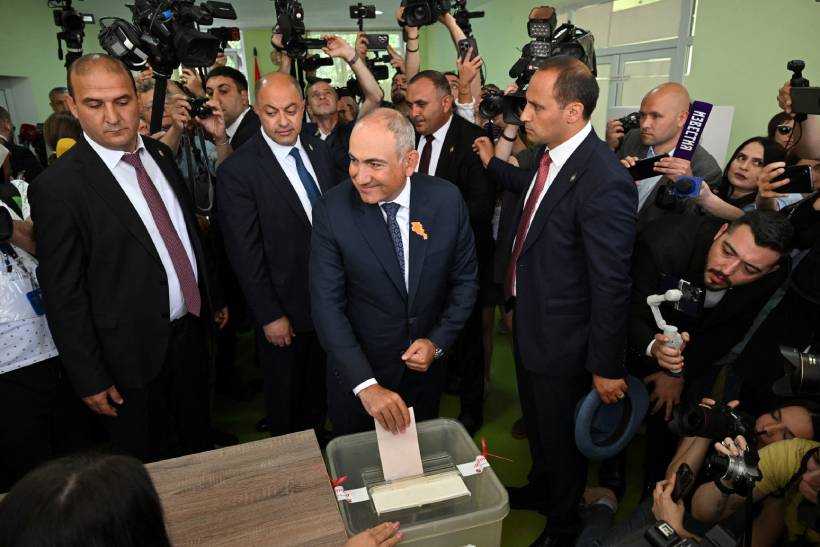
Armenia voted on June 7 in a parliamentary election intensely contested by 18 political parties and alliances. The 59 percent voter turnout was a healthy sign of the high stakes. The election unfolded in a highly charged geopolitical environment, with Western leaders supporting incumbent Prime Minister Nikol Pashinyan and his Civil Contract party and Russia opposing.
Contributing to the transparency of the elections, 13 domestic citizen observer groups and 8 international observer organizations monitored the campaign and voting.
In a joint statement, observers from the OSCE, European Parliament and the Council of Europe determined that Armenian voters were offered a “genuine choice” in a well-administered election, but noted that the campaign rhetoric was “divisive” and “highly confrontational”, criminal proceedings against opposition supporters resulted in their “refraining from actively engaging in the campaign”, “pressure on public sector employees to attend ruling party events” and recently introduced social and economic measures raised concerns about the “equality of opportunity to campaign”.
Non-governmental observers went further. The International Observatory for Democracy in Armenia (IODA), an independent initiative, published a comprehensive and sobering pre-election report that should give pause to anyone invested in Armenia’s democratic trajectory. It documents formally intact democratic institutions operating in a deeply distorted political environment — one in which legal instruments, administrative resources, and political discourse are deployed to advantage the incumbent and constrain opponents.
Stay ahead of the geopolitical week.
MD Briefing delivers expert analysis across five global fronts — the Indo-Pacific, energy, geoeconomics, European security, and the Middle East — every Monday morning. Free.
While Pashinyan’s Civil Contract won 49.7 percent of the popular vote and 64 parliamentary seats (down from 71), sufficient to form a government without coalition partners, but short of the two-thirds majority needed to initiate constitutional amendments and appoint key officeholders. As one observer noted, “the ruling party has been handed a mandate to run the state, but not to rewrite its political DNA”.
Two opposition groups, billionaire Samvel Karapetyan’s Strong Armenia Alliance and former President Robert Kocharyan’s Armenia Alliance, both labeled by the west as pro-Russian, won 23.27 and 9.92 percent of the vote, and 29 and 12 seats respectively. A third opposition party, billionaire Gagik Tsarukyan’s Prosperous Armenia, missed the 4 percent threshold by 783 votes. The remaining 14 smaller parties collectively garnered about 10 percent but likewise failed to clear the threshold. The results, challenged in courts, must be finalized by the end of June.
Armenia’s new parliament is likely to reinforce political polarization and the dominance of binary black-and-white politics, leaving little room for critical policy considerations.
Securitization of Politics
The joint OSCE/EU/CoE statement notes that the electoral campaign was “highly polarized and confrontational, with repeated use of inflammatory rhetoric, including by the ruling party,” centered on messages of peace, relations with Azerbaijan, and regional stability, “with several foreign leaders making public interventions and endorsements in favor of the ruling party.” This was a reference to western interference, albeit benign — including two EU summits in Yerevan and visits by the French president and U.S. Secretary of State shortly before June 7 — all meant to shore up Pashinyan’s campaign. The statement also noted “direct pressure” from Russia, including threats of “economic and security consequences” and, most ominously, a “Ukraine scenario” warning if Armenia pursued closer EU alignment.
A month before the election, according to Reuters, Western intelligence sources revealed that Russia was recruiting up to 100,000 Armenian citizens working in Russia to travel home, all expenses paid — a reported US$50 million operation — to vote for Karapetyan’s Strong Armenia Alliance. However, after June 7, Armenia’s Interior Minister Arpine Sargsyan declined to disclose how many travelers arrived from Russia around election day, or whether anyone had been charged for receiving funds to vote.
IODA’s assessment also documents Prime Minister Pashinyan’s repeated claim that renewed war with Azerbaijan would be inevitable if his party lost — a framing that transformed a democratic vote into an existential referendum. The main opposition forces were collectively branded a “three-headed war party.” This narrative, amplified through pro-government media and digital networks, reduced legitimate political pluralism to alleged complicity in national catastrophe. Some opposition contestants further contributed to the confrontational discourse by making “unsubstantiated claims that a Civil Contract Party victory would lead to the resettlement” of 300,000 Azerbaijanis in Armenia.
IODA also documents disturbing direct confrontations between Pashinyan and citizens. In one widely circulated exchange, he publicly referred to displaced Armenians from Nagorno-Karabakh as “runaways,” “bastards,” and “scum,” asking one man why he was still alive rather than having died in battle. Such statements, captured on video during campaign appearances, are part of a broader pattern of stigmatization with a chilling effect on political participation, particularly among the most vulnerable.
One of the rare independent media organizations in Armenia, Civilnet, noted that the election “resembled a battlefield of information warfare” and media organizations “became direct participants in the political struggle. Political polarization evolved into information polarization.” Civilnet continued, “This was arguably the most geopolitically charged election in Armenia’s history…. The impression was that Armenian citizens were choosing not between their own political leaders, but between Putin and the West.”
Concentration of Power
The IODA report documents the consolidation of authority around Pashinyan and Civil Contract, steadily narrowing the space for meaningful institutional independence. Appointments to the Constitutional Court, the Supreme Judicial Council, the Central Electoral Commission, and the Prosecutor General’s office have reflected political loyalty over institutional autonomy. The election of a sitting Civil Contract MP to the Constitutional Court — with only ruling party members participating — and the appointment of the Prime Minister’s former assistant as Prosecutor General illustrate how formally compliant procedures can nonetheless produce manifestly subservient institutions.
A Guardian commentator similarly noted that Prime Minister Pashinyan’s “style of government is highly personalized rather than institutionalized…. Pashinyan displays a worrying lack of interest in building durable institutions…. Those worries are likely to intensify after the election. In his first remarks following his electoral victory, Pashinyan suggested that leading opposition figures should be arrested.”
Legal Instruments as Political Tools
Perhaps the most alarming dimension of the IODA report concerns the selective use of criminal law against political opponents, journalists, clergy, and civil society actors. Broadly worded provisions — covering “hooliganism”, “calls for violence”, and “calls for the overthrow of the constitutional order” — have been invoked disproportionately against government critics. Legal experts told IODA that an estimated 90 to 95 percent of cases initiated under such provisions originate from complaints filed by representatives of the ruling majority.
The report also documents an alarming pattern of prosecutions and detentions targeting the leadership and supporters of the Armenian Apostolic Church, following Catholicos Garegin II’s public criticism of the government’s handling of the 2023 Azerbaijani ethnic cleansing of Nagorno-Karabakh. Archbishop Bagrat Galstanyan, who led a protest movement, was charged with organizing “terrorist” activities. Similarly, bishops have faced criminal proceedings, travel restrictions, and in one case a rapid trial resulting in imprisonment. The ruling party’s electoral platform explicitly included provisions for “reforming” the Church — a step that raises serious questions about the constitutional separation of church and state.
More ominously, Pashinyan’s post-election announcement that the three main opposition leaders are “criminal oligarchs” whose assets the state should “urgently confiscate” is already bearing fruit: on June 9, Armenian authorities filed criminal charges of “large-scale tax evasion” against Prosperous Armenia’s leader, Gagik Tsarukyan. Similar proceedings against other opposition leaders and travel bans are now in effect.
What Is at Stake
International governmental and non-governmental observers, including IODA, are careful in their methodology and measured in their conclusions. None claim that the June 7 elections were fraudulent in the conventional sense — ballot-stuffing and falsified counts were not their concern. What they document instead is something subtler and, in some ways, more difficult to remedy, a cumulative distortion of the conditions under which citizens form political opinions and cast votes in Armenia.
Yet, Armenia’s democratic aspirations remain genuine and widely shared. Having made a geopolitical choice toward Euro-Atlantic integration, its citizens deserve elections and governance whose integrity matches those ambitions.
