


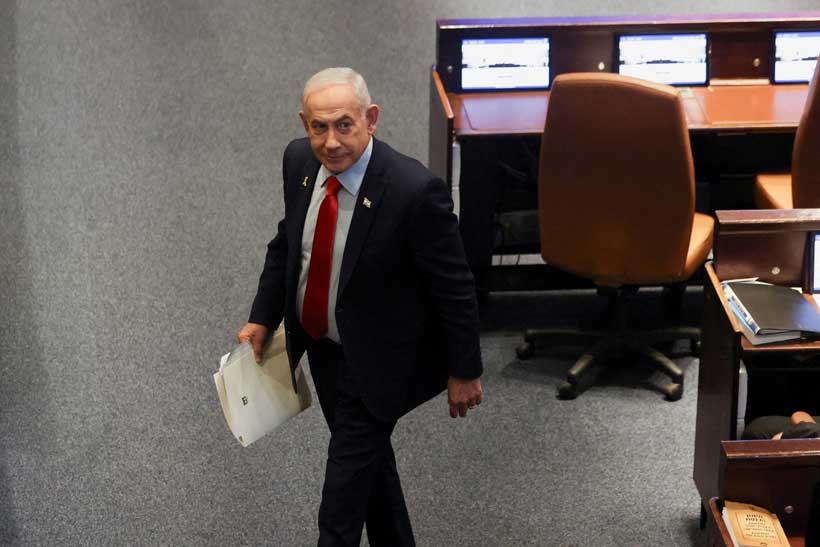
Israeli Prime Minister Benjamin Netanyahu will seek another term in office, his Likud party announced, ending speculation after U.S. President Donald Trump said he was unsure whether Netanyahu planned to run again.
The election, which must be held by October, will be Israel’s first national vote since the October 7, 2023 Hamas attack that triggered the Gaza war and reshaped Israeli politics.
Netanyahu returned to power in December 2022 at the head of the most right wing coalition in Israel’s history. His current term has been dominated by multiple crises, including the wars in Gaza, Lebanon, and Iran, domestic political unrest, and ongoing corruption charges that he denies.
While Netanyahu remains one of Israel’s most experienced political figures, recent opinion polls suggest his coalition could struggle to secure a parliamentary majority in the next election.
Stay ahead of the geopolitical week.
MD Briefing delivers expert analysis across five global fronts — the Indo-Pacific, energy, geoeconomics, European security, and the Middle East — every Monday morning. Free.
Why It Matters
The election will be one of the most consequential in Israel’s recent history, serving as a referendum on Netanyahu’s leadership during a period marked by war, security challenges, and political polarization.
For supporters, Netanyahu is viewed as an experienced leader who has guided Israel through multiple regional conflicts and strengthened ties with key allies, particularly the United States.
Critics argue that the October 2023 Hamas attack exposed major security failures under his government and that prolonged conflicts have deepened divisions within Israeli society.
The election will also influence Israel’s future approach toward Gaza, Iran, Lebanon, relations with Washington, and efforts to normalize ties with regional partners.
Polling Challenges Facing Netanyahu
Recent surveys suggest Netanyahu faces significant public skepticism.
A June poll by the Israel Democracy Institute found that a majority of Israelis believe he should not seek another term. Polling has also consistently shown his coalition trailing the threshold needed to form a majority government.
However, Israel’s fragmented political system means opposition parties face their own challenges. Many opposition groups remain divided on security policy, governance priorities, and whether to cooperate with Arab political parties.
As a result, dissatisfaction with Netanyahu does not automatically translate into a clear alternative governing coalition.
Trump Netanyahu Relationship Remains Under Scrutiny
The announcement comes after renewed attention on the relationship between Trump and Netanyahu.
The two leaders coordinated closely during the conflict with Iran and have maintained strong political ties over the years. However, tensions have surfaced periodically, particularly regarding military operations in Lebanon and broader regional diplomacy.
Trump recently acknowledged using harsh language during a private conversation with Netanyahu but also stressed that they continue to have a strong working relationship.
The state of U.S.-Israel relations could become an important campaign issue, particularly if regional conflicts continue or new diplomatic initiatives emerge before the election.
- Benjamin Netanyahu – Seeking another term in office.
- Likud – Netanyahu’s ruling party.
- Israel – Preparing for a critical national election.
- Donald Trump – A key international partner whose relationship with Netanyahu remains influential.
- Israeli opposition parties seeking to unseat Netanyahu.
- Israeli voters assessing leadership after years of conflict and political turmoil.
- Regional governments monitoring the election’s impact on Middle East diplomacy and security.
Future Outlook
Netanyahu enters the election as one of Israel’s most recognizable and politically resilient leaders, but also one of its most polarizing figures.
The campaign is expected to focus heavily on national security, the aftermath of the October 2023 attacks, the wars in Gaza and Iran, economic pressures, and questions surrounding governance and accountability.
While polls currently suggest Netanyahu faces an uphill battle, Israel’s coalition politics make outcomes difficult to predict. A fragmented opposition and concerns over security could still provide opportunities for him to remain in power.
The election’s result will shape not only Israel’s domestic political future but also its approach to regional conflicts and relations with major international partners.
Analysis
Netanyahu Is Betting on Security Credentials Over Public Fatigue
By confirming his candidacy, Netanyahu is signaling confidence that security concerns will outweigh voter dissatisfaction.
Although many Israelis blame his government for failures surrounding the October 2023 Hamas attack, Netanyahu is likely to argue that his experience is essential in an increasingly unstable region. His campaign will probably emphasize leadership during wartime rather than broader domestic issues.
The strategy reflects a belief that voters may ultimately prioritize security and continuity over demands for political change.
Poll Numbers May Overstate Opposition Strength
Polls show declining support for Netanyahu, but Israel’s political landscape remains deeply fragmented.
Many opposition parties disagree on major policy issues and may struggle to unite behind a single governing vision. Even if Netanyahu’s coalition loses seats, opposition groups could find it difficult to build a stable majority.
This dynamic has repeatedly allowed Netanyahu to remain politically competitive despite periods of low approval ratings.
Regional Conflicts Could Reshape the Election
The election environment remains highly sensitive to developments in Gaza, Lebanon, Iran, and the broader Middle East.
Any major military escalation could strengthen arguments for experienced leadership and shift voter priorities away from corruption allegations or domestic grievances. Conversely, prolonged conflicts without clear outcomes could increase public frustration and benefit opposition candidates.
As a result, external events may play a larger role in the election than traditional campaign messaging.
The Vote Will Be About More Than Netanyahu
While the election is often framed as a referendum on Netanyahu himself, it also represents a broader debate about Israel’s future direction.
Voters will effectively decide how Israel balances security, diplomacy, governance reforms, relations with the United States, and the management of ongoing regional conflicts.
The outcome will determine whether Israel continues along the path established under Netanyahu’s leadership or moves toward a new political coalition with different priorities.
Netanyahu Remains Politically Vulnerable but Far From Defeated
Despite unfavorable polling and public criticism, writing off Netanyahu would be premature.
Throughout his political career, he has repeatedly survived crises that many analysts believed would end his tenure. His political experience, party machinery, and ability to shape security narratives continue to make him one of the most formidable figures in Israeli politics.
The coming election is therefore likely to be less about whether Netanyahu can compete and more about whether his opponents can offer a convincing alternative capable of governing a divided Israel.
With information from Reuters.
