


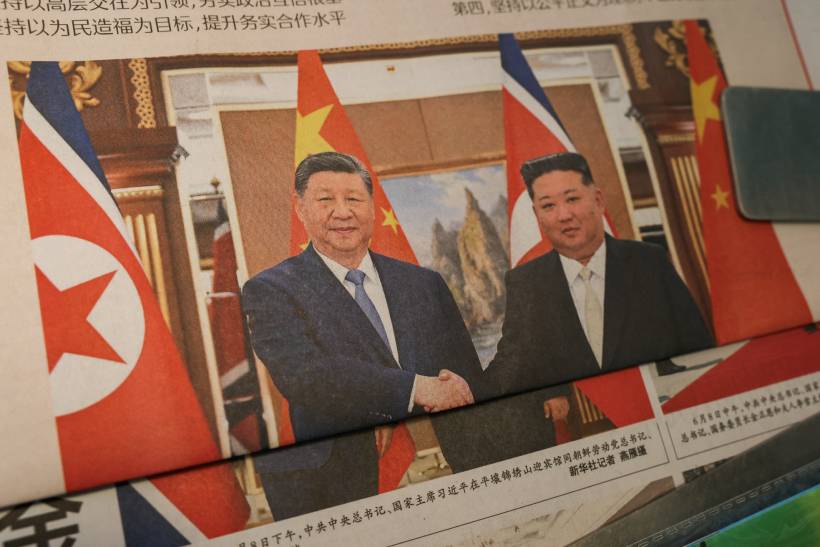
Chinese President Xi Jinping and North Korean leader Kim Jong Un agreed to strengthen cooperation in politics, trade, culture, and diplomatic coordination during Xi’s first visit to Pyongyang in seven years. The summit coincided with the 65th anniversary of the friendship treaty between the two countries and was presented by both governments as a milestone in bilateral relations.
According to North Korean state media, the leaders pledged to enhance strategic communication through increased high level exchanges and closer policy coordination. Kim also reiterated support for Beijing’s One China principle, a politically significant gesture given rising tensions across the Taiwan Strait.
The visit featured highly symbolic events, including Xi’s visit to the Sino Korean Friendship Tower, which commemorates Chinese soldiers who fought in the Korean War, and a joint tree planting ceremony that both sides described as representing enduring friendship. Cultural performances and state banquets further reinforced the image of unity between the two governments.
However, analysts noted important differences in how the two sides portrayed the summit. Chinese media emphasized practical cooperation, economic exchanges, agriculture, transportation links, and regional stability. North Korean media, meanwhile, focused on political solidarity, equality between the two nations, and shared resistance to external pressure.
Stay ahead of the geopolitical week.
MD Briefing delivers expert analysis across five global fronts — the Indo-Pacific, energy, geoeconomics, European security, and the Middle East — every Monday morning. Free.
Why It Matters
The summit underscores the continuing strategic importance of China North Korea relations at a time of significant geopolitical uncertainty in East Asia. While China remains North Korea’s largest trading partner and most important economic lifeline, the relationship has often been marked by mutual suspicion and differing priorities.
For Beijing, strengthening ties with Pyongyang serves several objectives. First, it helps preserve stability on China’s northeastern border at a time when tensions over Taiwan, U.S. alliances in Asia, and broader great power competition are intensifying. Second, maintaining influence over North Korea gives China leverage in regional security discussions involving the United States, South Korea, and Japan.
For North Korea, the visit provides diplomatic legitimacy and demonstrates that Pyongyang is not internationally isolated despite sanctions and ongoing concerns about its nuclear weapons program. By highlighting the relationship as one between equals rather than benefactor and dependent, Kim appears intent on projecting greater strategic autonomy while still benefiting from Chinese economic support.
The summit also carries significance for the Taiwan issue. Kim’s public endorsement of the One China principle reinforces Beijing’s diplomatic position at a time when China is seeking broader international backing against what it views as growing support for Taiwan from Western countries.
Notably absent from public accounts of the talks were detailed discussions about North Korea’s nuclear program or future engagement with the United States. This omission suggests both governments preferred to focus attention on bilateral relations rather than controversial security issues that could overshadow the symbolism of the visit.
Stakeholders
- The Chinese government and Communist Party leadership
- The North Korean government and ruling Workers’ Party
- The United States and the Trump administration
- South Korea and its security establishment
- Taiwan, given North Korea’s support for Beijing’s position
- Japan and other regional powers monitoring security developments
- Businesses involved in China North Korea trade and cross border economic activity
Future Outlook
The summit suggests that China and North Korea are entering a period of closer political coordination, though the relationship is likely to remain driven by pragmatic interests rather than complete strategic alignment.
In the near term, greater cooperation in trade, transportation, tourism, and cultural exchanges is likely. China may seek to gradually deepen economic engagement with North Korea to stabilize its neighbor and expand its influence without provoking additional international scrutiny.
At the same time, underlying differences remain. Beijing’s priority is regional stability and the prevention of conflict, while Pyongyang’s focus remains regime security, military deterrence, and maintaining strategic independence. These differing objectives could limit the depth of future cooperation.
The visit also signals that China wants to ensure it remains North Korea’s primary diplomatic partner should talks between Pyongyang and Washington resume. While President Trump has expressed willingness to engage Kim again, Beijing appears determined to maintain a central role in any future diplomatic process affecting the Korean Peninsula.
More broadly, the summit reflects a changing geopolitical landscape in which China and North Korea increasingly view closer coordination as a way to navigate growing competition with the United States and its allies. As regional rivalries intensify, the relationship between Beijing and Pyongyang is likely to become an even more important factor shaping security dynamics across East Asia.
With information from Reuters.
