


Why Are South Korea and the US Holding New Military Drills?
South Korea and the United States will conduct major joint military exercises from August 17 to 27, as the allies adapt their defence preparations to what they describe as an increasingly sophisticated North Korean threat.
The annual Ulchi Freedom Shield exercise will incorporate training designed to counter drones, GPS disruption and cyberattacks, reflecting the changing nature of warfare and lessons emerging from conflicts such as the war in Ukraine.
Around 18,000 South Korean troops will participate in the drills, a similar scale to previous exercises. The allies said the exercise will also test South Korea’s ability to maintain government operations and emergency preparedness during a crisis.
The drills come at a time when tensions on the Korean Peninsula remain high, with North Korea continuing to expand its nuclear and missile capabilities and taking an increasingly confrontational position toward South Korea.
Stay ahead of the geopolitical week.
MD Briefing delivers expert analysis across five global fronts — the Indo-Pacific, energy, geoeconomics, European security, and the Middle East — every Monday morning. Free.
Preparing for a New Type of Warfare
The military exercise is intended to go beyond conventional battlefield scenarios.
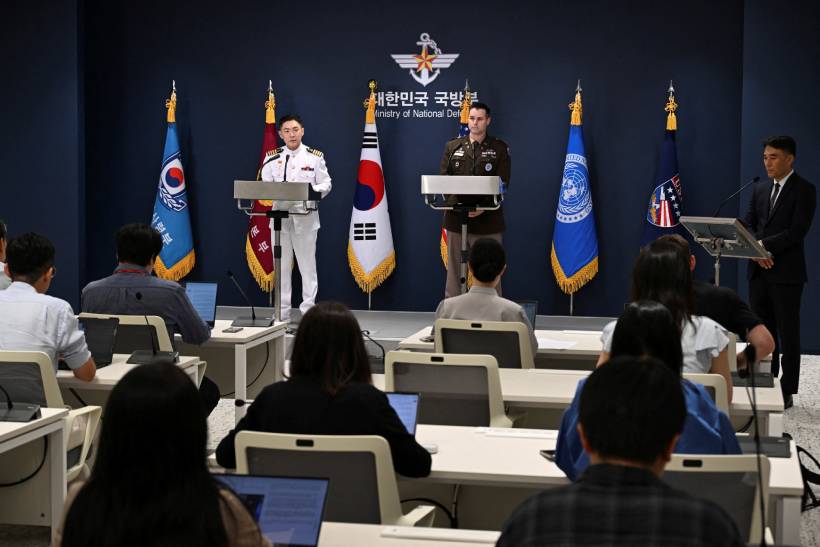
Colonel Ryan Donald, director of public affairs for the Combined Forces Command, United Nations Command and U.S. Forces Korea, said the drills would reflect the growing importance of unmanned systems, electronic warfare and cyber operations.
He also pointed to North Korean soldiers’ involvement in Russia’s war against Ukraine as a factor in the changing threat environment.
“DPRK soldiers have deployed and fought in Ukraine, and they’ve taken those lessons they’ve learned there and brought them back to North Korea,” Donald said, using the official name of North Korea.
The experience could provide Pyongyang with exposure to modern battlefield technologies and tactics, particularly the extensive use of drones, electronic warfare and coordinated artillery operations seen in Ukraine.
For South Korea and the United States, this means preparing for a conflict that may no longer be dominated by traditional artillery and missile exchanges. Disruption of communications, GPS systems, military networks and critical infrastructure could become equally important elements of a future confrontation.
North Korea Continues Military Expansion
North Korea has continued to develop a broad range of military capabilities despite international sanctions.
The country maintains its nuclear weapons programme while expanding ballistic and cruise missile capabilities, artillery systems and other conventional weapons.
Last week, North Korea also fired a short-range ballistic missile toward the sea, underscoring its continued testing and development of missile systems.
Pyongyang has repeatedly condemned U.S.-South Korean military exercises as provocative and has historically described them as preparations for an invasion.
Washington and Seoul, however, maintain that the exercises are defensive and designed to strengthen their ability to respond to an attack.
The latest drills are therefore likely to reinforce the familiar cycle on the peninsula: North Korean weapons development prompts greater military preparedness by the allies, while those exercises provide Pyongyang with further justification for expanding its own military capabilities.
Relations Between the Koreas Harden
The exercises also take place against a backdrop of increasingly hostile relations between North and South Korea.
North Korea has abandoned previous references to reconciliation and reunification, instead defining South Korea as a separate and hostile entity.
Its constitution was revised to remove references to reunification and to define North Korean territory as bordering South Korea.
North Korea has also described itself as a “responsible nuclear weapons state” and has committed to continuing the development of its nuclear capabilities.
That shift represents more than rhetorical escalation. It indicates that Pyongyang increasingly views its nuclear arsenal as a permanent element of its national security strategy rather than simply a bargaining tool for negotiations.
The Ukraine Factor
One of the most significant developments shaping the latest exercises is North Korea’s growing military relationship with Russia.
North Korean troops have participated in Russia’s war against Ukraine, giving Pyongyang’s forces direct experience of a modern conflict involving drones, electronic warfare, precision weapons and intensive artillery operations.
The experience could have implications beyond Ukraine.
If North Korean personnel return with battlefield knowledge and Russia provides additional military or technological assistance, Pyongyang could improve aspects of its own military doctrine and capabilities.
For South Korea and the United States, this creates a more complicated security environment. The threat is no longer limited to North Korea’s indigenous weapons development but potentially includes lessons, technologies and operational experience acquired through its cooperation with Russia.
Why the Exercises Matter
The importance of Ulchi Freedom Shield extends beyond the number of troops participating.
The exercise reflects a broader transformation in how South Korea and the United States are preparing for conflict. Drones, cyberattacks and electronic warfare have become central features of modern warfare, and the allies are attempting to ensure that their forces can continue operating even if communications, navigation systems and military networks are disrupted.
For South Korea, the stakes are particularly high. Its densely populated territory and proximity to North Korean artillery and missile systems leave little room for error during a crisis.
The United States, meanwhile, maintains a major military presence on the peninsula and regards the defence of South Korea as a central element of its Indo-Pacific security commitments.
Analysis
The latest drills highlight a fundamental change in the security environment on the Korean Peninsula. The traditional deterrence framework remains centred on North Korea’s nuclear weapons and missiles, but the character of a potential conflict is becoming increasingly complex.
North Korea’s involvement in the Ukraine war gives Pyongyang an opportunity to observe and participate in a modern battlefield where inexpensive drones, electronic warfare and cyber capabilities can have an outsized impact. The United States and South Korea are therefore attempting to close a potential gap before those lessons can translate into a more capable North Korean military.
At the same time, the exercises risk reinforcing the security dilemma that has defined relations on the peninsula for decades. Seoul and Washington view military drills as necessary deterrence, while Pyongyang interprets them as evidence of hostile intentions and responds by strengthening its own military capabilities.
The growing alignment between North Korea and Russia makes this cycle more significant. If military cooperation between Moscow and Pyongyang continues, North Korea could gain access to battlefield experience and potentially other forms of military assistance, while Russia gains a partner capable of providing troops and ammunition.
The result is a Korean Peninsula facing not only an entrenched North-South confrontation but also the effects of a wider geopolitical realignment.
The August exercises are therefore about more than preparing for North Korea’s existing capabilities. They are an attempt by Seoul and Washington to anticipate how those capabilities could evolve as Pyongyang gains experience from one of the world’s most technologically intensive wars.
