


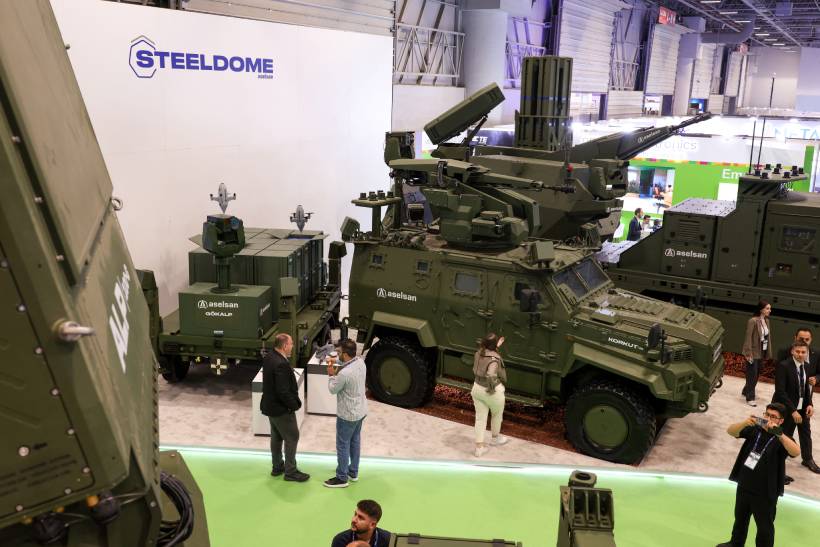
Turkey is seeking to expand its role in the global defence market after two decades of sustained investment transformed it from a major arms importer into a leading exporter of military equipment. Today, Turkish defence companies supply drones, ammunition, armoured vehicles, and other military systems to nearly 40 countries across Europe, Asia, Africa, and the Gulf.
The push comes amid a changing international security environment shaped by Russia’s war in Ukraine, growing concerns over the future of U.S. security commitments, and increasing defence spending across Europe. Turkish officials hope these developments will create new opportunities for exports, joint production agreements, and deeper industrial cooperation with Western partners.
Defence exports have grown significantly in recent years, reaching approximately $10 billion last year, while exports to Europe and the United States have increased sharply. Companies such as Baykar, Turkish Aerospace Industries, and Kale Group have emerged as important players in international defence markets.
Drivers of Turkey’s Defence Expansion
Several factors have contributed to Turkey’s emergence as a major defence exporter.
Stay ahead of the geopolitical week.
MD Briefing delivers expert analysis across five global fronts — the Indo-Pacific, energy, geoeconomics, European security, and the Middle East — every Monday morning. Free.
First, Ankara has pursued a long term strategy of reducing dependence on foreign suppliers by investing heavily in domestic defence production and research. This policy accelerated after repeated disputes with Western partners over arms sales and technology transfers.
Second, Turkish manufacturers have developed a reputation for delivering systems more quickly and often at lower costs than many Western competitors. This has made Turkish products attractive to countries seeking affordable and adaptable military capabilities.
Third, ongoing conflicts in Ukraine and the Middle East have increased demand for drones, ammunition, and air defence systems. Turkish equipment has benefited from extensive battlefield exposure, enhancing its international profile.
Opportunities in a Rearming Europe
The rapid increase in European defence spending presents a significant opportunity for Turkey.
Many European governments are reassessing defence procurement strategies following Russia’s invasion of Ukraine. Concerns about production bottlenecks, supply chain constraints, and uncertainty surrounding future U.S. commitments have encouraged European states to seek alternative suppliers and industrial partners.
Turkey’s position as a NATO member with substantial manufacturing capacity places it in a favourable position to benefit from this trend. Existing defence agreements with countries such as Poland, Romania, Spain, and Portugal demonstrate growing acceptance of Turkish military technology within Europe.
Ankara also hopes that upcoming NATO discussions will strengthen prospects for joint production initiatives and deeper integration into Western defence supply chains.
Challenges and Constraints
Despite growing export success, Turkey continues to face significant obstacles.
Political tensions with several European governments remain a major barrier. Concerns regarding democratic governance, foreign policy disputes, and regional security disagreements have limited Turkey’s participation in some European defence initiatives.
Turkey also remains excluded from certain European Union defence programmes, reducing access to funding and industrial partnerships available to EU members.
On the military side, Ankara continues to face technological gaps in areas such as advanced aircraft engines, tank engines, and sophisticated air defence capabilities. Addressing these weaknesses will require further investment and international cooperation.
In addition, ambitious projects such as the development of long range missile systems have generated debate among analysts regarding technical feasibility and strategic messaging.
Strategic Implications
Turkey’s growing defence industry reflects broader changes in the international security landscape. As geopolitical competition intensifies and defence spending rises globally, industrial capacity is becoming as important as military capability itself.
The country’s success demonstrates how middle powers can leverage defence production to expand diplomatic influence, strengthen strategic autonomy, and generate economic growth simultaneously.
Turkey’s expanding role also highlights the evolving nature of NATO, where industrial cooperation is increasingly viewed as a component of collective security. European states seeking rapid procurement solutions may find Turkish manufacturers increasingly difficult to ignore despite political reservations.
Stakeholders
Turkey
- Expanding defence exports and industrial capacity.
- Strengthening strategic autonomy and economic growth.
European NATO Members
- Seeking reliable defence suppliers amid rising security concerns.
- Exploring alternative procurement partnerships.
United States
- Monitoring changes in NATO burden sharing and defence industrial cooperation.
Defence Industry
- Turkish manufacturers seeking greater access to Western markets.
- European firms evaluating partnership opportunities.
Russia and Regional Actors
- Assessing the implications of Turkey’s expanding military industrial influence.
Analysis
Turkey’s defence sector has evolved from a national security project into a significant instrument of foreign policy and economic strategy. The convergence of rising global defence spending, uncertainty over traditional security arrangements, and growing demand for military technology has created favourable conditions for Ankara’s ambitions.
However, commercial success alone may not be sufficient to secure Turkey’s long term objectives. Political tensions with European partners continue to limit full integration into Western defence frameworks, while technological dependencies in critical sectors remain unresolved.
The coming years will likely determine whether Turkey can translate its expanding export footprint into sustained strategic influence. If Ankara successfully balances industrial growth with improved relations with European partners, it could emerge as one of the most important defence manufacturing hubs within the broader NATO ecosystem.
With information from Reuters.
