


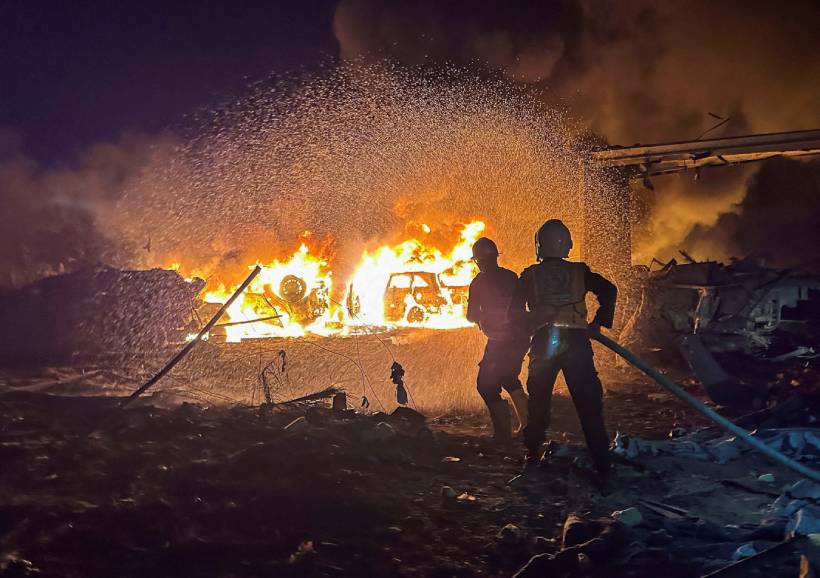
At least nine Palestinians, including five members of the same family, were killed in Israeli airstrikes across the Gaza Strip on Thursday, according to local health officials.
The attacks occurred before dawn and targeted multiple residential apartments, adding to concerns that violence in Gaza continues despite ongoing ceasefire efforts and international calls for de-escalation.
Health officials said at least 15 other people were injured in the strikes.
Multiple Airstrikes Hit Residential Areas
According to medics, Israeli aircraft struck four apartments in separate locations across Gaza at roughly the same time.
Stay ahead of the geopolitical week.
MD Briefing delivers expert analysis across five global fronts — the Indo-Pacific, energy, geoeconomics, European security, and the Middle East — every Monday morning. Free.
One of the attacks reportedly killed an entire family of five, including both parents and their children.
Emergency teams rushed to the affected areas to recover victims and transport the wounded to nearby medical facilities.
The Israeli military did not immediately issue a statement regarding the reported strikes.
Scenes of Destruction Emerge
Images and videos from the aftermath showed extensive damage to residential buildings.
Footage circulating online depicted apartments severely damaged by explosions, with furniture destroyed and debris scattered across surrounding streets.
A video shared on Palestinian social media appeared to show residents entering a burning apartment in an attempt to recover victims from beneath the rubble. The footage could not be independently verified.
Rescue operations continued throughout the morning as emergency crews searched damaged structures.
Ceasefire Fails to End Violence
The latest strikes occurred despite a ceasefire arrangement brokered by the United States earlier this year.
The truce was intended to reduce hostilities following months of conflict that began after the October 2023 attacks by Hamas on southern Israel.
However, violence has continued throughout the ceasefire period, with both sides accusing each other of violations.
Israeli military operations have persisted across parts of Gaza, while negotiations aimed at securing a more comprehensive agreement remain stalled.
Talks on Second Phase Remain Deadlocked
Efforts to implement the next stage of the ceasefire agreement have made little progress.
Indirect negotiations have focused on issues including the withdrawal of Israeli forces from Gaza and the disarmament of Hamas.
Diplomatic sources say significant disagreements remain between the parties, preventing a breakthrough despite ongoing mediation efforts.
The deadlock has raised concerns that prospects for a lasting ceasefire remain uncertain.
Israel Says Strikes Target Security Threats
Israeli officials have consistently maintained that military operations in Gaza are conducted to prevent attacks and eliminate security threats.
Israel says its strikes target militant infrastructure and individuals involved in planning or carrying out attacks against Israeli civilians and military personnel.
Israeli authorities have also stated that humanitarian aid and commercial goods continue to enter Gaza under existing arrangements.
The military had not commented on the specific incidents reported on Thursday at the time of publication.
Casualties Continue to Mount
According to figures released by Gaza health authorities, approximately 930 Palestinians have been killed in Israeli strikes since the ceasefire came into effect.
The figures do not distinguish between civilians and combatants.
Meanwhile, the Israeli military says four Israeli soldiers have been killed by militants during the same period.
The continuing casualties on both sides underscore the fragility of the ceasefire and the difficulty of achieving a sustainable end to the conflict.
Background
The conflict in Gaza intensified following Hamas attacks on southern Israel in October 2023, which triggered a large-scale Israeli military response.
Since then, repeated international efforts have sought to secure ceasefires, facilitate humanitarian assistance and create conditions for a broader political settlement.
While temporary truces have reduced violence at various points, none have succeeded in fully ending hostilities or resolving the underlying disputes driving the conflict.
The humanitarian situation in Gaza remains a major concern for international organizations, with large numbers of civilians displaced and significant damage to infrastructure.
Analysis: Ceasefire Exists on Paper but Not on the Ground
The latest strikes highlight the growing gap between diplomatic agreements and realities on the ground in Gaza.
Although a ceasefire framework remains formally in place, ongoing military operations and continuing casualties demonstrate that violence has not been meaningfully halted. The lack of progress in negotiations over the second phase of the agreement further complicates efforts to achieve lasting stability.
For Israel, military operations remain tied to security objectives and the prevention of future attacks. For Palestinians, continuing airstrikes and civilian casualties reinforce concerns that the ceasefire has failed to provide meaningful protection.
The deadlock in negotiations suggests that neither side is currently prepared to make the concessions necessary for a comprehensive settlement. As a result, the conflict risks settling into a prolonged cycle of intermittent violence despite ongoing diplomatic efforts.
Without significant progress in negotiations, the ceasefire is likely to remain fragile, leaving civilians on both sides vulnerable to further escalation.
Conclusion
At least nine Palestinians were killed in Israeli airstrikes across Gaza on Thursday, according to health officials, highlighting the continued violence despite an existing ceasefire framework. With negotiations over the next phase of the agreement stalled and casualties continuing to rise, hopes for a durable resolution to the conflict remain uncertain as international mediators push for renewed diplomatic progress.
With information from Reuters.
