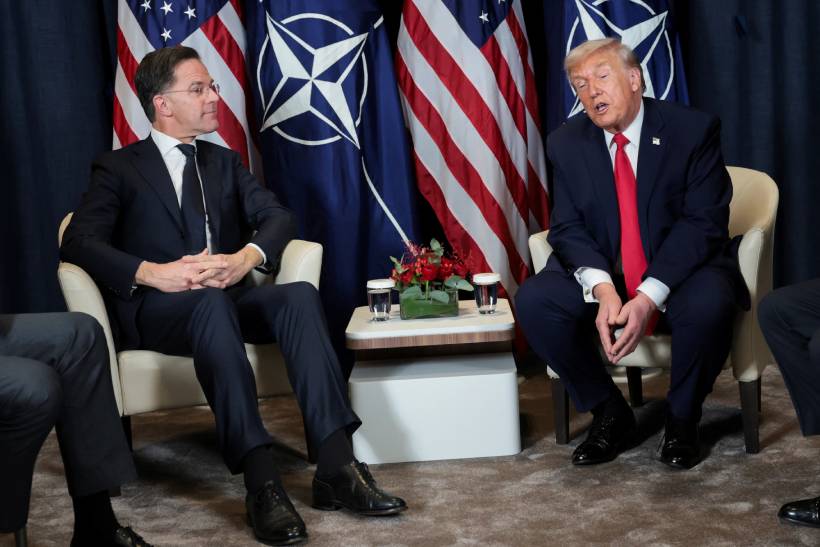
There is a point at which unpredictability ceases to function as a negotiating instrument and begins to function as noise. Donald Trump has not simply introduced uncertainty into the Atlantic relationship in the way that any administration produces friction through its particular priorities or domestic constraints; he has generated a volume and velocity of contradictory signals on NATO’s future, on Article 5, on the Iran war, on burden-sharing, on the conditions under which American guarantees apply, that have made the United States genuinely difficult to read. The illegibility is structural to how this presidency operates, not a tactical choice that could be reversed by a change of tone. Allies are no longer managing a demanding partner whose demands, however uncomfortable, follow a logic they can track across time. They are managing something closer to entropy, by which I mean not simply volatility or disagreement, but the breakdown of interpretability itself: a condition in which the signal can no longer be distinguished from the noise regardless of how carefully allies attend to it.
Western security architecture was not designed to guarantee certainty so much as to sustain a particular kind of expectation. The reasonable confidence, shared across governments and general staffs alike, was that American commitments would hold across administrations. The framework within which allies made their defence calculations was sufficiently stable to anchor long-term decisions. Deterrence, forward deployment, burden-sharing. None of these mechanisms required the United States to be beyond question. They required it to be legible. When the signal becomes indistinguishable from the noise, the system does not collapse at once, but it begins operating on different assumptions, and those assumptions quietly restructure everything built upon them.
The Entropy Problem
Trump has returned repeatedly to the suggestion that the United States might leave the alliance, a position sufficiently alarming that members of Congress have moved to impose legislative constraints on his ability to do so. Whatever his actual intentions, the effect of floating the possibility in public, at irregular intervals, without coordination with the State Department or allied governments, is to introduce conditionality into the one part of the alliance architecture that was specifically designed to be unconditional. Article 5 functions not because every ally believes American intervention is inevitable in every scenario, but because the probability is high enough and stable enough to anchor deterrence calculations. Once that probability becomes a variable subject to the mood of a single presidency, allies begin quietly recalculating what the guarantee is actually worth. In practice, that recalculation means accelerated hedging, increased investment in autonomous capacity, and a quiet downgrading of collective commitments from background constants to contingent variables that must be actively managed rather than simply assumed.
Stay ahead of the geopolitical week.
MD Briefing delivers expert analysis across five global fronts — the Indo-Pacific, energy, geoeconomics, European security, and the Middle East — every Monday morning. Free.
Trump’s demand for allied solidarity in Iran had no basis in the alliance’s own treaty logic. Article 5 commits members to collective defence in response to an armed attack against one of them, and applies exclusively to crises in Europe and North America. The Iran campaign was neither. Allies were declining discretionary involvement in a war they had not been consulted on and did not endorse. The confusion between those two things, repeated across weeks of public statements, is itself a form of entropy, whether it reflects a genuine misreading of the architecture or a deliberate attempt to reframe treaty obligations as conditional on allied deference. Either way, the effect on allied decision-making is the same.
The most telling signal of the current dynamic was not what Trump said before meeting NATO’s secretary general in early April, but what he posted immediately afterward: that NATO had not been there when needed and would not be there again. Rutte left Washington unable to confirm whether any commitment had been made. When the statement follows the diplomatic encounter rather than preceding it, the encounter itself has lost its function.
The pattern extended from rhetoric into policy posture when the American defence secretary declined to restate the alliance’s core commitment, referring the question instead to presidential discretion. That is not a posture designed to project strength or extract leverage. It confirmed what European governments had begun to suspect: that the reliability they had priced into their security calculations for decades is now contingent in ways it was not before. The contingency is not tied to any legible set of conditions they could meet. A demanding partner is manageable. An unreadable one forces a different kind of response.
When Secretary of State Rubio stated publicly that the United States would re-examine its relationship with NATO after the Iran conflict, the signal ceased to be the improvisation of one unpredictable principal and became something closer to coordinated institutional messaging. An alliance can absorb an erratic president by treating his statements as noise around a stable policy signal. It cannot absorb the same message arriving simultaneously from the defence secretary and the secretary of state. At that point the noise and the signal have become indistinguishable, and allies have no remaining interpretive anchor to hold onto.
The conditionality is not confined to improvised statements. The 2026 National Defense Strategy, the formal doctrinal document governing American military posture, states explicitly that European allies are capable enough to take primary responsibility for their own conventional defence, and that if the United States becomes involved in a conflict with China, the defence of Europe against Russian aggression is a European problem to manage. The framing is not that allies are failing; it is that they are capable enough to be held fully accountable. What had been presidential rhetoric has been codified.
American defence officials introduced the concept of NATO 3.0 at a ministers meeting in Brussels in February 2026, describing it as the necessary evolution of an alliance in which Europe assumes primary responsibility for its own conventional defence while the United States pivots toward the Indo-Pacific. What had appeared as improvised disruption has an institutional name, a framework, and people tasked with implementing it.
The implementation is already visible at the command level. Reports confirm that the United States is transferring command of key NATO structures, including Allied Joint Command Naples and Joint Force Command Norfolk, to European flag officers, a structural reorganisation that would have been inconceivable as recently as 2024 and that embeds the reorientation in the alliance’s own institutional architecture regardless of what any future administration might prefer.
At the NATO foreign ministers meeting in Helsingborg on 22 May, secretary general Rutte told the press conference that American troop reductions reflect a necessary pivot toward Asia and will unfold gradually as European allies build capacity. The framing was Rutte’s familiar instrument: absorbing disruptive American behaviour into reassuring institutional language as a way of keeping Washington nominally inside the alliance.
The explanation had not settled before Washington announced it would send 5,000 troops to Poland, a reinforcement of the eastern European flank that sits at some distance from any Pacific reorientation. European governments that have watched the same approach applied to Greenland, to Article 5, and now to a withdrawal that reversed itself before Rutte had finished explaining it, are increasingly doubtful that managed narration can substitute for the commitments it is being used to explain away.
When Patience Runs Out
The shift did not happen overnight. European governments had absorbed considerable pressure through 2025, adjusting postures on trade, defence spending, and Ukraine in ways designed to keep the relationship functional. The Greenland episode in January 2026, in which Trump threatened tariffs against Denmark until it agreed to relinquish a territory whose population had no interest in being relinquished, was for many the point at which accommodation ceased to feel like strategy and began to feel like surrender.
Allied patience, the political and diplomatic infrastructure that absorbed American pressure in the past and translated it into manageable disagreement, has begun to withdraw. Emmanuel Macron has stopped engaging Trump’s statements on their own terms, stopped interpreting them, stopped justifying them to European publics, stopped treating them as the opening position in a negotiation with a legible endpoint. The withdrawal represents something more consequential than personal frustration. It is visible in observable terms: European leaders are no longer publicly contextualising American statements, no longer absorbing the diplomatic friction of explaining Washington’s position to their own parliaments, and no longer treating American unpredictability as a temporary condition requiring patient management.
Macron’s call in early May for the European Union to activate its most powerful trade enforcement instrument against the United States makes the shift concrete. Tools that European governments previously reserved for adversaries are now being directed at their principal security guarantor.
NATO’s own secretary general, Mark Rutte, came under fire from European governments for going too far in his public alignment with the American position on the Iran war. The man tasked with keeping the alliance intact was being pulled simultaneously toward Washington and away from it by the members he represented. That is a different kind of institutional stress from anything the alliance has previously absorbed.
The withdrawal of patience is not confined to western European capitals. Poland, the NATO member with the most direct and immediate stake in Article 5 credibility, has seen its prime minister state publicly that the greatest threat to the transatlantic community is not its external enemies but the ongoing disintegration of the alliance itself. When the ally most dependent on the American guarantee begins describing the guarantor as the primary source of risk, the credibility repricing has reached its most consequential point.
Alliance theory has traditionally treated abandonment and entrapment as opposite ends of the same dilemma: the fear that a guarantor will not be there when needed, against the fear of being dragged into conflicts that serve the guarantor’s interests rather than one’s own. European governments are currently navigating both at once: potential abandonment on the collective defence commitment that underpins their security architecture, and active pressure toward entrapment in a Middle Eastern war they neither endorsed nor were consulted on. That combination is not a temporary imbalance. It is a structural condition that forces a fundamental reassessment of what the alliance is actually for.
Across southern and eastern Europe, the same pattern repeated. Access denied, airspace closed, hardware withheld. None of it constitutes an exit from the Western security system. These governments are not leaving NATO. They are repositioning within it, insulating themselves from the immediate noise while preserving optionality for when conditions change. The bet, implicit in most European capitals, is that the current administration is a bounded disruption and that institutional continuity will reassert itself in time. On that reading, the rational strategy is to reduce exposure to the most volatile elements of the relationship while investing in alternatives that did not previously seem necessary or politically feasible.
The two logics are not contradictory. Governments that believe a disruption is temporary are precisely the ones with the most incentive to extract permanent structural gains from it while the conditions that make those gains politically feasible still hold.
The recalibration is also partly opportunistic. Unpredictability has created the political conditions for integration initiatives that would have faced far greater domestic resistance under normal alliance conditions. Defence spending increases that were previously politically difficult are now passing with reduced friction, because the framing has shifted from American pressure to European necessity.
Germany, which for decades resisted French calls for greater European defence autonomy, has now backed the creation of a coalition of the willing capable of operating without the United States, a shift that paves the way for broader consensus among Britain, France, Poland, the Nordic countries and Canada.
The Northwood Declaration of July 2025, formalising Franco-British nuclear coordination for the first time, signals how far that construction has already advanced: the most politically sensitive dimension of European defence, the nuclear guarantee, is being institutionalised between two sovereign states precisely because the American umbrella can no longer be assumed to open automatically. The entropy emanating from Washington is, in a specific and paradoxical sense, doing the work that decades of European federalist argument could not.
The Hormuz Abdication
The Strait of Hormuz episode crystallised something beyond alliance management. Following the joint US-Israeli military campaign launched in late February 2026, which effectively blockaded one of the world’s most critical energy chokepoints, Washington informed its allies, whose economies depend far more directly on Middle Eastern energy flows than the American economy now does, that reopening the strait was their problem to resolve. Trump’s framing was explicit: Washington no longer needs the region’s oil and gas, so those who do should bear the responsibility for securing access.
The scale of European exposure to that logic is not abstract. In the sixty days of conflict alone, Europe’s bill for fossil fuel imports rose by over twenty-seven billion euros without a single additional unit of energy reaching the continent, according to figures presented to the European Parliament. The strategic incoherence of creating a crisis and then declining responsibility for its consequences is visible enough. The deeper significance lies elsewhere, in what the posture reveals about how this administration understands the relationship between American military capacity and American structural influence.
Alliance credibility and system management rest on the same foundational assumption. The guarantee that anchors deterrence and the willingness to bear the costs of managing strategic chokepoints both depend on American commitments being reliable enough to be treated as constants by the actors who depend on them.
Control over the nodes through which global commerce moves has never been incidental to American power but constitutive of it. The postwar bargain was not simply military. It rested on a political arrangement in which Washington bore the costs of system management and in exchange exercised disproportionate influence over the rules and conditions under which the system operated. That arrangement was sometimes resented and often contested, but it was broadly accepted because the alternative, a world in which no actor was willing to assume those costs, was understood to produce worse outcomes for almost everyone.
When Washington signals that it is no longer interested in bearing those costs while retaining the expectation of disproportionate influence, it is not renegotiating the bargain. It is dissolving it unilaterally. And the influence that depended on the bargain does not persist simply because the military capacity that enforced it remains available. Presence without commitment is a different kind of power, and it does not produce the same effects.
The Space That Opens
The space the United States is vacating will not remain empty, and will not be held in reserve for Washington’s eventual return. Coordination roles, once assumed by other actors, develop institutional weight of their own. The alternative energy partnerships, the diversified diplomatic channels, the nascent security structures that European states and regional powers are building in response to American unpredictability: these reflect their own interests rather than American preferences, and dismantling them on American request becomes progressively harder to justify domestically once the constituencies that benefit from their existence are established.
Washington moved from weighing plans to executing them. The withdrawal of thousands of active-duty troops from Germany, announced without consulting allied governments or NATO command, was followed within days by the suspension of planned deployments to Poland and parts of eastern Europe. The country that had increased its defence spending most aggressively and positioned itself as the eastern anchor of NATO’s deterrence posture was told, without warning or explanation, that the American forces it had been promised would not be arriving. It arrived not as a strategic recalibration but as a punitive statement, uncoordinated and undetailed, of the kind that orderly alliance management was specifically designed to prevent.
The episode that followed the Hormuz ceasefire made the reorientation visible. Washington rejected NATO’s belated offer of assistance, while separately and publicly thanking Gulf states for their support during the campaign. The pairing was not incidental. Whether the substitution is deliberate or symptomatic, its effect is the same: Washington was publicly pairing the dismissal of Atlantic partners with warm acknowledgment of states that had supported American operations on transactional terms. If that pattern consolidates, the coordination roles the United States is vacating within the Western security architecture will not remain empty. They will be filled by different actors operating on different terms, and the conditions under which Washington might reclaim them will look nothing like the ones that existed before.
The administration’s approach has been described by analysts as extractive transactionalism, the deliberate use of European need to remain inside the alliance as a lever to extract compliance, while simultaneously tilting toward a milder posture with Moscow. The concept maps onto a specific kind of structural damage. An alliance treated as a dependency to be monetised produces different behaviour from one treated as a shared security good, because actors who are being charged for protection eventually begin calculating whether the protection is worth the price, and some of them will decide it is not.
The most visible illustration of how rapidly the coordination map is being redrawn came when Canadian Prime Minister Mark Carney became the first non-European leader invited to a meeting of the European Political Community, where he said the international order could be rebuilt out of Europe and that Ottawa was looking to deepen ties with reliable partners. Canada, a founding NATO member whose security relationship with the United States predates the alliance itself, is now being positioned within a European-led architecture as an alternative framework for collective reliability. The word reliable was doing considerable analytical work in Carney’s remarks.
American re-entry into any strategic terrain it has vacated will face rising costs with each cycle of withdrawal and return. The architecture allies build in Washington’s absence will increasingly reflect a world in which American reliability is no longer assumed, and the cost of re-entry rises with every cycle precisely because that architecture serves their interests, not Washington’s preferences. The implicit infrastructure that made rapid allied coordination possible in past crises, the shared assumptions, the interpretive trust, the expectation that American commitments were background constants rather than political variables, is eroding. Its absence will not be fully apparent until a genuine collective defence emergency requires exactly the kind of seamless response the system was designed to produce.
The asymmetry that makes European rearmament simultaneously urgent and structurally incomplete is visible in the gap between what Washington is demanding and what Europe can physically deliver. The Pentagon has set 2027 as the deadline by which Europe must assume primary responsibility for NATO’s conventional defence, covering everything from ground forces and air defence to intelligence systems and logistics. Meeting that deadline would require approximately 300,000 additional troops, 1,400 tanks, and 2,000 infantry fighting vehicles, at a cost analysts place at no less than 250 billion euros in additional annual spending. European defence production backlogs, accumulated over decades of underinvestment, mean that even orders placed today for critical systems cannot be fulfilled within that window. The deadline measures the gap between American expectations and European capacity rather than closing it.
The structural problem with European rearmament runs deeper than financing alone. Recent institutional assessments have noted that accelerating the process requires a degree of transatlantic trust and prioritisation that may no longer exist. The fast track to rearmament runs through American defence industry and American interoperability frameworks.
The slow track requires Europe to build independent capacity from a fragmented industrial base while managing active shortfalls in precisely the systems the Iran conflict has burned through most severely. Within the first seven weeks of the campaign, the United States had expended nearly half its Patriot air defence interceptors and more than half its THAAD inventory, according to analysis of Pentagon procurement data. European holdings of the same systems are a fraction of American pre-war stocks. The gap between what the threat environment demands and what European rearmament can realistically deliver within that timeframe is the strategic vulnerability that American unpredictability has opened.
The re-entry problem extends beyond the current administration. Former American officials with direct experience of the alliance have said publicly that something fundamental has broken, and that Trump does not believe America’s security depends on the security of Europe, a position that defies decades of foreign policy logic going back to the alliance’s founding. When that language comes from within the American foreign policy establishment rather than from European capitals, it carries a different analytical weight. It is a recognition that the operating assumptions of the postwar order have been withdrawn from one of their primary institutional expressions.
Even a future American administration with stronger transatlantic inclinations will find it genuinely difficult to return to a relationship in which European opinions carry less weight by default and American primacy is simply assumed. The dependencies that underwrote that relationship are being actively dismantled on both sides simultaneously, by Washington through withdrawal and conditionality, and by Europe through the accelerated construction of autonomous capacity. What is being built in the interim will not simply pause and wait. Institutional assessments now use the word irreparably to describe what this period could do to the alliance as mutual confidence erodes and both sides brace for repeated confrontation on core issues. The word is doing the analytical work that the rest of the piece has been building toward. Some of what is being lost in the current moment cannot be recovered by a change of administration, a new summit communiqué, or a revised burden-sharing formula. The foundational assumptions are shifting, and the institutions that depended on them are shifting with them.
The Atlantic alliance still exists, and its institutional frameworks, treaty obligations, and the military interoperability accumulated over generations remain. But the internal logic of the system is shifting, from one organised around stable expectations to one organised around contingency management. Each interaction becomes negotiated rather than assumed. Security guarantees are treated as variables subject to political cycles rather than constants that transcend them. European states are simultaneously hedging against American unreliability and seizing the political moment to build structures they could not have built before. Regional and emerging powers are watching the spaces that open when the system manager steps back from its role. The architecture persists, but what it produces when tested will depend on assumptions that have quietly changed, without announcement, across the foreign ministries and defence establishments of every government that has spent the last two years learning to plan around American unpredictability rather than with American reliability. European rearmament can compensate for some of what is being lost. It cannot compensate for credibility, which took seven decades to accumulate and cannot be rebuilt through any defence budget, however large, once the foundational assumption of American reliability has been repriced out of the system.