


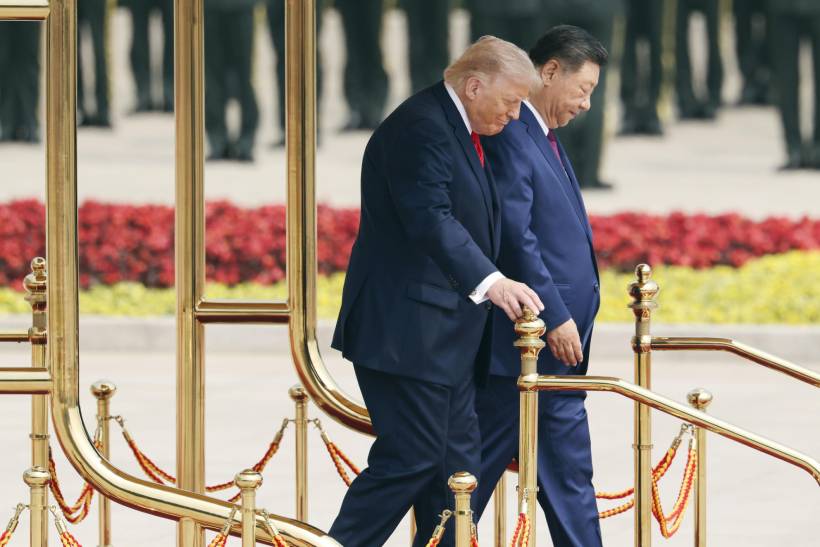
During recent talks in Beijing, Chinese President Xi Jinping reportedly asked United States President Donald Trump whether the two countries could avoid what is commonly called the “Thucydides trap.” The phrase has become increasingly influential in discussions about global power competition, especially regarding relations between the United States and China.
The concept originates from the writings of the ancient Greek historian Thucydides, who documented the Peloponnesian War between Athens and Sparta during the fifth century BCE. Modern political scientist Graham Allison popularized the term in contemporary international relations by using it to describe the danger of conflict between an established global power and a rapidly rising rival.
Today, many analysts see parallels between ancient Greece and the growing rivalry between Washington and Beijing.
What Is the Thucydides Trap
The Thucydides trap describes a situation in which a dominant power becomes fearful of a rising competitor, increasing the likelihood of confrontation or war.
Stay ahead of the geopolitical week.
MD Briefing delivers expert analysis across five global fronts — the Indo-Pacific, energy, geoeconomics, European security, and the Middle East — every Monday morning. Free.
The term comes from Thucydides’ famous observation in History of the Peloponnesian War:
“The growth of the power of Athens, and the alarm which this inspired in Sparta, made war inevitable.”
In simple terms, Thucydides argued that Sparta feared the growing strength of Athens so deeply that conflict eventually became unavoidable.
The theory suggests that fear, insecurity, and strategic rivalry can push nations toward war even when peaceful alternatives exist.
In modern politics, the United States is often viewed as the established global superpower, while China is seen as the rising power challenging the existing international balance.
The Ancient Conflict Between Athens and Sparta
To understand the theory fully, it is important to examine the historical conflict itself.
During the fifth century BCE, Athens grew into a dominant naval and economic power across the Aegean region. It expanded its alliances, increased its military strength, and extended its political influence over neighboring Greek states.
Sparta, meanwhile, was the traditional military power in Greece and led its own alliance network. As Athens became stronger, many Spartan allies feared losing influence and security.
According to Thucydides, these growing tensions eventually pushed Sparta into war in 431 BCE. The Peloponnesian War lasted for twenty seven years and devastated much of the Greek world.
Although Sparta eventually defeated Athens, the victory came at a severe cost. The prolonged conflict weakened Sparta politically, economically, and militarily.
Why Many Scholars Disagree With the Modern Interpretation
Modern scholars of ancient Greece often argue that the phrase “Thucydides trap” oversimplifies the historical reality.
The word “trap” implies that Sparta made an avoidable mistake driven mainly by fear. However, Thucydides’ account suggests Sparta had legitimate strategic concerns. Athens had become an aggressive and expanding power that threatened the existing balance of power in Greece.
Athens was attracting Sparta’s allies and increasing its regional dominance. Many allies pressured Sparta to confront Athens before its own position became too weak.
From this perspective, Sparta’s actions were not irrational panic but a response to real geopolitical pressures.
This debate matters because it affects how policymakers interpret modern competition between China and the United States. Some believe conflict can be avoided through diplomacy and cooperation, while others argue that structural rivalry between great powers naturally creates instability.
The Long Term Lessons of the Peloponnesian War
One of the most important lessons from the Peloponnesian War is that victory in great power competition can still lead to decline.
After defeating Athens, Sparta expanded aggressively and attempted to dominate Greece completely. However, this expansion frightened other Greek states, which eventually united against Sparta.
In 371 BCE, Sparta suffered a catastrophic defeat at the Battle of Leuctra, ending its dominance permanently. Its alliance system collapsed, its military prestige disappeared, and it became a minor regional power.
Athens, meanwhile, recovered gradually after the war. Although it never regained its earlier empire fully, it restored its democracy, rebuilt parts of its military, and remained culturally influential.
Interestingly, Athens later accepted the limits of its power and reduced its broader imperial ambitions, choosing stability over endless expansion.
Relevance to United States China Relations
The concept of the Thucydides trap has become central to debates about modern international politics because many analysts fear that strategic competition between the United States and China could eventually lead to military confrontation.
Several issues already create tension between the two countries, including:
Trade and Economic Competition
The United States and China compete heavily in manufacturing, technology, artificial intelligence, and global trade influence. Tariffs, sanctions, and restrictions on advanced technology exports have increased mistrust between both governments.
Taiwan
Taiwan remains one of the most sensitive issues in China United States relations. Beijing views Taiwan as part of China, while the United States supports Taiwan’s defensive capabilities and democratic system.
Many experts believe Taiwan could become the most dangerous flashpoint between the two powers.
Military Expansion
China’s growing military strength and expanding influence in the Indo Pacific region have increased American concerns about regional security and freedom of navigation.
At the same time, Beijing views American military alliances and naval presence near its borders as attempts to contain China’s rise.
Analysis
The idea of the Thucydides trap highlights an important reality of international politics: fear between powerful states can become as dangerous as direct aggression itself.
However, history also shows that war is not always inevitable. Unlike ancient Greece, modern powers operate in a world shaped by nuclear deterrence, economic interdependence, international institutions, and global communication networks.
The United States and China are deeply connected economically in ways Athens and Sparta never were. A direct conflict today would have devastating consequences not only for both countries but also for the global economy.
The historical lesson may therefore be less about inevitable war and more about the importance of managing competition carefully. Ancient Greece demonstrates how fear, alliance pressures, and strategic rivalry can spiral into destructive conflict when diplomacy fails.
At the same time, the later history of Athens and Sparta also suggests that successful powers must recognize the limits of expansion and avoid overextending themselves politically and militarily.
Ultimately, the discussion around the Thucydides trap reflects growing uncertainty about the future global order. Whether the United States and China repeat the mistakes of ancient powers or develop a more stable form of coexistence may shape international politics for decades to come.
With information from Reuters.
