


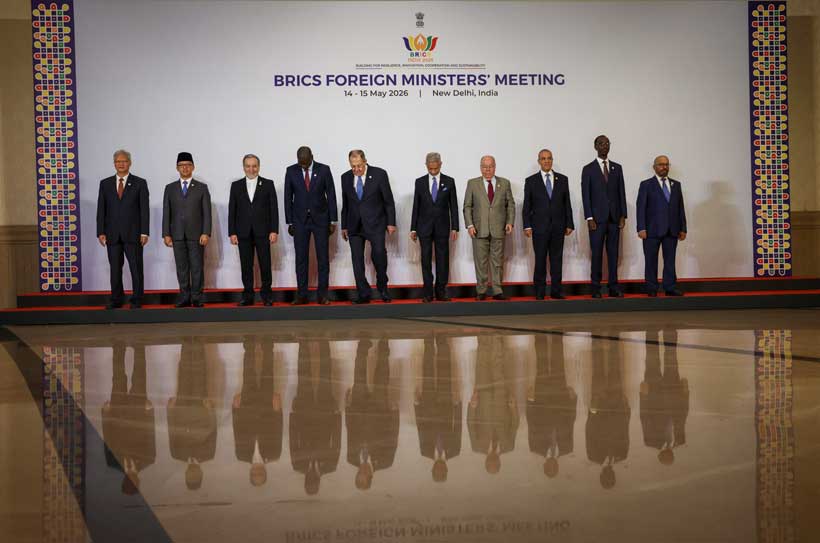
Foreign ministers from the BRICS nations ended a two day meeting in New Delhi without issuing a joint statement, highlighting deep divisions within the bloc over the ongoing conflict involving Iran, the United States, and Israel.
The diplomatic gathering brought together representatives from an increasingly diverse and politically complex alliance that now includes both Iran and the United Arab Emirates, two regional rivals currently on opposite sides of the escalating Middle East crisis.
Because member states could not agree on language regarding the war, host country India released only a chair’s statement summarizing discussions rather than a unified declaration endorsed by all participants.
Stay ahead of the geopolitical week.
MD Briefing delivers expert analysis across five global fronts — the Indo-Pacific, energy, geoeconomics, European security, and the Middle East — every Monday morning. Free.
Iran Pushes for Stronger Condemnation
Iran reportedly sought a stronger collective position condemning the United States and Israel for military operations against it.
Tehran also accused the UAE, a close American partner in the Gulf region, of involvement in military activities linked to the conflict.
Iranian Foreign Minister Abbas Araqchi stated that one BRICS member blocked sections of the proposed statement, although he did not directly name the UAE.
Araqchi attempted to soften tensions publicly by emphasizing that Iran did not view the UAE itself as a direct target in the conflict. He argued that Iranian strikes had focused only on American military facilities located on Emirati territory.
At the same time, he expressed hope that relations inside BRICS could improve before the leaders’ summit later this year.
India’s Carefully Balanced Position
India’s final chair statement revealed the difficulty of managing competing geopolitical interests within the expanded BRICS bloc.
The document acknowledged that member countries held different perspectives regarding the Middle East crisis. According to the statement, discussions included calls for diplomacy, respect for sovereignty, protection of civilian lives, and the importance of maintaining secure maritime trade routes.
However, the absence of a formal joint declaration demonstrated that BRICS members remain divided on critical geopolitical questions.
India’s approach reflected its broader diplomatic strategy of balancing relations with multiple global powers simultaneously. New Delhi maintains close ties with the United States and Gulf countries while also preserving strategic partnerships with Russia, Iran, and China.
Gaza and Palestine Also Cause Disagreement
Divisions were not limited to the Iran conflict.
The chair statement noted that BRICS ministers reaffirmed support for Palestinian self determination and described Gaza as an inseparable part of the occupied Palestinian territories.
The document also supported efforts to unify Gaza and the West Bank under the Palestinian Authority and backed the establishment of an independent Palestinian state.
However, the statement acknowledged that one unnamed member state held reservations regarding aspects of the Gaza section as well.
This further illustrated the challenge of building unified foreign policy positions within a grouping that includes countries with vastly different regional interests and diplomatic alignments.
BRICS and the Global South Narrative
Despite internal disagreements, BRICS members emphasized the importance of cooperation among developing nations.
India’s statement described the Global South as an important force for positive international change during a period marked by rising geopolitical tensions, economic uncertainty, technological disruption, protectionism, and migration pressures.
The expanded BRICS bloc now includes:
- Brazil
- Russia
- India
- China
- South Africa
- Ethiopia
- Egypt
- Iran
- UAE
The expansion of the bloc has increased its global economic and political weight but has also introduced more ideological and strategic divisions.
The Economic Impact on India
The Middle East conflict has had serious economic implications for India.
As one of the world’s largest oil importers, India depends heavily on energy shipments passing through the Strait of Hormuz. The disruption of maritime traffic in the region has increased energy costs and raised concerns about inflation and supply stability.
Indian personnel have reportedly been killed in incidents linked to the regional conflict, while an India flagged vessel was sunk during the recent escalation.
Against this backdrop, Indian Prime Minister Narendra Modi visited the UAE and publicly condemned attacks targeting the Gulf nation.
Modi praised the UAE’s restraint and described attacks against it as unacceptable, signaling India’s effort to maintain strong ties with key Gulf partners despite its participation alongside Iran in BRICS.
Analysis
The failure of BRICS foreign ministers to produce a joint statement highlights the growing contradictions inside the expanded organization.
Originally conceived as an economic coalition of major emerging powers, BRICS increasingly aspires to become a broader geopolitical platform representing the Global South. However, the inclusion of regional rivals and states with conflicting strategic interests makes unified diplomacy increasingly difficult.
The Iran conflict exposed these tensions clearly. Iran sought solidarity against the United States and Israel, while Gulf states inside the bloc maintain close security relationships with Washington and face direct security threats from Tehran.
India’s cautious wording reflected the reality that BRICS currently functions more as a flexible diplomatic forum than a cohesive political alliance.
The episode also demonstrates a larger shift in global politics. As Western led institutions face criticism from many developing nations, alternative groupings like BRICS are gaining visibility. Yet these organizations must still overcome major internal disagreements if they hope to shape global governance effectively.
For India, the situation illustrates the complexity of its foreign policy position. New Delhi seeks leadership within the Global South while simultaneously maintaining relations with competing regional and global powers.
Ultimately, the Delhi meeting showed both the growing importance and the structural limitations of BRICS. The bloc may continue expanding economically and politically, but achieving consensus on major international crises will remain a significant challenge as geopolitical rivalries deepen across the world.
With information from Reuters.
