


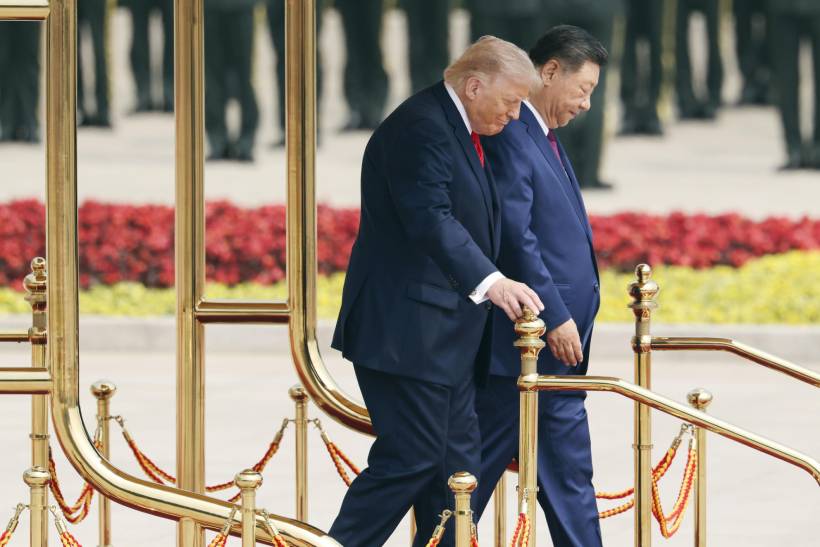
China’s currency reached its strongest level against the United States dollar in more than three years as investors closely monitored the summit between Chinese President Xi Jinping and United States President Donald Trump in Beijing.
While the strengthening yuan reflected growing confidence in China’s economic resilience, Chinese stock markets moved lower as investors waited for clearer outcomes from the high level talks.
The summit comes at a critical moment in China United States relations, with both countries attempting to manage economic rivalry, technology competition, and ongoing trade tensions.
Yuan Reaches Strongest Level in Three Years
The Chinese yuan appreciated significantly against the dollar, reaching its strongest level since 2023.
Stay ahead of the geopolitical week.
MD Briefing delivers expert analysis across five global fronts — the Indo-Pacific, energy, geoeconomics, European security, and the Middle East — every Monday morning. Free.
The People’s Bank of China set the official midpoint rate at its highest level in more than three years, signaling confidence in the currency’s stability and broader economic conditions.
Several factors have supported the yuan’s rise in recent months:
- Strong Chinese export performance
- A large trade surplus
- Relative weakness in the United States dollar
- Improved investor confidence in China’s economy
The yuan has reportedly gained around three percent against the dollar this year and strengthened against many major global currencies.
However, analysts noted that the central bank continues to manage the pace of appreciation carefully to avoid excessive volatility that could hurt exports.
Chinese Stocks Pull Back
Despite the stronger currency, Chinese stock markets showed caution.
The Shanghai Composite Index declined after recently reaching an eleven year high, while the CSI300 Index also moved lower.
The market reaction suggests investors remain uncertain about whether the Trump Xi summit will produce concrete economic agreements or simply symbolic diplomatic messaging.
Many investors appear to believe that expectations for major breakthroughs remain relatively low.
Focus on Stability Rather Than Major Deals
Chinese officials described the summit as marking a “new positioning” in relations between the world’s two largest economies.
However, early reports from the talks offered limited details regarding specific policy agreements.
Analysts suggest Beijing’s primary objective is to project stability and predictability rather than secure dramatic concessions from Washington.
China’s leadership likely wants to reassure both domestic and international audiences that relations with the United States remain manageable despite ongoing competition.
The summit also reflects mutual recognition that prolonged economic confrontation could damage both economies.
Technology and Artificial Intelligence Take Center Stage
Although trade tensions remain important, investors increasingly view artificial intelligence and advanced technology competition as the central issue in China United States relations.
The ongoing dispute over Nvidia’s H200 artificial intelligence chips highlights the growing strategic importance of semiconductors.
Recent reports indicated that the United States approved several major Chinese firms to purchase Nvidia’s advanced AI chips, although no deliveries have yet occurred.
This demonstrates how technology policy has become deeply intertwined with national security concerns.
Chinese companies are simultaneously accelerating efforts to reduce dependence on foreign technology and strengthen domestic semiconductor production.
Meanwhile, the United States continues to balance commercial interests with strategic concerns over maintaining technological leadership.
Why Markets Are Less Reactive to Trade Tensions
Some analysts believe financial markets have become less sensitive to developments in the trade dispute compared to previous years.
Several reasons explain this shift:
Greater Economic Resilience
China’s economy has adapted to years of tariffs, export controls, and geopolitical pressure. Investors increasingly believe Beijing can withstand prolonged competition with Washington.
Managed Competition
Both governments appear to recognize that a full economic rupture would be extremely costly. This has increased expectations that tensions will remain controlled rather than escalate uncontrollably.
Technology Driven Optimism
Rapid growth in artificial intelligence and advanced technology sectors continues to support investor optimism despite geopolitical uncertainty.
Many investors now view AI competition itself as a driver of innovation and long term economic growth.
Possible Trade Adjustments
Reports suggest both countries may explore limited arrangements involving non sensitive goods.
Such mechanisms could potentially allow selected products to move between the two economies with reduced tariffs while avoiding sectors linked to national security concerns.
If implemented, these arrangements could provide temporary stability in bilateral trade relations and ease some pressure on businesses operating across both markets.
However, any agreements are likely to remain limited and carefully controlled given the broader strategic rivalry.
Strategic Implications
The summit highlights the evolving nature of China United States competition.
The relationship is no longer defined solely by trade disputes. Instead, it increasingly revolves around:
- Artificial intelligence leadership
- Semiconductor technology
- Supply chain security
- Economic resilience
- Strategic influence in global markets
Both countries are attempting to compete economically while preventing direct confrontation.
This creates a delicate balance between cooperation and rivalry that will continue shaping global politics and financial markets.
Future Outlook
The most likely short term outcome is a continuation of managed competition between Beijing and Washington.
Markets may respond positively if both leaders signal commitment to stability and limited economic cooperation.
However, deeper tensions over technology, security, and geopolitical influence remain unresolved.
As artificial intelligence becomes central to economic and military power, future China United States relations will likely depend heavily on technological competition rather than traditional trade issues alone.
Conclusion
China’s strengthening yuan and cautious stock market reaction reflect the uncertain but important nature of the Trump Xi summit.
While investors welcome signs of diplomatic stability, expectations for major breakthroughs remain limited.
The broader relationship between the United States and China is increasingly shaped by artificial intelligence, semiconductor competition, and strategic economic positioning.
Even as both powers seek stability, their rivalry over technology and global influence is expected to define international politics and markets for years to come.
With information from Reuters.
