


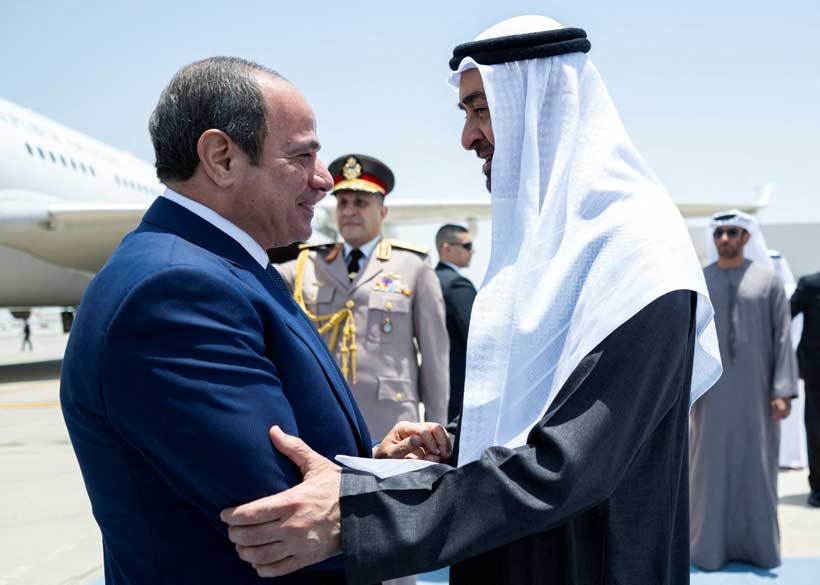
China is encouraging an Egyptian military presence in the UAE by May 2026 to protect the UAE’s strategic interests as a (regional alternative to American deterrence). Beijing believes that coordinated Egyptian and Emirati military forces can form a regional security guarantor, reducing the need for a traditional US military presence and facilitating China’s economic and military influence in the Gulf and the Middle East. Based on current strategic developments following a potential US-Israeli war against Iran, the Middle East, the Gulf region, the UAE, and Egypt are witnessing a reshaping of military alliances with Chinese assistance. The Egyptian-Emirati-Chinese partnership plays a pivotal role in this growing military cooperation. China’s expansion, based on its Military Silk Road (or its strategy to protect overseas interests), relies on reliable regional partners. Egypt and the UAE are considered key pillars of this expansion, especially given the growing Emirati and Gulf skepticism about relying solely on the US presence and military bases in the Gulf states, particularly after a potential war with Iran.
In this context, Chinese intelligence agencies analyze the deployment of Egyptian forces in the UAE, through analyses conducted by the Chinese military and intelligence services of the People’s Liberation Army (PLA). The presence of Egyptian forces and (Rafale fighter jets) within the framework of the Egyptian military advisory/security presence in the UAE, especially after the May 2026 reports of Egyptian military aircraft being stationed in the UAE. The Chinese consider the Egyptian military presence in the UAE to be part of supporting China’s New Silk Road military initiative to secure (China’s overseas interests). The Chinese believe that the Egyptian military presence in the UAE enhances the security of Chinese maritime and air routes from Djibouti (China’s base on the Red Sea) to the Arabian Gulf. China also prefers dealing with countries with strategic stability, such as Egypt and the UAE, rather than engaging in random alignments or high-risk hotspots. Therefore, China is encouraging new military partnerships with Egypt and the UAE, and increasing its military influence, as exemplified by the Civilization Eagles joint military exercises between Egypt and China. China views these air exercises with Egypt as an opportunity to integrate Chinese aircraft, such as the (J-10C), with Egypt’s existing Western and Russian systems, thereby enhancing the capabilities of both sides.
It’s worth noting that the Chinese military presence in the UAE is not a recent development following the Iran-Iraq War. China had been preparing for this presence for several years prior. Leaked US intelligence reports circulating in early 2026 indicate increased Chinese military activity within the UAE, reflecting Beijing’s strategy to expand its influence in the Arabian Gulf. This Chinese military buildup (which is being monitored by its American counterpart) has been analyzed as part of broader efforts to secure China’s economic interests and energy supply lines, to serve as a strategic alternative to Western and American influence, and as a cornerstone of China’s new military Silk Road. The most prominent Chinese military deployment by Chinese People’s Liberation Army PLA activity points in the UAE, according to assessments up to 2026, is represented in Zayed Military City (Abu Dhabi). The Chinese presence has been assessed based on the presence of elements of the People’s Liberation Army (PLA) within this base since 2020. Chinese personnel operating drones and ballistic missile defense systems have also been observed at internal Emirati military sites, which have been shrouded in secrecy. In fact, US officials have been denied access to parts of Zayed Military City, raising serious concerns about the nature of Chinese military and intelligence activities there. The growing Chinese military presence at Khalifa Port (Abu Dhabi) has been noted, with China announcing its presence there for construction work. This was leaked by the United States, which announced the discovery of espionage equipment at a suspected Chinese construction site in Khalifa Port (Abu Dhabi). Chinese work at the site was temporarily halted in 2021 following US pressure, but activities to resume Chinese construction work were later observed within the Emirati port. The purpose of this significant Chinese presence in the UAE, and specifically in Emirati ports, is seen as part of Beijing’s plan to establish a global military logistics network. This plan culminated in the Falcon Shield exercises between China and the UAE, as part of their joint air cooperation. These joint air exercises, Falcon Shield, marked a significant milestone in Chinese-Emirati military cooperation, with China deploying J-10 fighter jets, early warning aircraft, and aerial refueling equipment to the UAE in December 2025.
A strategic analysis of Chinese military and intelligence objectives within the UAE indicates that they aim to protect China’s Belt and Road Initiative and secure its New Silk Road military infrastructure. This strategy seeks to safeguard China’s massive commercial investments and energy resources in the Gulf by establishing logistical bases, particularly in the UAE. Furthermore, this Chinese military presence within the UAE facilitates intelligence gathering. Washington fears that the Chinese military will use these sites within the UAE and other Gulf states to gather information on US forces stationed at the nearby Al Dhafra Air Base, thereby diminishing American influence in favor of China. Beijing is thus striving to bolster its influence in the Gulf as a strategic alternative to reduce regional dependence on Washington. This is being achieved through the use of Chinese artificial intelligence technology. Chinese technology has been transferred, via companies such as G42, to enhance Chinese missile guidance systems. This suggests deep Chinese security and technological cooperation with the UAE in response to growing American influence in the region.
Stay ahead of the geopolitical week.
MD Briefing delivers expert analysis across five global fronts — the Indo-Pacific, energy, geoeconomics, European security, and the Middle East — every Monday morning. Free.
Therefore, the UAE’s response to these American accusations regarding the growing Chinese military presence within the Emirates was to deny the existence of any agreements to host permanent Chinese military bases. The UAE emphasized that the cooperation falls within the framework of the strategic partnership between China and the UAE. However, the UAE faces a difficult balancing act between its traditional security ally (the United States) and its largest economic partner (China). Consequently, the United States continues to monitor Chinese activities within the UAE with great concern and is pressuring Abu Dhabi to limit this rapprochement with China, considering it a threat to American interests in the region and the Gulf.
Here we can analyze the ways in which Egypt benefits from Chinese military bases and activity in the UAE. Through this rapprochement, Egypt seeks to achieve strategic objectives: Diversifying arms sources: China provides a strategic alternative for Egypt, especially with reports of Egypt contracting for Chinese WJ-700 drones and interest in the J-10C/J-35 and negotiations for Yuan-class submarines with China. The Egyptian army can also acquire advanced defense technology through the deployment of Egyptian military forces in the UAE and by activating Egyptian-Chinese agreements, particularly with the UAE-China Al Qalaa Red Flag Group, to localize the defense industry in Egypt and enhance deterrence in the Eastern Mediterranean and the Red Sea through Egyptian military utilization of Chinese anti-drone laser systems (Silent Hunter) to protect vital installations within Egypt and the UAE. This can be interpreted as a comprehensive security partnership between Egypt, China, and the UAE, utilizing the Chinese presence in the UAE to enhance Egypt’s strategic depth in the Gulf. This strengthens its position as a key security player in the region, with the assistance of China and the People’s Liberation Army, to confront escalating regional threats.
In this context, the strategic points of China’s new military Silk Road can be secured with Egyptian-Emirati assistance. This Chinese military Silk Road has been constructed through practical steps involving the three countries, known as the Djibouti-UAE-Egypt axis. China uses its base in Djibouti as a launching point, while the UAE serves as an advanced logistical hub for China, and Egypt secures the Red Sea through its new bases. This could enhance defense integration between Egypt, China, and the UAE in Sudan and the Horn of Africa. The IISS 2026 analysis points to the formation of a quadrilateral military alliance comprising Egypt, the UAE, China, and Turkey, supporting the Sudanese Armed Forces. This would ensure Chinese influence in areas of tension and secure the western coast of the Red Sea, leading to the exchange of operational expertise. For example, the (joint Egyptian-Chinese Civilization Eagles military exercises), conducted between April and May 2025, took place at Egyptian bases such as (Wadi Abu Al-Rish), which represents a practical development of the joint Egyptian-Chinese defense plans. In addition to Chinese support for the Egyptian army, China recognizes the Egyptian military’s importance as a bulwark against the fragmentation of the region. Therefore, China strongly supports the modernization of Egypt’s military infrastructure and considers the new Egyptian bases a strategic pillar for securing its interests.
Based on the preceding analysis and understanding, we can see how the alliance between Egypt, the UAE, and China could transform by 2026 from political coordination to operational integration. Egypt and the UAE would provide the space and legitimacy to protect Chinese interests in exchange for advanced military technology and Chinese political and economic support. This would fundamentally alter the security landscape, which Washington has long dominated in the UAE, the Gulf, and the wider Middle East.
