Authors: Athanasios G. Platias and Vasilis Trigkas*
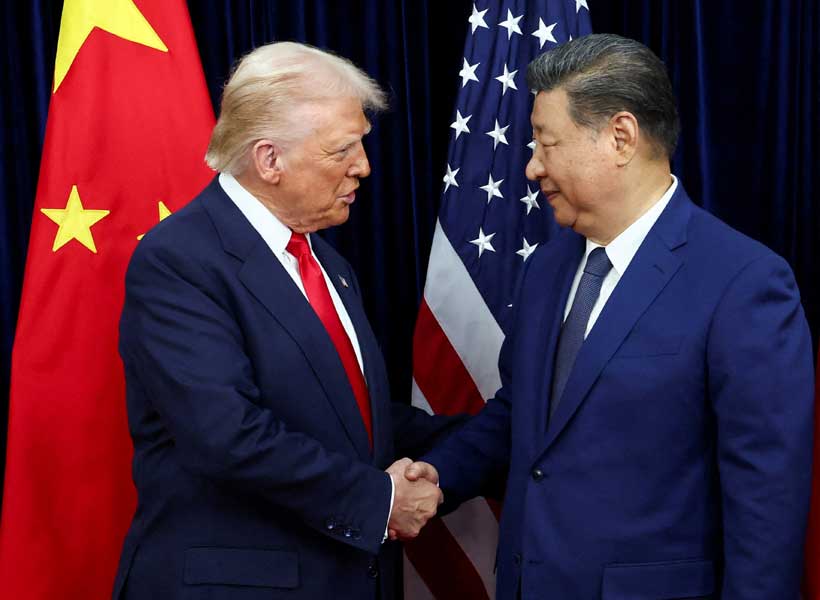
When Donald Trump lands in Beijing on 14 May, the optics will matter almost as much as the outcomes. Trump will become the first American president to visit China in nearly a decade—the last, in 2017, was Trump himself. That fact alone says much about how narrow and brittle the relationship has become.
Yet this summit is more than a diplomatic set piece. It takes place against the backdrop of a structural economic transformation: the gradual bifurcation of the international economic system into two partially incompatible orders. One is centered on the United States and its allies, the other on China and its partners. This is a new Cold War whose defining feature is not direct military confrontation but structural decoupling across technology, energy, finance, shipping, insurance, and the institutional architecture of global commerce itself.
The summit’s agenda reflects this reality even where its language will not.
Stay ahead of the geopolitical week.
MD Briefing delivers expert analysis across five global fronts — the Indo-Pacific, energy, geoeconomics, European security, and the Middle East — every Monday morning. Free.
The architecture of decoupling
The most consequential development in U.S.–China relations over the past two years has not been any single tariff, sanction, or military signaling. It has been the progressive construction of two parallel economic systems—each with its own standards, infrastructure, and legal logic—that are becoming increasingly difficult to reconcile. “Positional power,” that is, control over the strategic nodes of global economic networks and supply chains, has undermined market imperatives.
Washington’s strategy reflects this shift. Export controls on advanced semiconductors aim to deny China access to the computational foundation of next-generation military and economic power. Measures targeting Chinese shipping and logistics extend American financial and regulatory pressure far beyond U.S. borders. Increasingly, access to the American market, the dollar system, and Western technology comes tied to geopolitical alignment.
The events of 2025 increasingly resembled a supply-chain war rather than a traditional trade dispute. Beijing’s restrictions on rare earth exports fundamentally altered the bilateral dynamic, reminding Washington that interdependence cuts both ways. The core competition has become a race to reduce exposure: China seeks to escape dependence on Western semiconductors and software, while the United States attempts to reduce reliance on China’s dominance in rare earth processing and industrial manufacturing capacity.
The asymmetry is striking. American vulnerability to China remains broad but shallow; China’s vulnerability to the United States is narrower but concentrated in critical technological chokepoints. The result is a condition best described as “mutually assured economic disruption.” It is a fragile equilibrium in which both sides possess the capacity to inflict substantial systemic costs on the other.
China’s response has moved beyond retaliation toward the construction of an alternative techno-commercial and institutional ecosystem. Beijing has introduced new anti-sanctions regulations prohibiting compliance with certain foreign extraterritorial measures and allowing countermeasures against firms that implement them. The significance is not legal but geopolitical. China is no longer merely resisting American pressure; it is attempting to create a parallel economic and regulatory sphere capable of operating outside U.S. jurisdictional reach.
Trade: optics over substance
Against this backdrop, trade negotiations matter less for their economic content than for their political symbolism. Trump enters the summit seeking a visible reduction of the bilateral trade imbalance. Yet the structural realities of the Chinese economy make any meaningful rebalancing implausible within a politically relevant timeframe. Beijing’s long-term strategy focused on industrial upgrading and reduced dependence on foreign technology; its “dual circulation” model moves in the opposite direction. China does not intend to buy substantially more from the West in the future. It intends to need the West less.
The likely outcome is therefore predictable: symbolic purchases of natural gas, aircraft, and soybeans; temporary pauses in tariff escalation; and declarations of progress designed for domestic audiences. The economic iron curtain separating the core strategic sectors of the two economies will remain largely intact. The trade ceasefire will generate headlines, but it will not alter the strategic trajectory towards US-China economic decoupling.
Technology: the irreversible logic of techno-bloc formation
If trade is about optics, technology is about power. The battle over semiconductors, artificial intelligence, and critical minerals has become the center of gravity of Sino-US competition. Export controls on advanced chips represent Washington’s attempt to slow China’s ascent in artificial intelligence and civil-military fusion. Beijing has responded by leveraging its dominance in rare earths and battery supply chains while accelerating efforts at technological self-sufficiency.
Both sides have now internalized the same conclusion, rejecting the liberal ideal that interdependence is a stabilizing force. It is not. It is a strategic vulnerability. Thus, what began as globalization is increasingly ending as techno-bloc formation, two competing technological ecosystems with diverging standards, infrastructures, and security priorities. The logic has become self-reinforcing. American restrictions accelerate Chinese substitution efforts; Chinese countermeasures deepen US fears of vulnerability. No summit communiqué will reverse that trajectory.
Tehran: the unresolved war at the center of the table
Iran is not merely one issue among several. It is the geopolitical acute crisis under which the summit takes place.
For China, the stakes are considerable. Before the war, roughly one-third of Chinese crude imports transited the Strait of Hormuz, while Iranian oil remained an important discounted supply source for Chinese refiners. Beijing has weathered the disruption better than many anticipated, but at a rising economic cost through expensive alternative sourcing and greater reliance on domestic coal consumption. China therefore has a genuine interest in restoring stability in the Gulf. Washington has openly pressed Beijing to use its leverage over Tehran while threatening additional penalties on firms involved in Iranian energy transactions.
In principle, there is room for tactical alignment. Both powers want to avoid an uncontrolled energy shock capable of destabilizing the global economy. But the geometry is triangular. Iran remains linked to the broader Eurasian balancing coalition involving China and Russia. Any Chinese move perceived as facilitating a strategic defeat for Tehran risks weakening that wider coalition. Beijing must therefore balance its energy interests against its geopolitical priorities.
Tokyo: the return of balancing
Japan’s increasingly assertive posture under Prime Minister Sanae Takaichi has unsettled Beijing in ways that go beyond military capabilities alone. What China fears is not simply Japanese rearmament but its demonstration effect. A Japan willing to challenge Chinese pressure signals to countries such as India, Vietnam, and the Philippines that balancing China is possible. This undermines one of Beijing’s core strategic objectives: cultivating the perception that Chinese primacy in Asia is inevitable and resistance futile.
Beijing may quietly seek American restraint toward Tokyo, yet it is unlikely to receive it. From Washington’s perspective, a stronger Japan reduces the burden of U.S. regional deterrence while strengthening the broader ring fencing China in the first island chain. In realist terms, Tokyo is not a problem to be managed but rather a strategic asset being actively nurtured.
Taipei: the irreducible core
At the center of the relationship remains Taiwan. For Xi, a path toward reunification is the defining strategic objective. For Trump, Taiwan operates simultaneously as a test of American credibility, a bargaining chip and a possible instrument of transactional diplomacy. The signals have occasionally appeared ambiguous. Reports that additional U.S. arms packages may be delayed until after the summit have fuelled anxieties in Taipei that Taiwan could become part of a broader transactional bargain. Xi is expected to press for constraints on arms sales and adjustments in American declaratory language regarding Taiwan’s status.
Yet the structural constraints remain considerable. American commitments to Taiwan are deeply embedded within the institutional architecture of U.S. policy, while bipartisan distrust of China in Washington limits room for dramatic concessions. The more plausible outcome is therefore tactical ambiguity rather than a new strategic grand bargain. Still, the fact that such fears are now openly discussed in Taipei reveals how unstable the triangular relationship has become.
What the summit can—and cannot—achieve
In performative terms, the summit will be a success for both leaders almost regardless of outcome. For Trump, it reinforces his preferred image as the indispensable dealmaker at the center of global geopolitics. For Xi, hosting the American president confirms that China remains an equal pole of power capable of engaging Washington on its own terms despite mounting pressures.
Substantively, however, the outcomes are likely to be modest: symbolic trade gestures, cautious language on technology, ambiguous signaling on Iran, and no breakthroughs on Japan or Taiwan. The deeper reason is structural. The United States and China are no longer negotiating within a shared global system. They are competing to shape two different systems that are progressively diverging.
The Beijing summit will therefore be less a turning point than a diagnostic. It will be a snapshot of a world moving toward a more bipolar order defined by competing economic architectures: rival financial systems, rival shipping regimes, rival legal frameworks, and rival technological ecosystems whose standards are becoming increasingly incompatible.
In such a world, cooperation becomes tactical as both sides attempt to position themselves better in playing the long game. Both leaders understand this. The task in Beijing is not to resolve the rivalry but to impose enough discipline on it to prevent it from becoming unmanageable. In the language of the new Cold War, that alone would count as success.
*Vasilis Trigkas is an assistant professor of global affairs jointly appointed at Schwarzman College and the Department of International Relations, Tsinghua University. He is a member of the Council for International Relations, Greece.