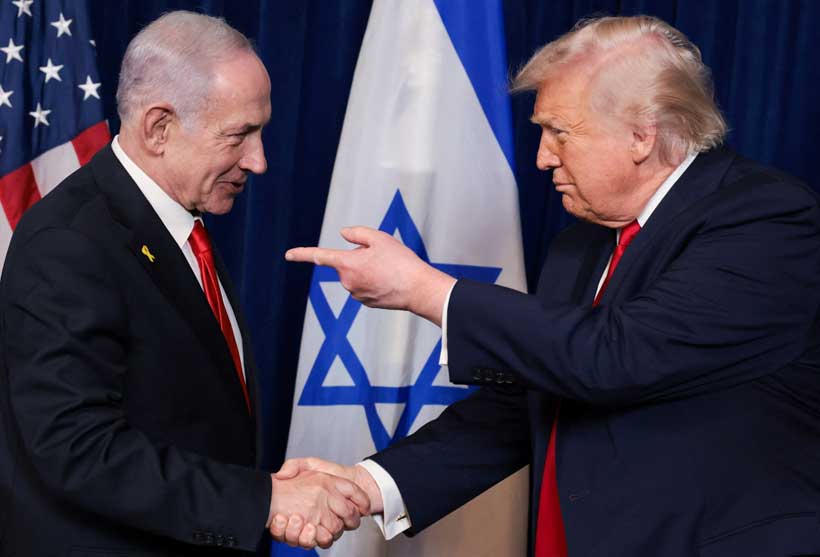
Less than 48 hours before a U. S.-Israeli strike on Iran, Prime Minister Benjamin Netanyahu spoke to President Donald Trump about the reasons for initiating a distant military action against Iran, which Trump had previously opposed. They had learned from intelligence that Iranian Supreme Leader Ayatollah Ali Khamenei and his aides would meet in Tehran, creating an opportunity for a targeted attack on their leadership. New information, however, indicated that the meeting was moved to Saturday morning instead of Saturday night.
Netanyahu was eager to carry out the operation he had promoted for many years. He highlighted the urgency to kill Khamenei and avenge previous Iranian assassination attempts against Trump. One major incident involved a murder-for-hire plot linked to Iran when Trump was a 2024 candidate, which was tied to Iran’s desire for revenge for the killing of their top commander, Qassem Soleimani.
By that time, Trump had already approved the military operation against Iran but was still deciding when and how to proceed. The U. S. military had increased its presence in the region, leading many to believe Trump’s decision was imminent. A planned attack just days before was canceled due to bad weather.
The details of the call between Netanyahu and Trump had not been disclosed before, but it appeared to serve as Netanyahu’s final pitch to convince Trump to act against Iran. Insiders noted that the intelligence about the limited window for attacking Khamenei was a significant factor in Trump’s decision to proceed with Operation Epic Fury on February 27. Netanyahu argued that Trump could create history by helping remove a widely disliked Iranian leadership, which could potentially lead to regime change in Iran.
On February 28, the first bombs were dropped, and that evening, Trump announced Khamenei’s death. The White House confirmed the military operation aimed to destroy Iran’s capabilities, but did not comment directly on the call between the leaders. Netanyahu refuted claims that Israel had pressured the U. S. into conflict with Iran, while Trump insisted the decision to strike was solely his own. Reports suggest that while Netanyahu did not force Trump into action, his reasoning and framing of the operation were influential.
In 2024, Trump ran his campaign focused on “America First” foreign policy, advocating for diplomacy with Iran to avoid war. However, after negotiations about Iran’s nuclear program failed, Trump considered military action. In June, Israel attacked Iranian nuclear facilities, later with U. S. involvement, leading Trump to celebrate the operation’s success. Later, U. S. and Israeli discussions resumed about further attacks on Iran’s missile facilities, aiming to prevent Iran from developing nuclear weapons. Israel also targeted Khamenei, who was a significant enemy to Israel.
During a visit to Mar-a-Lago, Netanyahu expressed dissatisfaction with the June operation to Trump, who showed openness for another attack while suggesting more diplomatic attempts. Two significant events influenced Trump’s stance: a successful U. S. operation in Venezuela that had minimal consequences for U. S. forces and massive protests in Iran against the government which were met with violent repression. Trump voiced support for the Iranian protesters but took little public action.
Simultaneously, U. S. and Israeli military collaboration intensified, leading to secret joint planning sessions. In February, Netanyahu briefed Trump on Iran’s ballistic missile threats, emphasizing the risks that Iran’s capabilities posed to the U. S. homeland. Despite inquiries, the White House did not comment on these discussions.
By late February, many officials believed a U. S. attack on Iran was likely, although specifics were unclear. Trump received briefings on the potential benefits of an attack, including the destruction of Iran’s missile program. Secretary of State Marco Rubio warned Congressional leaders that Israel would likely strike Iran regardless of U. S. involvement, predicting Iranian retaliation against U. S. interests, which ultimately occurred. The Iranian counterattacks resulted in casualties, affecting U. S. service members, civilian deaths, damages to Gulf allies, disrupted shipping routes, and rising oil prices.
Trump was informed that the death of key Iranian leaders could lead to a more negotiable government in Tehran, an argument made by Netanyahu in a call before Trump ordered the attack. However, the CIA predicted that Khamenei’s death would not likely result in improved relations since a hardliner would likely take his place. Following Khamenei’s death, Trump encouraged uprising in Iran; however, the Revolutionary Guards maintained control, and millions of Iranians remained confined. Khamenei’s son, Mojtaba, was appointed as the new supreme leader, regarded as even more hardline against the U. S. than his father.
With information from Reuters