


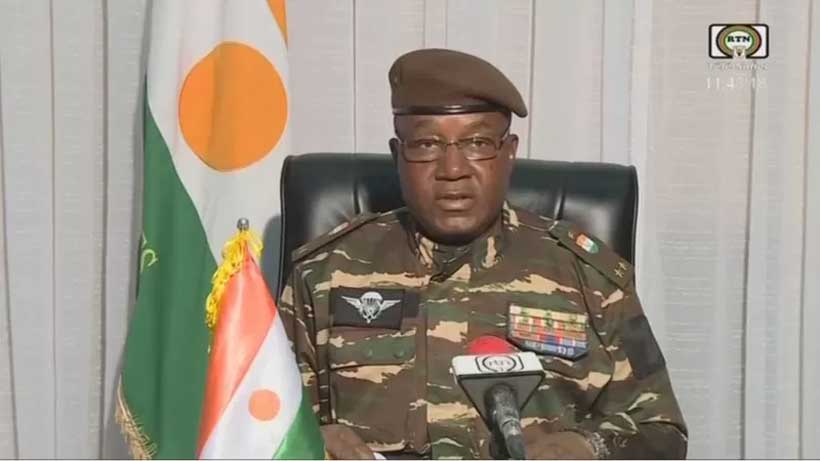
On 26 July 2023, a face largely unknown to the public appeared on Niger’s national television. Abdourahamane Tchiani, commander of the presidential guard, stood before the cameras in military uniform and delivered a terse announcement: President Mohamed Bazoum’s government had been formally deposed.
There was no great battle. No crisis visible from the outside. Only a statement, and power changed hands.
In the hours that followed, the junta began constructing its narrative. The justification, they said, was straightforward: Bazoum’s government had failed to secure Niger. Armed groups continued to strike. Civilians remained unprotected. The military, left with no alternative, had been compelled to act.
That story sounds plausible on the surface. But when examined through the lens of realism—a framework that reads the world as an arena of power competition in which every actor prioritizes its own survival—the junta’s account reveals something rather different from what they claim (Waltz, 1979).
Stay ahead of the geopolitical week.
MD Briefing delivers expert analysis across five global fronts — the Indo-Pacific, energy, geoeconomics, European security, and the Middle East — every Monday morning. Free.
Niger Before the Coup: A Real Threat, but a Manageable One
The Sahel was, undeniably, under enormous strain. Armed groups affiliated with Al-Qaeda and the Islamic State were operating actively along the borders of Mali, Burkina Faso, and Niger. Attacks on isolated villages and military outposts had become routine. This was a genuine and serious problem.
Yet in realist logic, a threat cannot be assessed by its mere existence alone—what matters is a state’s capacity to respond to it (Mearsheimer, 2001). On that measure, Niger under Bazoum was in a comparatively stronger position than its neighbors. Data from the Armed Conflict Location and Event Data Project (ACLED) showed no dramatic escalation in attack frequency in the period immediately preceding the coup.
Bazoum understood a foundational realist principle: weak states survive not through isolation, but through alliance-building (Waltz, 1979). He maintained active military cooperation with France and the United States, two major powers that provided training, intelligence, and joint operations. Within a balance-of-power framework, this was rational statecraft—Niger compensating for its own limitations by anchoring itself to larger external forces.
The results were imperfect, but the situation was manageable. Niger, in short, was not a state on the verge of collapse requiring an emergency military ‘rescue.’
The Coup and the Security Dilemma the Junta Created for Itself
What transpired after the coup exposed a profound irony. The junta’s first move was to expel foreign forces—France departed, then the United States. Niger, which had been the region’s most cooperative partner in counter-terrorism operations, suddenly stood alone.
Within a realist framework, this was a counterproductive step. By severing the alliances that had long served as a source of equilibrium, the junta actively weakened Niger’s own strategic position (Mearsheimer, 2001). The vacuum was subsequently filled by Africa Corps, the rebranded successor to the Russian Wagner Group. But replacing one patron with another is not an assertion of sovereignty—it is merely a change of dependency.
More fundamentally, this sequence triggered what realism describes as a security dilemma: a situation in which actions taken to enhance one’s own security make the surrounding environment less stable for everyone (Herz, 1950). The expulsion of Western forces and the arrival of Africa Corps alarmed neighboring states and regional actors, strained diplomatic relations, and ultimately narrowed Niger’s own room for maneuver. The economic sanctions imposed by ECOWAS further degraded Niger’s capacity to finance its own defense (ECOWAS, 2023).
Reports from the United Nations and ACLED throughout 2023 and 2024 confirmed what might have been anticipated: jihadist attacks in western Niger increased following the coup. The junta’s central argument was disproved by its own actions.
Power, Not Security, Was What Was Being Preserved
Realism teaches us that the most important actor to understand is not always the state as a whole, but whoever controls the instruments of power within it (Morgenthau, 1948). And here the true motivation behind Niger’s coup becomes clearer.
In the period leading up to the takeover, Bazoum had been pursuing reforms within the presidential guard—including command changes that directly threatened Tchiani’s position. A senior officer facing the loss of institutional power has a deeply personal incentive to act, entirely independent of the national security situation. In realist terms, Tchiani was protecting his own political survival, not the security of Niger.
This is what distinguishes the junta’s claim from its reality. What was being preserved was not the security of the population, but the security of a military elite’s grip on power. National security served merely as the rhetorical frame that lent the action an air of legitimacy.
The Coup Belt and the Shifting Regional Balance of Power
Niger cannot be read in isolation from its regional context. Since 2020, Mali, Guinea, Burkina Faso, and Niger have all experienced military coups. Each expelled the Western military presence and pivoted towards Russia.
From a balance-of-power perspective, this represents a significant structural shift. France—the longstanding hegemonic presence in its former West African colonies—lost its foothold across the subregion in rapid succession. Russia, through Wagner and subsequently Africa Corps, moved to fill that void. Not because Russia is more capable of managing the Sahel’s security crises, but because it offers something the West does not: unconditional support.
For these juntas, aligning with Russia is not an ideological choice—it is a realist calculation. Russia demands no elections, exerts no pressure on human rights, and issues no threats of sanctions in response to coups. From the standpoint of regime survival, such a patron is considerably more convenient.
But regime convenience is not the same as public security. And therein lies the deepest chasm in this entire story.
So Then: A Coup for Security?
Having examined the evidence through the lens of realism, it is difficult to endorse the junta’s claims.
Niger before the coup was pursuing a strategy that was, by realist standards, coherent: building a balance of power through alliances and managing threats with available capacity. The junta dismantled that strategy, triggered a new security dilemma, and worsened the very conditions it claimed to be remedying.
What actually took place was a struggle for power at the level of the military elite, subsequently dressed in the language of national security. Realism, paradoxically, is precisely the framework that allows us to see through it: behind the rhetoric of ‘acting for the nation’s security,’ what was truly being protected was the security of one general’s position.
Niger’s people are now bearing the consequences—economic sanctions, diplomatic isolation, and unrelenting violence. They are paying the price of a power calculus that was never really about them.
